En bref : les meilleurs outils de sécurité côté client
- L'angle mort du navigateur : Les outils de sécurité web hérités (WAF, détection d'endpoints) ne voient pas ce qui se passe à l'intérieur du navigateur. Cela maintient l'exécution du code côté client comme une couche non surveillée avec des risques de sécurité cachés.
- Une nouvelle catégorie d'outils : Les outils de sécurité côté client ont émergé pour combler cette lacune et détecter des menaces comme Magecart, l'exfiltration de données et la manipulation des éléments du navigateur.
- Cinq outils, quatre approches : Les outils dédiés à la sécurité côté client se répartissent en quelques approches : analyse des payloads côté serveur, agents JavaScript côté client, scanners à distance et rapports CSP. Ce guide en compare cinq.
- Comment évaluer : L'évaluation d'une solution doit tenir compte de : la profondeur de la protection, la facilité de mise en œuvre et le prix (que de nombreux fournisseurs gardent caché derrière des appels commerciaux, ce qui aboutit à des estimations très variables pour une fonctionnalité similaire)
- Pour les rapports de conformité : Pour les rapports de conformité et les audits de sécurité, privilégiez les outils qui transforment les preuves du runtime du navigateur en rapports exportables mappés aux exigences 6.4.3 et 11.6.1 de PCI DSS 4.0.1.
Peu de temps ? Découvrez le blocage de Magecart et de skimmers dans le navigateur de cside. Elle couvre tout ce qui suit en un seul déploiement.
Tableau comparatif : outils de sécurité côté client
La plupart des grands fournisseurs de sécurité web commercialisent une fonction de "sécurité côté client" ou de "protection de page", mais celles-ci sont souvent limitées en capacité et existent comme un module additionnel de vente.
Voici une liste sélectionnée d'entreprises qui font réellement progresser cet espace et s'attaquent à l'obscurité de la visibilité de la couche navigateur.
| Outil | Approche de protection | Analyse des payloads et archive forensique | PCI DSS 4.0.1 (6.4.3 et 11.6.1) | Prix public et offre gratuite |
|---|---|---|---|---|
| cside | Analyse des payloads côté serveur (télécharge chaque script) plus le Script Method et le Scan Method côté client ; s'exécute dans 100 % des sessions réelles des utilisateurs sans échantillonnage ; peut bloquer avant l'exécution | Archive immuable de chaque payload de script avec un historique complet des versions | Validé par un QSA (VikingCloud) pour 6.4.3 et 11.6.1 | Public, à partir de $99/month, offre gratuite |
| Feroot | Agents JS côté client (liste d'autorisation PageGuard) plus le crawler d'utilisateurs synthétiques Inspector ; détection comportementale après l'exécution des scripts ; échantillonne une fraction des sessions | Alertes et journaux comportementaux ; n'archive pas les payloads bruts | Non documenté dans cette comparaison ; la liste d'autorisation vérifie la source du script, pas le contenu servi | Non documenté dans cette comparaison |
| Jscrambler | Obfuscation JS de première partie plus protection au runtime/anti-altération et détection basée sur des pièges (objets leurres) ; toutes les détections s'exécutent côté client ; la surveillance repose sur un scan périodique | Ne suit pas le contenu des scripts ; pas d'archive de payloads bruts | Non documenté dans cette comparaison | Pas de prix public ; pas d'essai gratuit ni d'offre gratuite |
| Reflectiz | Scanner à distance "sans agent" ; crawler cloud périodique ; aucune visibilité du navigateur des utilisateurs réels | Notations de risque d'exposition et rapports d'inventaire ; pas d'archive de payloads au runtime | Non documenté dans cette comparaison | Pas de prix public ; pas d'essai gratuit ni d'offre gratuite |
| DomDog | Rapports CSP et triage des violations plus une revue des scripts via un tableau de bord d'agent JavaScript ; script d'en-tête unique ; ne voit que ce que la CSP est configurée pour observer | N'analyse pas les payloads et n'archive pas le code d'attaque | Conçu spécifiquement pour 6.4.3 et 11.6.1 ; aucune certification SOC 2 ou PCI DSS trouvée | Public, à partir de $999/year |
Comparaison des outils de sécurité côté client : cside vs Feroot vs Jscrambler vs Reflectiz vs DomDog
Quels outils de sécurité côté client fournissent des rapports de conformité pour les audits de sécurité ?
Réponse courte : ces outils commercialisent tous des rapports de conformité, mais ils ne produisent pas les mêmes preuves d'audit. Exigez des preuves du runtime du navigateur issues de sessions réelles d'utilisateurs, un support validé par un QSA pour PCI DSS 4.0.1 concernant les exigences 6.4.3 et 11.6.1, des rapports exportables et un historique forensique des changements de scripts pour les cadres sur lesquels vous rendez compte. Évaluez chaque outil par rapport à ces types de preuves à l'aide du tableau ci-dessous.
Ce qui a changé dans cette mise à jour 2026 : cette section sépare désormais les rapports de conformité en quatre types de preuves d'audit : couverture des cadres, preuves de scripts au runtime, rapports exportables et validation PCI DSS.
Pour les audits de sécurité, demandez à chaque fournisseur de montrer :
- L'inventaire actuel des scripts de première, tierce et quatrième partie
- Le propriétaire de l'approbation et la justification métier pour chaque script sensible
- L'historique des changements de scripts avec horodatages et contexte des alertes
- Les preuves du comportement au runtime, y compris les destinations des données et l'accès au DOM
- Des rapports exportables mappés aux exigences 6.4.3 et 11.6.1 de PCI DSS 4.0.1
| Outil | Cadres couverts | Preuves d'audit et rapports | PCI DSS 4.0.1 (6.4.3 / 11.6.1) |
|---|---|---|---|
| cside | PCI DSS, GDPR, CCPA/CPRA, HIPAA | Archive de payloads immuable, historique forensique des changements de scripts, documentation assistée par IA, rapports automatisés | Validé par un QSA |
| Feroot | Non documenté dans cette comparaison | Alertes comportementales et journaux de changements ; pas d'archive de payloads bruts | Non documenté dans cette comparaison |
| Jscrambler | Non documenté dans cette comparaison | Alertes de pièges et surveillance de l'intégrité ; ne suit pas le contenu des scripts | Non documenté dans cette comparaison |
| Reflectiz | Risque général d'exposition web | Notations de risque d'exposition et rapports d'inventaire (scan à distance) | Limité ; aucun QSA/SOC 2 Type II publié |
| DomDog | PCI DSS 6.4.3 et 11.6.1 uniquement | Rapports de violations CSP et revue des scripts via tableau de bord ; pas d'analyse ni d'archive de payloads | Conçu pour 6.4.3/11.6.1 ; aucune certification SOC 2/PCI trouvée |
Pour les programmes à fort volume d'audits, les différenciateurs pratiques sont la couverture des cadres, le fait que l'outil soit validé par un QSA pour PCI DSS 4.0.1, le fait qu'il capture des preuves du runtime du navigateur et le fait qu'il conserve un enregistrement forensique des changements de scripts que les auditeurs peuvent examiner après un incident. Le scan uniquement à distance peut aider à la gestion de l'exposition, mais il est plus faible comme preuve d'audit principale parce qu'il ne prouve pas ce qui s'est exécuté dans les navigateurs réels des utilisateurs.
Pourquoi la sécurité côté client est importante
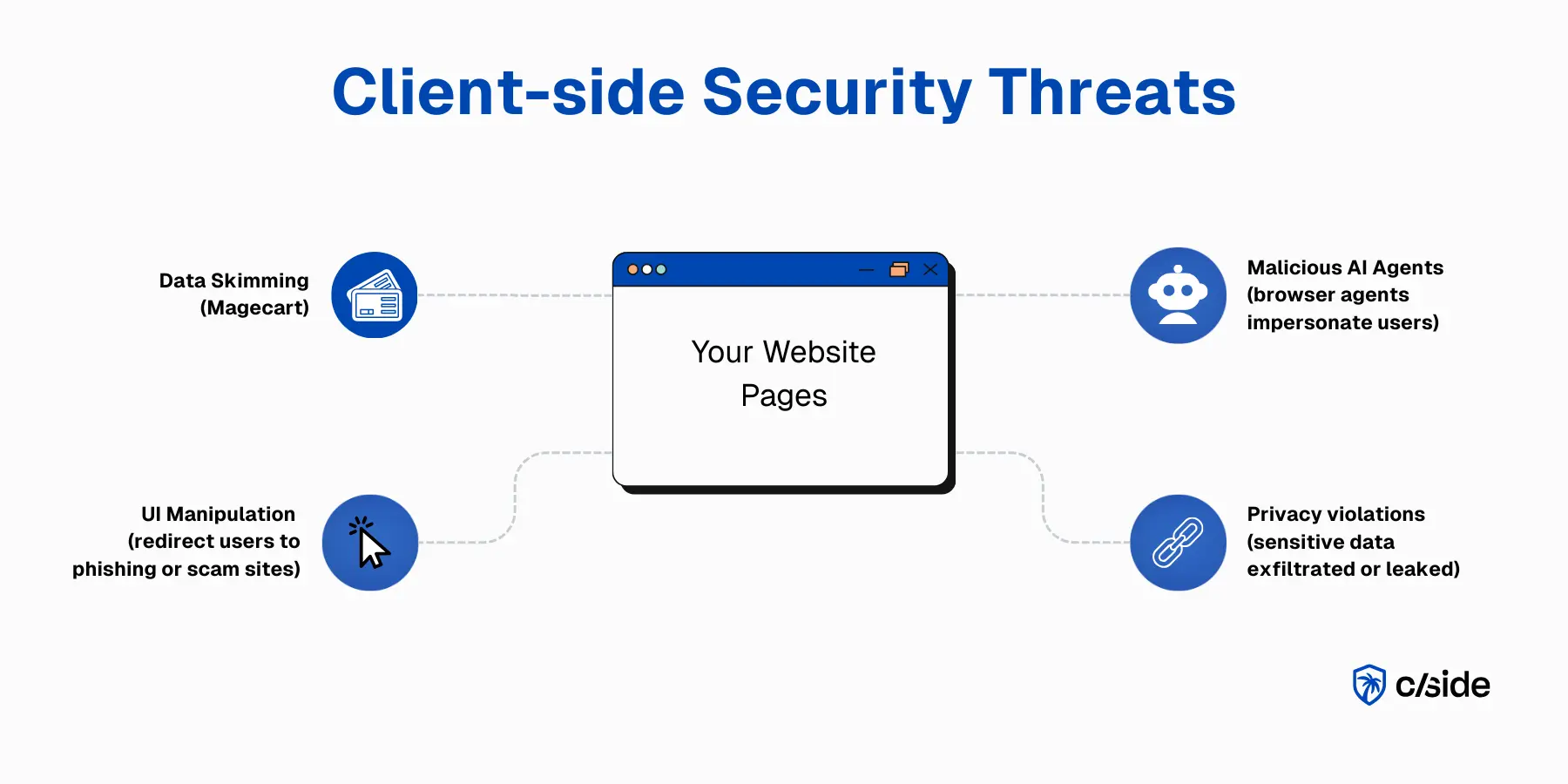
Les sites web et les applications web contiennent un mélange de code, la plupart écrit en interne et une partie importée de tierces parties. Pensez aux scripts tiers comme les chatbots, les outils d'analytique et les bibliothèques d'accessibilité. Chacun d'eux introduit des risques de sécurité sur votre site web. Ces scripts sont généralement approuvés une fois, changés fréquemment et rarement revus. C'est pourquoi les attaquants adorent cette surface comme point d'entrée. Par exemple, une fois qu'un attaquant accède à Google Tag Manager, il peut injecter du code qui arrive directement sur le site web en production.
Les conséquences d'une violation côté client dépassent l'incident immédiat. Selon une enquête de Ping Identity relayée par Security Magazine, 66 % des consommateurs déclarent qu'ils ne feraient plus confiance à une entreprise après une fuite de données, un coût de réputation qui persiste bien après la fin de la réponse technique.
Qu'est-ce que la sécurité côté client :
- Sécurité côté client
- La sécurité côté client protège tout ce qui s'exécute dans le navigateur d'un utilisateur, y compris le code front-end, JavaScript, les feuilles de style CSS et les scripts tiers. Ces éléments chargés par le navigateur peuvent être détournés pour voler des données, rediriger des utilisateurs ou commettre des fraudes. Les solutions de sécurité côté client surveillent et, dans certains cas, bloquent le comportement suspect de la couche navigateur pour protéger les visiteurs web.
Qui a besoin de sécurité côté client
Des données sensibles sont de plus en plus traitées dans le navigateur, ce qui fait de la visibilité côté client une nécessité à l'échelle de l'entreprise.
- Équipes de sécurité : détecter les menaces côté client comme les injections de scripts, l'exfiltration de données et le code malveillant qui existe en dehors du périmètre serveur et AppSec.
- Équipes de confidentialité et de conformité : démontrer les contrôles de sécurité pour des cadres comme PCI DSS, GDPR, CCPA/CPRA, HIPAA et plus.
- Équipes e-commerce : maintenir l'intégrité du paiement en détectant les scripts modifiés (Magecart) avant qu'ils ne volent les données de paiement des utilisateurs.
- Équipes anti-fraude : repérer plus tôt les signes de fraude grâce à des signaux côté client, notamment l'abus de rétrofacturation, les agents IA malveillants et les bots de test de cartes.
Recherche publique sur la montée des attaques côté client
- cside détecte 72 000 sites web compromis au T2 2025
- Les attaques côté client détectées parInsikt Groupsont multipliées par 3 en 2024 par rapport à 2023
Comparaison des meilleurs outils de sécurité côté client (fonctionnalités, avis)
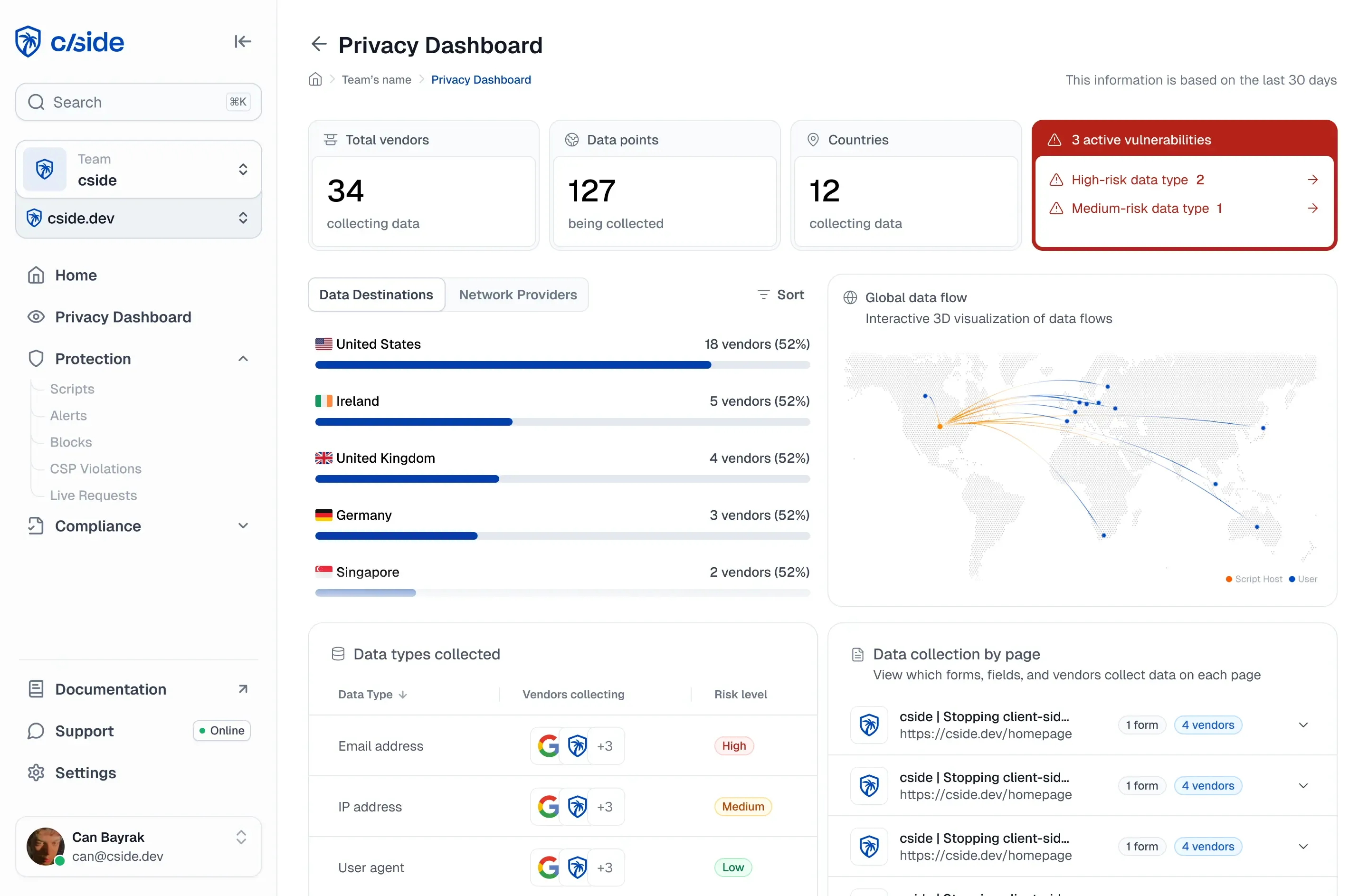
1. Sécurité côté client cside
cside a été fondée par des ingénieurs sécurité chevronnés qui ont remarqué la lacune de visibilité côté client dans la sécurité web.En tant que pionnière de l'introduction de l'IA dans la protection côté client, cside a remporté plusieurs prix du secteur pour son approche multicouche unique.
cside publie régulièrementdes recherches sur la sécurité côté client et contribue à des organismes comme leW3C. Ses ingénieurs interviennent régulièrement lors d'événements du secteur pour sensibiliser les dirigeants aux attaques web modernes. En plus de la sécurité côté client, la suite de la plateforme cside comprend la détection d'agents IA, la détection de fraude aux paiements et l'automatisation de la conformité en matière de confidentialité des sites web.
Les références spécifiques de l'équipe cside proviennent de travaux sur la sécurité des navigateurs et côté client chez Cloudflare (pare-feu, détection de bots et l'outil de dépendances côté client Page Shield) et Vercel (internes de V8 et sécurité des frameworks JavaScript). Les ingénieurs ont aussi contribué à des projets de navigateur, dont Servo, le moteur de navigateur basé sur Rust. cside contribue à des organismes de normalisation, dont l'équipe AppSec du W3C, le Fraud Detection Community Group et le Web Payment Security Interest Group, et présente des découvertes uniques d'attaques côté client lors de TPAC et BSidesSF.
Fonctionnalités de sécurité
- Détection des attaques côté client comme le formjacking, magecart et l'exfiltration de données. Couvre les scripts de première, tierce et quatrième partie.
- Analyse des payloads et du runtime des scripts pour identifier les signes de comportement malveillant du JavaScript (keylogging, injections d'iframe, redirections suspectes, manipulation du DOM)
- Protection avancée sur les pages de paiement contre l'e-skimming de cartes de crédit
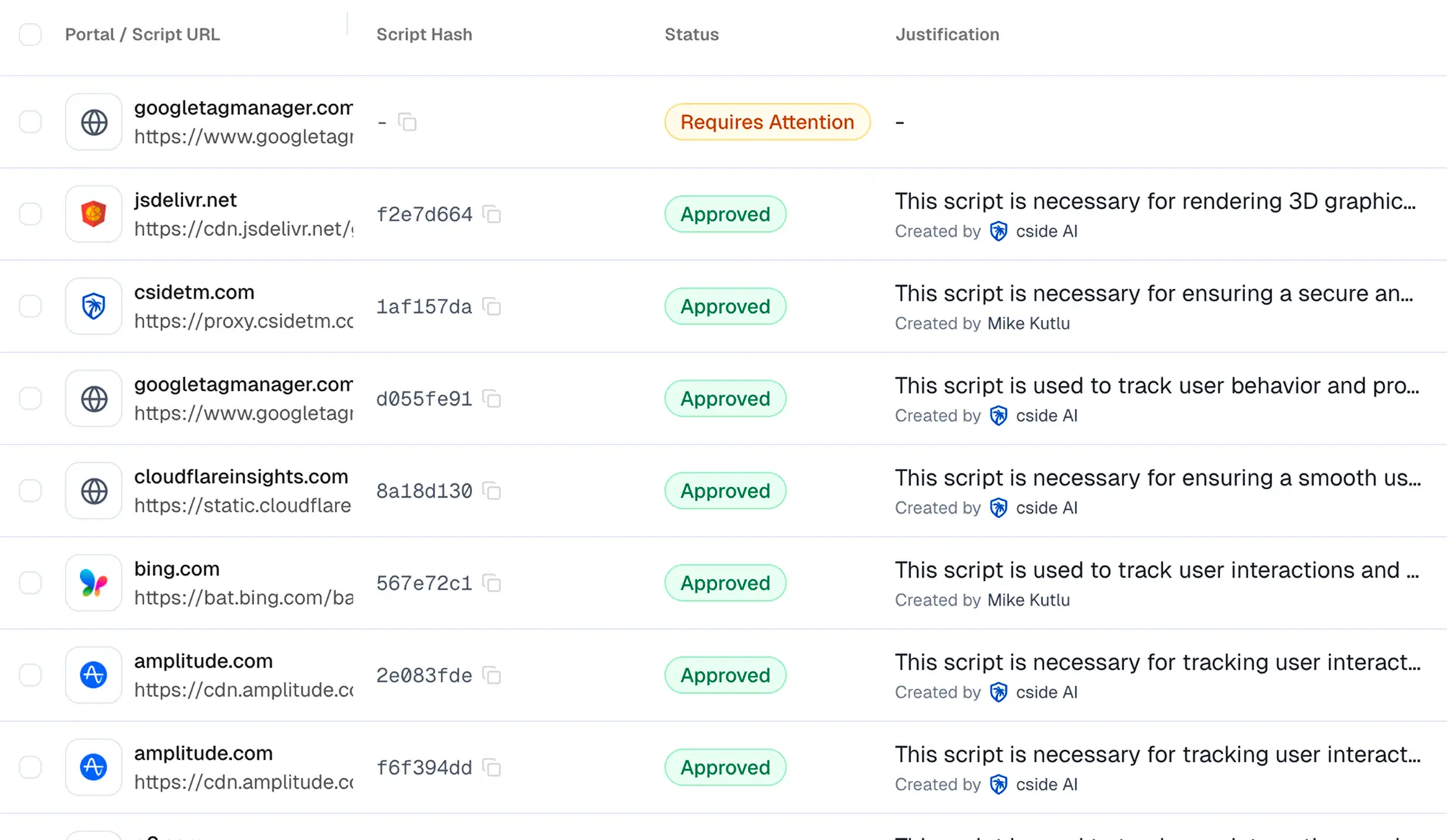
- Suivi automatique des scripts tiers. Recevez des alertes sur les signaux suspects lorsque de nouveaux scripts sont ajoutés ou que le code d'un script existant change.
- Moteur de revue amélioré par IA pour réduire les évaluations de sécurité manuelles
- Flux de menaces pour identifier les expositions de la chaîne d'approvisionnement JavaScript. Si un outil d'un fournisseur sur votre site web (chatbot, outil d'analytique) est compromis, vous pouvez agir avant d'être impacté.
- S'intègre aux SIEM et aux outils de sécurité existants.
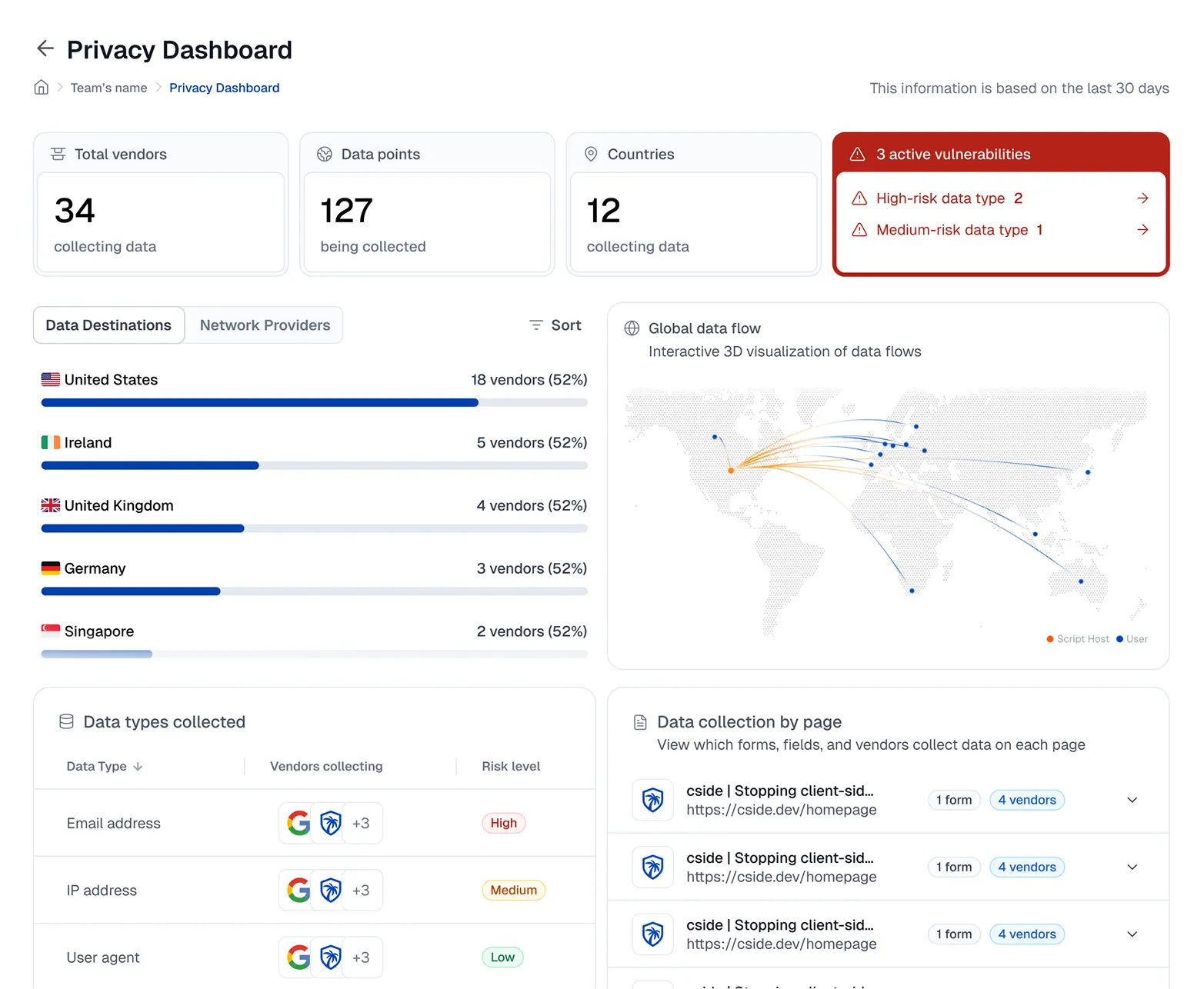
Fonctionnalités de conformité
- Revues de scripts assistées par IA, justifications et mappage vers des catégories juridiques
- Préparation de documentation assistée par IA pour PCI DSS, GDPR, CCPA/CPRA et d'autres cadres de conformité
- Historique forensique des scripts pour les enquêtes sur les incidents
- Preuve des garde-fous de sécurité contre les attaques côté client pour satisfaire les exigences de PCI DSS, GDPR, CPRA et plus
- Solution validée par un QSA pour les exigences 6.4.3 et 11.6.1 de PCI DSS 4.0.1
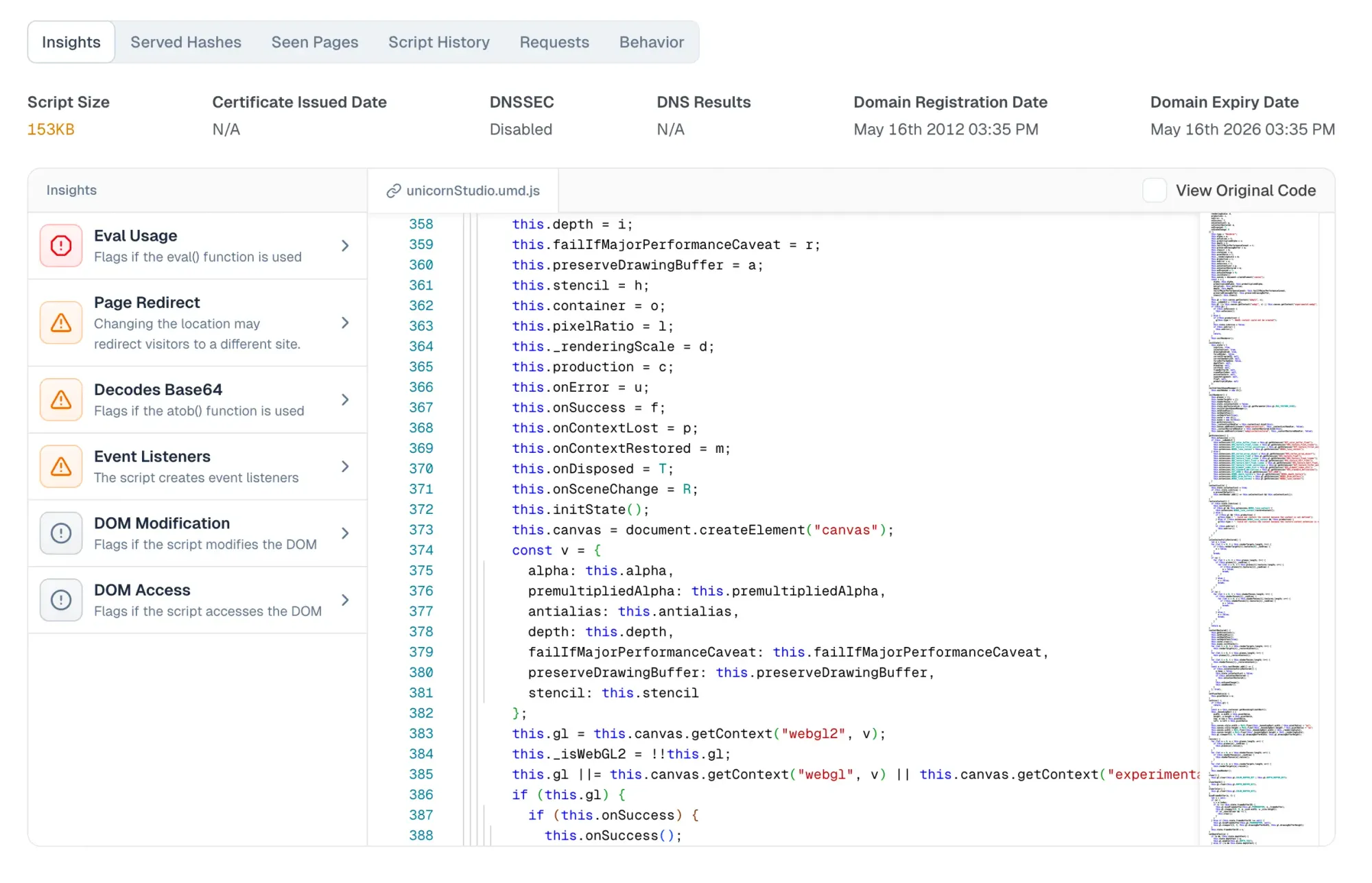
Approche de protection utilisée
Approche multicouche et configurable pour que les organisations puissent choisir les mesures appropriées selon le risque des données.
- Scanners
- Agents côté client (agents JS) pour l'analyse au runtime
- Analyse de risque des scripts améliorée par IA
Prix
- Le prix de cside est public sur la page de tarification, à partir de $99/month.
- Le prix de cside est basé sur les pages vues protégées des pages concernées, ce qui donne aux acheteurs une base prévisible avant le début des discussions d'achat.
- Une offre gratuite est disponible pour que les utilisateurs découvrent la plateforme, mettent en place une protection de base et passent à une version supérieure à tout moment pour une couverture complète.
Avis
cside est très bien noté sur les plateformes d'avis publiques, avec notamment une note de 5/5 sur Google Maps et des notes constamment élevées sur ses pages SourceForge et G2.
"Les capacités de détection que nous avons obtenues avec cside étaient différentes de tout ce que nous avions vu dans d'autres produits testés par le passé. Nous recommanderions vraiment le produit pour PCI et plus encore." - Mark D., (Citation d'un avis cside sur G2)
Facilité de mise en œuvre
cside propose plusieurs options de déploiement, permettant aux équipes d'équilibrer la profondeur de la sécurité et la facilité de mise en œuvre. Le script cside prend quelques minutes à ajouter à votre site et collectera instantanément des données et protégera vos pages. Pour les grandes entreprises, la mise en place du déploiement avec l'aide d'un support guidé prend généralement de quelques jours à quelques semaines.
cside permet aux utilisateurs de mettre en place la protection selon un modèle entièrement en libre-service. Cela facilite pour les organisations la découverte de la plateforme avant de lancer un processus de vente, ou un déploiement complet par elles-mêmes pour une mise en place rapide.
Avantages
- Options de déploiement flexibles qui s'adaptent à différents besoins de sécurité et opérationnels
- Rentable par rapport aux outils d'entreprise traditionnels côté client (à partir de $99/month)
- Validé par un QSA pour réussir les exigences 6.4.3 et 11.6.1 de PCI DSS 4.0.1
- Une couche différenciée pour une visibilité et un contrôle plus approfondis côté client que les scanners et agents traditionnels
- Option en libre-service pour les petites équipes qui n'ont pas besoin d'un support pratique
- La suite de produits côté client comprend la conformité en matière de confidentialité des sites web, la détection d'agents IA et des offres de fingerprinting
2. Feroot
Feroot a été fondée en 2017 comme une solution de sécurité côté client axée sur la protection des dépendances tierces. Son offre se divise en deux produits : PageGuard et Inspector. Ensemble, ils détectent l'activité de scripts côté client malveillante ou non autorisée en signalant les anomalies comportementales après que les scripts ont chargé et exécuté.
Fonctionnalités de sécurité
- PageGuard déploie des permissions et des politiques de sécurité sur les applications web basées sur JavaScript et réécrit certains JavaScript de base pour protéger les pages contre les menaces côté client, les malwares et les scripts tiers risqués.
- Une liste d'autorisation où vous approuvez à l'avance quels scripts sont autorisés à s'exécuter sur quelles pages. Cela vérifie la source d'un script, pas le code réellement servi.
- Inspector déploie des utilisateurs synthétiques déguisés en clients pièges pour simuler le comportement réel des utilisateurs et identifier les scripts malveillants et les actions non autorisées sur les actifs JavaScript, essentiellement un scanner/crawler qui effectue des vérifications périodiques.
- Détection comportementale via des agents côté client qui signalent les anomalies après que les scripts ont chargé et exécuté.
Approche de protection utilisée
- Agents côté client (agents JS) pour la surveillance comportementale au runtime
- Scanner/crawler d'utilisateurs synthétiques (Inspector) pour des vérifications périodiques
Prix
- Non documenté dans cette comparaison.
Avis
D'après la comparaison cside vs Feroot, Feroot est noté 4,6/5 sur G2, 2,3/5 sur Google Maps et n'a aucun avis sur SourceForge.
Facilité de mise en œuvre
Feroot utilise un déploiement axé sur la surveillance qui implique d'ajouter un script à vos pages web. La disponibilité d'une offre gratuite et du libre-service n'est pas documentée dans cette comparaison.
Limites par rapport à cside
- Comme la liste d'autorisation ne valide que la source d'un script et non son contenu servi, elle n'aurait pas détecté l'attaque Polyfill de 2024, où un domaine de confiance a changé de propriétaire et a commencé à servir un code différent.
- Inspector est un crawler, et on peut servir à un crawler des scripts propres selon l'IP ou le user agent, de sorte qu'un scanner seul ne peut pas satisfaire l'exigence de PCI DSS d'implémenter un mécanisme qui empêche les scripts non autorisés.
- Les agents de Feroot s'exécutent dans le navigateur, où des attaquants sophistiqués peuvent les détecter, les analyser et potentiellement les désactiver. Il n'échantillonne aussi qu'une fraction des sessions réelles des utilisateurs au lieu d'observer 100 % d'entre elles, de sorte que la majorité non échantillonnée, y compris les attaques ciblées sur des zones géographiques, des classes d'appareils ou des utilisateurs connectés spécifiques, passe inaperçue. La propre configuration de PageGuard de Feroot fixe samplingRate: 0.1, soit environ 10 % des sessions réelles des utilisateurs, de sorte qu'environ 90 % s'exécutent sans surveillance.
- Feroot fournit des alertes comportementales et des données de surveillance, mais n'archive pas le code malveillant exact qui a été bloqué, il lui manque donc les preuves de payloads de niveau forensique que cside conserve pour la revue QSA.
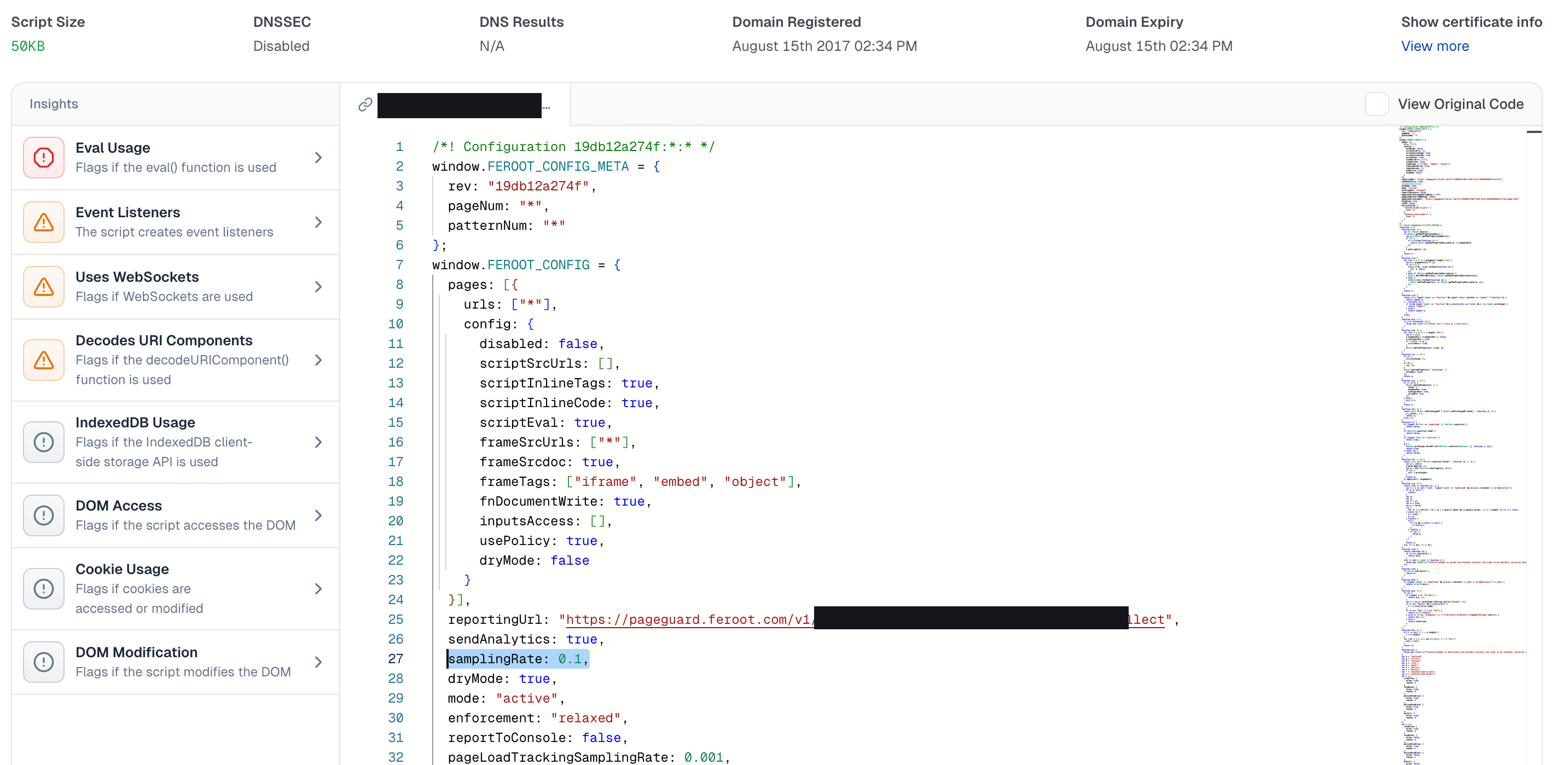
3. Jscrambler
Jscrambler est un outil de cybersécurité qui protège le code JavaScript via l'obfuscation, la protection au runtime et des techniques anti-altération. Il a débuté par l'obfuscation JavaScript et a ajouté l'intégrité des pages web plus tard. Son produit principal se concentre sur la protection du JavaScript de première partie en le transformant par obfuscation, ce qui le rend plus difficile à soumettre à l'ingénierie inverse ou à voler, utile pour les scripts à logique sensible comme des algorithmes propriétaires, l'application de licences ou la logique d'application dans le navigateur.
Fonctionnalités de sécurité
- Obfuscation JavaScript de première partie pour résister à l'ingénierie inverse et à l'altération.
- Des "code locks" qui restreignent où et quand le code peut s'exécuter (par exemple, un domaine ou une fenêtre temporelle spécifiques).
- Des protections au runtime qui visent à détecter l'altération et le débogage, bien qu'elles soient autonomes.
- Détection basée sur des pièges : Jscrambler injecte des objets leurres et du code de surveillance dans les pages, s'attendant à ce que les scripts malveillants interagissent avec ces pièges après leur chargement.
- Fonctionnalité IA limitée qui repose sur les API de grandes entreprises d'IA et n'est disponible que sur option.
Approche de protection utilisée
- Obfuscation JavaScript de première partie et anti-altération
- Détection côté client basée sur des pièges (objets leurres)
- Scan périodique des pages
Prix
- Le prix de Jscrambler n'est pas affiché publiquement.
- Jscrambler ne propose pas d'essai gratuit ni d'offre gratuite.
Avis
D'après la comparaison cside vs Jscrambler, Jscrambler est noté 4,3/5 sur G2 et n'a aucun avis sur SourceForge. Dans la catégorie Sécurité Côté Client des 2026 Globee® Cybersecurity Awards, Jscrambler a reçu le prix Argent tandis que cside a reçu l'Or (Best of Category).
Facilité de mise en œuvre
Jscrambler ne publie pas de prix ni d'offre gratuite, l'accès nécessite donc de contacter le fournisseur.
Limites par rapport à cside
- Toutes les détections de Jscrambler s'exécutent côté client, ce qui fait du navigateur un bac à sable idéal pour qu'un attaquant développe et teste un contournement, et en JavaScript les contournements sont courants.
- L'obfuscation n'est pas une solution miracle : des outils et des communautés de désobfuscation existent, et les LLM sont de plus en plus doués pour désobfusquer le JavaScript ou contextualiser ce qu'il fait. cside utilise des LLM en temps réel pour analyser le contenu des scripts, obfusqué comme désobfusqué, à la recherche de motifs malveillants.
- Jscrambler ne peut pas vous montrer le contenu des scripts parce qu'il ne le suit pas, et sa surveillance repose sur un scan périodique qui ne conserve pas les payloads bruts. Cela rend l'analyse forensique après une attaque échantillonnée difficile voire impossible.
- Sa fonctionnalité IA est limitée et dépend des API d'entreprises d'IA tierces (qui peuvent utiliser les données pour l'entraînement), tandis que cside exécute des LLM open source sur une infrastructure qu'elle contrôle. Jscrambler s'intègre à Jira mais pas à Linear, et sa page de statut est protégée par mot de passe sans SLA de disponibilité public.
4. Reflectiz
Reflectiz est une plateforme d'exposition web et de gestion des risques côté client. Elle utilise un modèle de scan à distance périodique (parfois qualifié de "sans agent"). Un crawler cloud visite vos pages selon un calendrier, de sorte que la couverture se limite à ce qu'il se trouve à voir au moment du scan. Un scanner ponctuel comme celui-ci voit encore moins qu'un agent en page échantillonné, car il ne s'exécute dans aucune session réelle d'utilisateur, seulement ce qui se charge pendant son crawl planifié.
Fonctionnalités de sécurité
- Un scanner à distance ("sans agent") périodique. Un crawler cloud visite vos pages selon un calendrier, de sorte que la couverture se limite à ce qu'il se trouve à voir au moment du scan.
- Inventaire de scripts et de composants assemblé à partir de ces scans de l'extérieur, utile pour une revue périodique.
- Aucune visibilité du navigateur des utilisateurs réels. Comme il ne repose que sur des données disponibles en externe, le scanner peut être identifié et contourné, avec des pages propres servies au crawler tandis que les utilisateurs réels reçoivent un code différent.
Approche de protection utilisée
- Scanner à distance ("sans agent"), crawler cloud périodique
Prix
- Reflectiz ne publie pas de prix.
Avis
D'après la comparaison cside vs Reflectiz, Reflectiz est noté 4,7/5 sur G2 sur 31 avis. Sur SourceForge, il a 0 avis natif (une infobulle agrège 33 notes tierces) et il a 0 avis sur Gartner Peer Insights. Les thèmes récurrents dans ses propres avis G2 incluent des rapports rudimentaires, une interface encombrée, des faux positifs sur des fournisseurs de paiement et de suivi courants, et le coût de la formation requise.
Facilité de mise en œuvre
Reflectiz fonctionne à distance et ne nécessite pas d'installer un script sur le site web surveillé. Cette commodité s'accompagne de limites : il ne repose que sur des données disponibles en externe et peut être contourné par les attaquants.
Limites par rapport à cside
- Un navigateur s'exécutant depuis l'IP d'un fournisseur cloud, avec un user agent prévisible, n'équivaut pas à un script s'exécutant dans le DOM réel d'une session réelle d'utilisateur. Les attaquants peuvent servir du JavaScript propre à l'infrastructure du scanner tandis que les utilisateurs réels reçoivent du code malveillant, en faisant varier le payload selon l'IP, la zone géographique, l'appareil, l'état de connexion, l'état de paiement ou la fenêtre temporelle.
- cside est validé par un QSA (VikingCloud) pour les exigences 6.4.3 et 11.6.1 de PCI DSS 4.0.1, et publie son rapport SOC 2 Type II et son auto-évaluation PCI DSS SAQ D via son Trust Center.
- Reflectiz ne publie aucune page de statut publique ni SLA de disponibilité, de sorte que les acheteurs ne peuvent pas vérifier la disponibilité de façon indépendante.
5. DomDog
DomDog est conçu sur mesure pour les exigences 6.4.3 et 11.6.1 de PCI DSS 4.0.1. Ses fondateurs ont une longue histoire et un solide bilan en sécurité côté client et, chose inhabituelle dans cet espace, toutes les informations produit et tarifaires sont entièrement visibles et faciles à trouver. À la base, DomDog est un outil CSP pour les rapports et le triage des violations : il collecte des données, montre les scripts sur un tableau de bord et demande à l'utilisateur de les examiner.
Fonctionnalités de sécurité
- Un agent JavaScript qui scanne quelles données divers scripts collectent et vous permet de mettre sur liste noire ou blanche des scripts sur certains sites web ou pages.
- Un tableau de bord qui fait apparaître les scripts de vos pages pour une revue manuelle, adapté à PCI DSS 6.4.3 et 11.6.1.
- Une couche Content Security Policy (CSP) qui agit comme un pare-feu, faisant confiance aux sources de scripts préapprouvées.
Approche de protection utilisée
- Rapports CSP et triage des violations
- Agent JavaScript (revue via tableau de bord)
Prix
- Le prix de DomDog est public et facile à trouver, à partir de $999 par an, similaire à cside.
Avis
Ses fondateurs ont un long bilan en sécurité côté client, et les détails de son produit et de ses prix sont ouvertement disponibles.
Facilité de mise en œuvre
La mise en place nécessite d'ajouter un seul script à la balise d'en-tête de votre site web, similaire à cside, bien que les deux scripts fonctionnent très différemment.
Limites par rapport à cside
- DomDog ne voit que ce que la CSP est configurée pour observer, et il n'analyse pas les payloads et n'archive pas le code d'attaque. Une liste d'autorisation CSP fait confiance à la source d'un script, pas à son contenu, de sorte qu'une source qui reste identique tandis que son contenu change, comme dans l'attaque Polyfill de 2024, ne sera pas détectée.
- Son agent JavaScript n'opère qu'au sein de la couche JavaScript et ne se place pas dans le flux de livraison, de sorte qu'un script XSS stocké qui devient malveillant peut passer inaperçu. Une détection après la livraison signifie qu'un attaquant peut exfiltrer des données avant que la moindre alerte ne se déclenche.
- DomDog se concentre étroitement sur PCI DSS 6.4.3 et 11.6.1 et ne couvre pas HIPAA, GDPR ni CPRA, tandis que cside les couvre tous.
- Aucune certification SOC 2 ou PCI DSS n'a pu être trouvée pour DomDog, et il ne publie aucune page de statut publique, portail de confiance ni SLA de disponibilité.
Les outils de sécurité web hérités ne surveillent pas le côté client
La sécurité web existe depuis des décennies, et la catégorie des logiciels de sécurité des sites web couvre désormais les pare-feu, les scanners et les outils d'endpoints. Malheureusement, l'accent est resté sur la protection des serveurs, des API et des réseaux. Toutes des surfaces d'attaque valides. Mais cela a laissé la couche navigateur comme une boîte noire obscure.
- WAF : les pare-feu applicatifs web (WAF) filtrent le trafic entrant et sortant entre les utilisateurs et le serveur applicatif. Ils sont efficaces mais s'arrêtent à la bordure du réseau. Une fois la page chargée dans le navigateur d'un utilisateur, le WAF n'a aucune visibilité sur les scripts qui s'exécutent, les données auxquelles ils accèdent ou la façon dont ils pourraient changer au runtime.
- Scanners à distance : les scanners externes explorent les sites web depuis l'extérieur. C'est idéal pour obtenir un instantané rapide. Cependant, cette approche passe à côté du véritable comportement au runtime et est contournée par les scripts qui se chargent de façon conditionnelle.
"Les outils de sécurité traditionnels, tels que les pare-feu, les systèmes de détection d'intrusion et les systèmes de détection et de réponse sur les endpoints (EDR) sont limités par leur perspective des états d'exécution de l'application et de l'infrastructure du point de vue d'un fournisseur … ces outils peuvent négliger les fuites de données non intentionnelles entre les navigateurs des clients et les services tiers, ainsi que les attaques Magecart qui pourraient exploiter ces services tiers de confiance." Rapport ISACA, Traditional Security Solutions Fall Short in Protecting Against Web Client Runtime Risk, Sergei Vasilevsky et Kamal Govindaswamy
Approches de la sécurité côté client
Il existe plusieurs approches largement utilisées pour ajouter de la sécurité côté client à votre site web. Chacune s'accompagne de niveaux différents de visibilité, de protection et de facilité de mise en œuvre. En fin de compte, il est recommandé de superposer différentes approches, car chaque méthode observe une partie différente du problème.
1. CSP et SRI
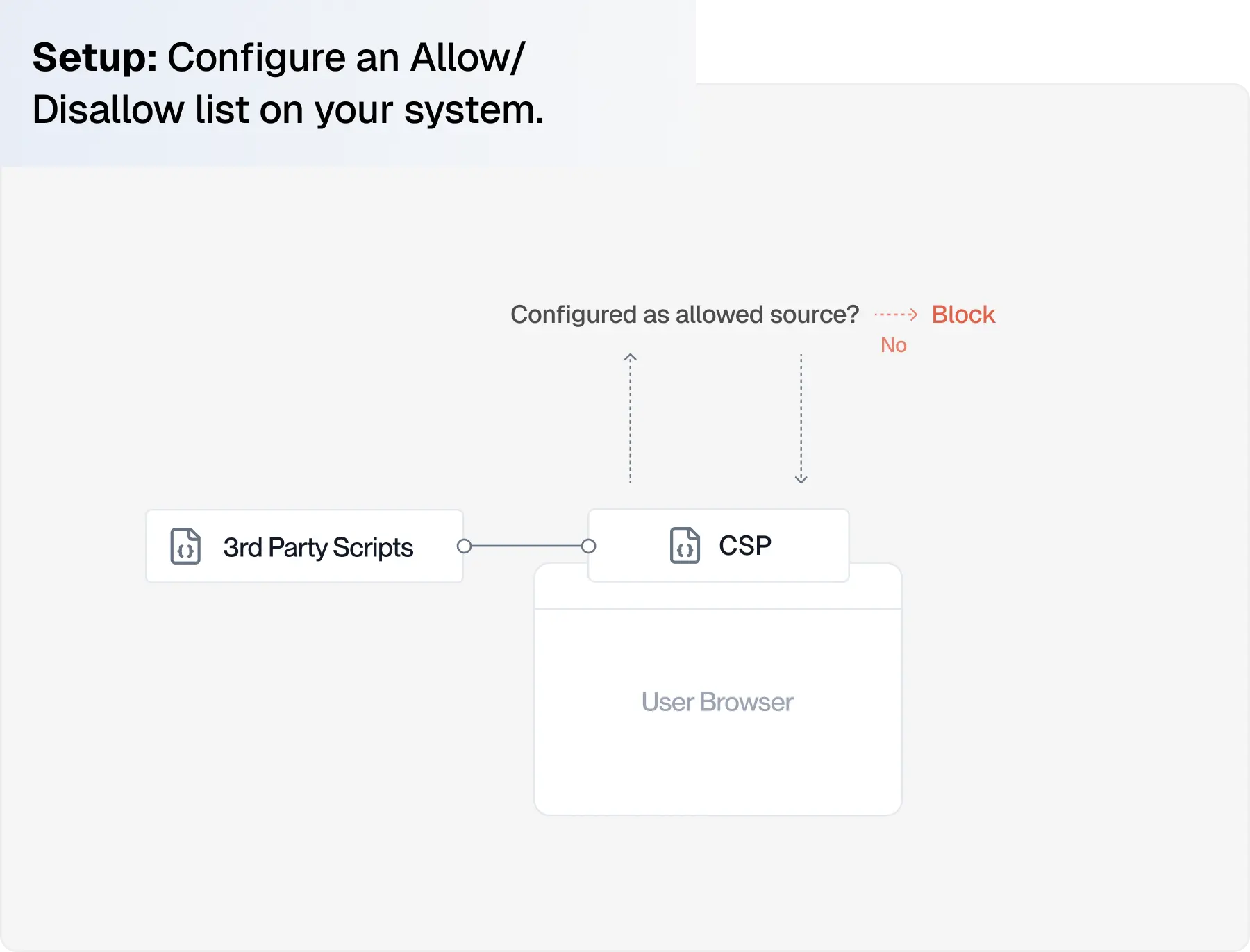
CSP
La Content Security Policy est un mécanisme du navigateur qui permet aux propriétaires de sites (généralement des développeurs web) de définir une liste de domaines externes autorisés à charger des scripts et d'autres ressources. Cela limite l'accès aux sources "de confiance".
Limites de la CSP :
- Les CSP nécessitent une maintenance manuelle, ce qui devient difficile sur les sites modernes comptant des dizaines de scripts qui changent fréquemment
- Si un fournisseur "de confiance" est compromis, des injections de code peuvent passer à travers les CSP sans être détectées.
SRI
La Subresource Integrity (SRI) utilise des hachages cryptographiques pour vérifier que les ressources externes n'ont pas été modifiées depuis le déploiement. C'est un autre mécanisme de contrôle que les développeurs web peuvent implémenter sur un site.
Limites de la SRI :
- La Subresource Integrity est efficace pour les scripts statiques et versionnés, mais elle échoue avec les scripts dynamiques. La plupart des sites web modernes reposent sur des scripts dynamiques.
2. Scanners à distance
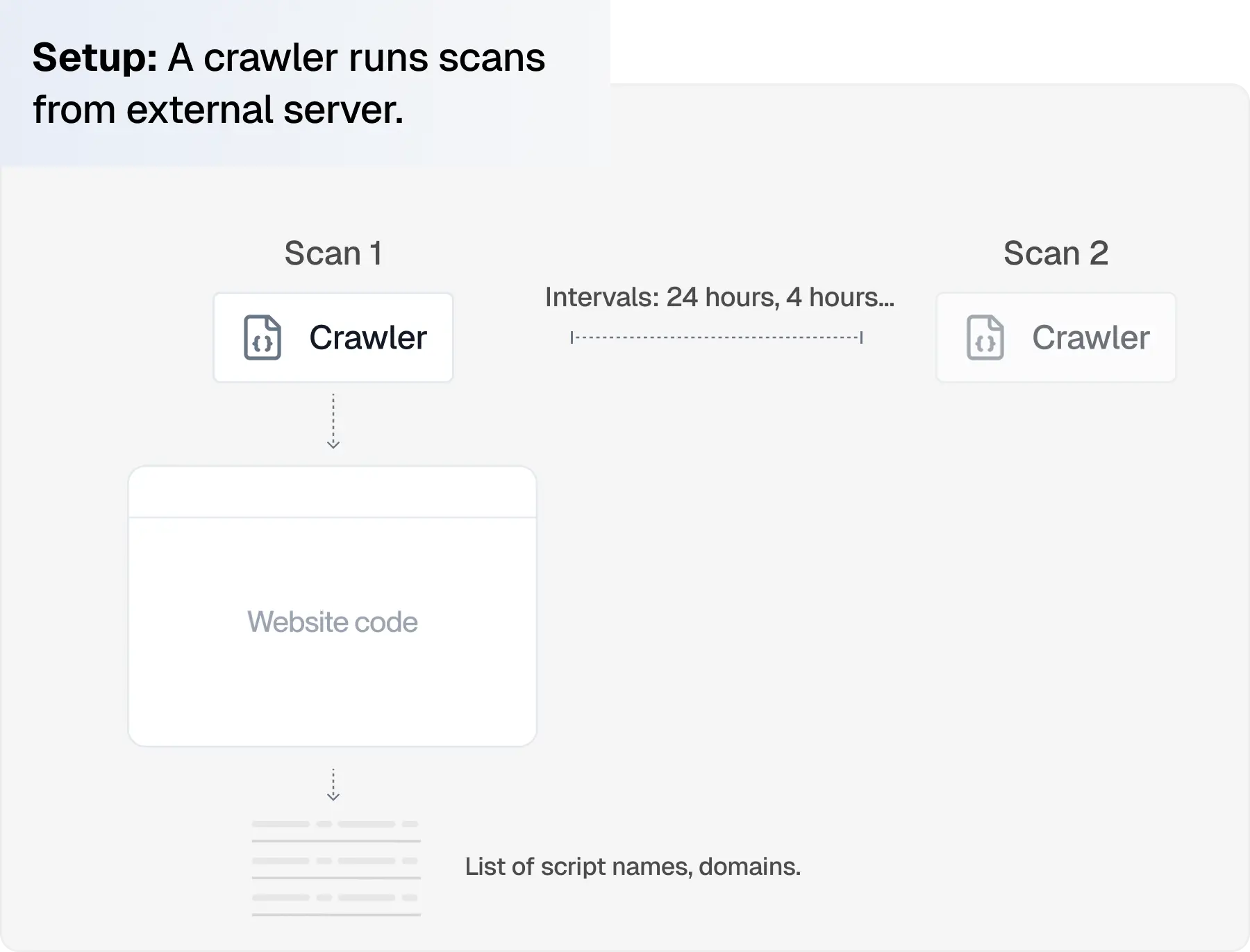
Les scanners à distance ou solutions "sans agent" explorent un site web depuis l'extérieur. Ils peuvent inventorier les scripts, détecter les ressources nouvellement ajoutées et signaler les différences qui pourraient suggérer des changements malveillants. Ces solutions sont les plus faciles à mettre en œuvre puisqu'elles opèrent en externe.
Limites des scanners :
- Cette approche est contournée par les scripts qui se chargent de façon conditionnelle ou mutent après l'exécution.
- Une analyse sectorielle publiée par ISACA soutient que l'analyse programmée ne donne qu'une vision limitée de ce qui s'exécute côté client
3. Agents côté client
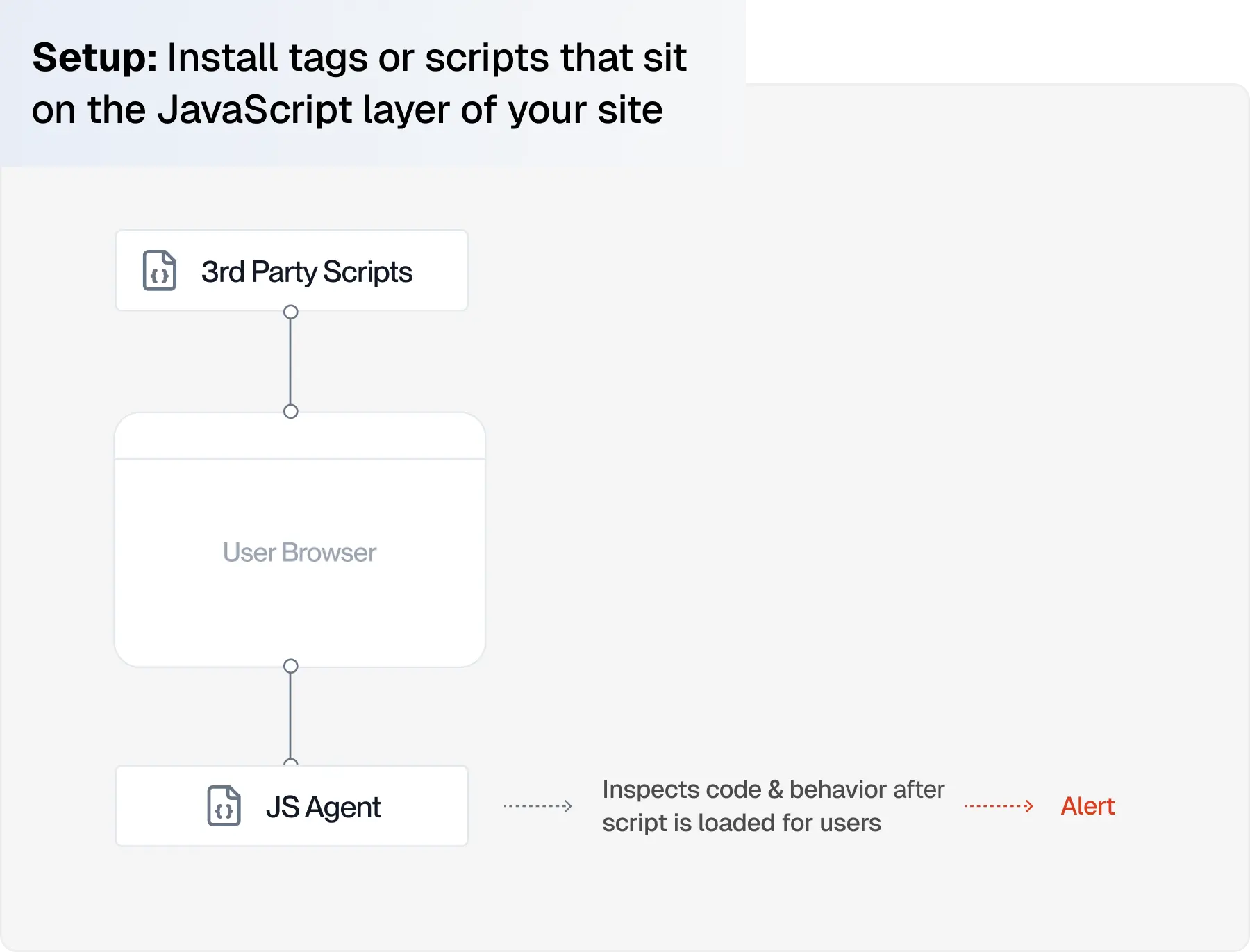
Les agents côté client fonctionnent en ajoutant une balise JavaScript sur un site web protégé. L'exécution des scripts, les flux de données et les interactions des utilisateurs sont surveillés en continu. Contrairement aux scanners à distance, ces outils observent le véritable comportement au runtime qui se produit dans les sessions du navigateur de l'utilisateur.
Limites des agents côté client
- Comme les agents côté client sont visibles dans le code du navigateur, les attaquants peuvent voir leur présence et mener des attaques sophistiquées pour les éviter.
4. Approche multicouche avec analyse par IA
cside combine le scan à distance, la surveillance côté client et la détection améliorée par IA pour donner aux équipes une visibilité approfondie de l'activité du navigateur. Les contrôles de politique peuvent être informés par les comportements des scripts plutôt que par la seule source du script. Les équipes peuvent autoriser les scripts approuvés (qui se comportent comme prévu) à accéder à des données sensibles. D'autres scripts non autorisés ou du code de confiance modifié de façon suspecte peuvent être bloqués. Chacune de ces couches alimente un tableau de bord centralisé qui se connecte au reste de votre environnement (comme les CSP et les SIEM).
Limites d'une approche multicouche
- Une approche multicouche nécessite une configuration supplémentaire avant d'atteindre une couverture complète. La plupart des équipes peuvent tout de même déployer cette approche en quelques jours ou semaines.
Contre quoi protège la sécurité côté client :
Simon Wijckmans, PDG de cside, intervenant sur la sécurité côté client lors d'un événement sectoriel PCI DSS
Les outils de sécurité côté client surveillent ce qui se passe à l'intérieur du navigateur de l'utilisateur après le chargement de la page. Ils protègent contre les attaques qui manipulent les éléments du navigateur ou injectent du code servi aux utilisateurs :
- JavaScript malveillant ou injecté depuis des fournisseurs compromis ou des attaques de la chaîne d'approvisionnement
- Exfiltration de données via des captures de formulaires cachées ou des appels réseau sortants
- Manipulation du paiement et des formulaires comme Magecart ou le formjacking
- Changements de scripts non autorisés ou nouveaux scripts introduits via des gestionnaires de balises
Les outils de renseignement côté client comme cside ajoutent une visibilité qui comble les lacunes des autres logiciels de surveillance de la fraude/des sites web :
- Violations de la vie privée par des scripts non autorisés collectant des données personnelles au-delà du périmètre prévu
- Signaux d'abus de rétrofacturation ou de bots de test de cartes
- Détection de VPN pour se conformer aux lois de vérification de l'âge
- Contrôles de gouvernance pour les agents IA, permettant aux agents commerciaux d'acheter tout en bloquant les agents IA malveillants.
Quels outils peuvent détecter le skimming numérique en temps réel ?
La détection du skimming numérique en temps réel nécessite d'observer le comportement des scripts à l'intérieur du navigateur du visiteur à mesure que les scripts s'exécutent, et non selon un calendrier. Exigez une plateforme qui télécharge chaque script tiers sur sa propre infrastructure pour une analyse côté serveur tout en observant aussi le comportement au runtime du navigateur, de sorte qu'un payload qui ne se déclenche que sur une page de paiement pour un segment d'utilisateurs spécifique soit détecté au moment où il s'exécute, et non au prochain scan à distance. Les agents côté client fournissent une surveillance au runtime mais s'exécutent là où les attaquants peuvent les voir ; les scanners uniquement à distance ne voient que ce qu'un crawler planifié rencontre et peuvent manquer entièrement les payloads de skimmer dynamiques ; les outils basés uniquement sur la CSP font confiance à une source plutôt qu'au code qu'elle sert. Vérifiez l'approche de chaque outil par rapport au tableau comparatif ci-dessus.
Quel fournisseur possède la plateforme de protection côté client la plus solide pour arrêter les scripts malveillants ?
La solidité se mesure ici à trois choses : la capacité de la plateforme à voir les payloads conditionnels qui ne se déclenchent que pour de vrais utilisateurs, sa capacité à bloquer un script malveillant avant qu'il ne s'exécute plutôt que de seulement alerter après, et sa capacité à produire les preuves de niveau QSA qu'attendent les exigences 6.4.3 et 11.6.1 de PCI DSS 4.0.1. Exigez une plateforme qui combine l'observation du runtime du navigateur avec l'analyse des scripts côté serveur et le blocage basé sur des politiques, et qui est validée par un QSA par rapport à 6.4.3 et 11.6.1. Les agents fonctionnant uniquement au runtime peuvent faire l'objet d'ingénierie inverse dans le navigateur par des attaquants sophistiqués ; les outils fonctionnant uniquement par scan peuvent être identifiés et recevoir des copies propres ; les outils basés uniquement sur la CSP font confiance à une source plutôt qu'à son contenu servi. La posture la plus solide superpose ces approches ; utilisez le tableau comparatif ci-dessus pour voir quel outil remplit les trois critères.
Qui offre la protection côté client la plus complète pour une application SaaS ?
Les applications SaaS exposent généralement plusieurs surfaces d'attaque à la fois : des tableaux de bord authentifiés, des pages marketing qui partagent des balises tierces avec l'application, et des flux de paiement soumis à PCI DSS. Pour couvrir les trois depuis un seul déploiement, exigez une plateforme qui fonctionne avec n'importe quel CDN sans verrouillage fournisseur, s'exécute dans 100 % des sessions réelles des utilisateurs sans échantillonnage, propose des tableaux de bord PCI DSS 4.0.1 aux côtés de contrôles GDPR et CCPA/CPRA, et publie des prix transparents pour qu'une équipe SaaS puisse évaluer la couverture sans cycle de vente. Évaluez les options du tableau comparatif par rapport à ces exigences.
Les applications web nécessitent-elles des outils de sécurité côté client différents ?
Les applications web modernes, les frameworks PHP rendus côté serveur, les SPA React et Vue, et les frameworks hybrides comme Next.js, exécutent tous un mélange de JavaScript de première et de tierce partie dans le navigateur. Quel que soit le modèle de rendu, les scripts tiers récupérés auprès de fournisseurs d'analytique, de gestionnaires de balises, de chatbots et d'outils de test A/B introduisent la même surface d'attaque côté client. Ce qui varie, c'est la profondeur de la dépendance : les SPA et les applications hybrides chargent généralement plus de scripts tiers, mais les outils qui les protègent n'ont pas besoin de différer de ceux qui protègent les sites statiques ou rendus côté serveur. Les contrôles natifs du navigateur (CSP, SRI) fonctionnent de façon identique quel que soit le type d'application ; les plateformes multicouches appliquent les mêmes moteurs de détection quelle que soit la façon dont la page est rendue.
Pourquoi les scanners basés sur des crawlers manquent-ils de vraies attaques côté client ?
Les scanners basés sur des crawlers visitent un site web selon un calendrier avec un navigateur headless, généralement Playwright ou un outil d'automatisation similaire. Les attaquants détectent et identifient ces scanners, et les attaques modernes côté client sont conçues pour servir un contenu propre à toute requête qui ressemble à un bot. Les scanners échantillonnent aussi le trafic, de sorte qu'un payload qui ne se déclenche que pour une zone géographique, une classe d'appareils ou des utilisateurs connectés peut rester au sein de la majorité non échantillonnée pendant des semaines. Une analyse sectorielle publiée par ISACA soutient que les scanners statiques sont systématiquement contournés par les scripts dynamiques côté client. L'observation au runtime des sessions réelles des utilisateurs est le seul moyen fiable de détecter ces payloads.
La sécurité côté client avec cside
En tant que pionnière de l'introduction de l'IA dans la protection côté client, cside a pour mission de résoudre l'obscurité de la sécurité web qui bloque les équipes de sécurité depuis des décennies.
La solution de sécurité côté client de cside aide les organisations à :
- Se conformer aux exigences 6.4.3 et 11.6.1 de PCI DSS 4.0.1
- Démontrer les contrôles de protection des données côté client pour GDPR, CCPA/CPRA et HIPAA.
- Protéger les pages de paiement contre Magecart, le formjacking et d'autres attaques de skimming de données basées sur JavaScript.
- Prévenir l'exposition des données sensibles des utilisateurs par des scripts tiers mal configurés ou malveillants
- Gouverner les agents IA opérant dans le navigateur
Essayez cside avant d'acheter. cside propose un plan gratuit : vous pouvez vous inscrire, le déployer et explorer la plateforme par vous-même, sans appel commercial ni processus d'achat. Et notre équipe de support est à portée de message dès que vous avez besoin d'aide.
Vous pouvez commencer avec notreoffre gratuite ouréserver une démo pour voir comment la sécurité côté client soutient votre stack de défense.