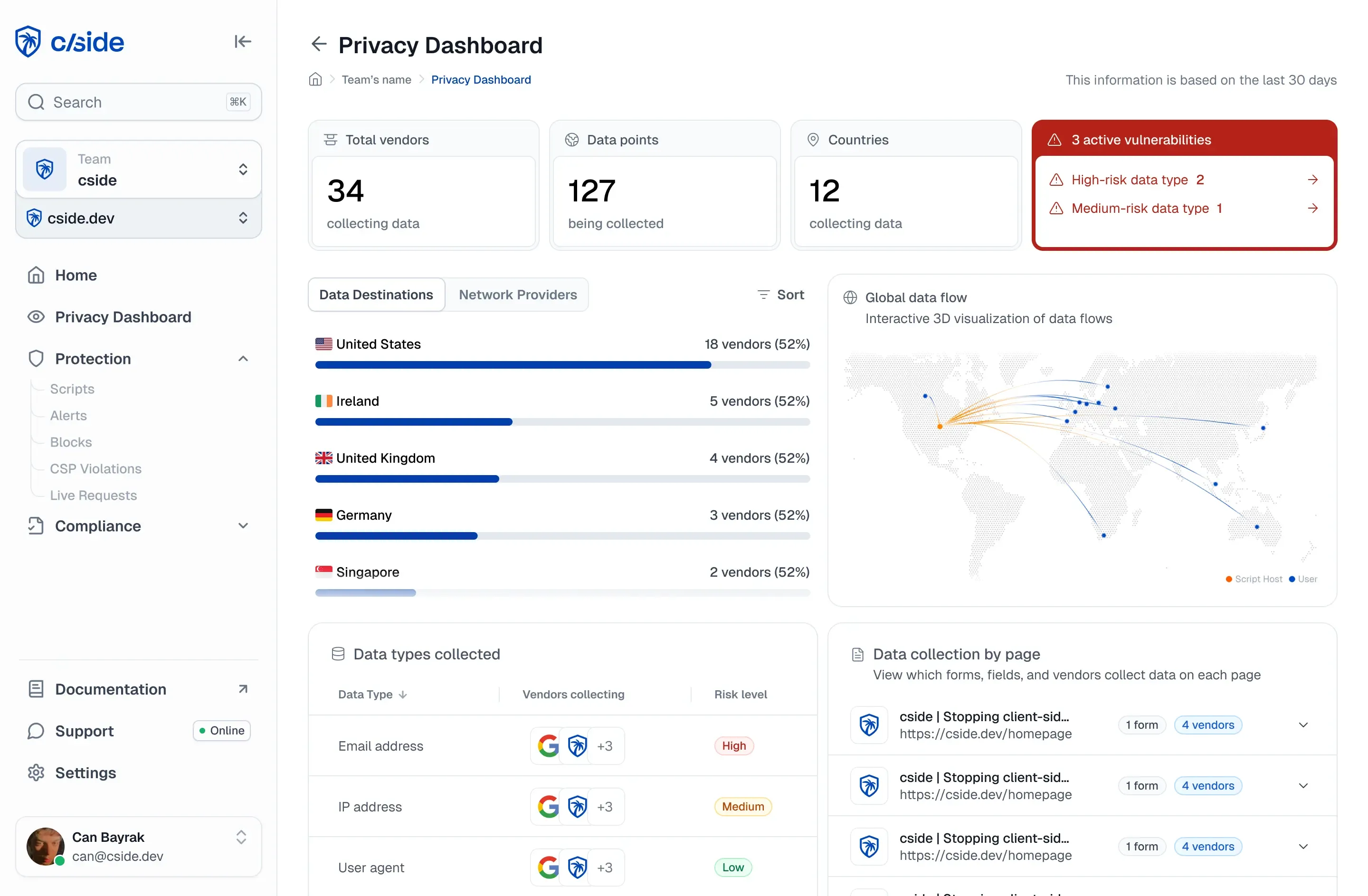

TL;DR: detect Magecart in a live session
- Scans are theater: Daily scans are compliance theater when Magecart payloads activate, exfiltrate, and self-terminate inside a single session. Attackers fingerprint your scanner and serve clean code back. The scanner never sees the attack.
- Sub-60-second detection: The 2018 British Airways skimmer ran undetected for 15 days and hit around 500,000 customers. cside product data shows average detection latency under 60 seconds, inside real user sessions, at under 5 ms of overhead.
- Test with a real payload: PCI DSS 11.6.1 mandates weekly script change detection. If your platform relies on synthetic crawls, that is the ceiling. Ask for a demo where a conditionally activated payload fires only for real user profiles, then see who catches it.
Short on time? See cside's in-browser Magecart and skimmer blocking. It covers everything below in one deployment.
Real-time browser attack visibility is the ability to detect, record, and alert on malicious script activity inside the browser as it happens during a live user session, typically within seconds to under two minutes of the attack occurring. It is distinct from two weaker models that dominate the market. Near-real-time monitoring detects changes within hours, usually through scheduled remote browser crawls that replay site behaviour outside of genuine user sessions. Periodic monitoring detects changes on a daily or weekly scan cycle, which is the baseline mandated by PCI DSS 11.6.1 but leaves organisations exposed to attacks that activate, exfiltrate, and self-terminate within a single browsing session. The gap between these tiers is not cosmetic. The 2018 British Airways breach affected approximately 500,000 customers over 15 days before it was discovered, a dwell time that is feasible only because periodic scanning cannot observe attack payloads that are conditionally activated or session-fingerprint aware. Security teams choosing a client-side monitoring platform need to understand which products actually instrument real user sessions and which substitute scheduled crawls or synthetic traffic for genuine session coverage.
What is real-time browser attack visibility? Real-time browser attack visibility is the capacity of a security platform to detect and alert on malicious script behaviour executing inside a real user's browser session, with detection latency measured in seconds rather than hours or days. It requires instrumentation that runs alongside genuine user traffic, not synthetic crawls or scheduled scans. Platforms that achieve this close the attack dwell-time window that periodic and near-real-time tools leave open.
What Real-Time Visibility Actually Requires
Quick answer: Real-time browser attack visibility requires four things: instrumentation embedded in genuine user sessions, a behavioural baseline to identify deviations from normal script execution, the ability to detect new or modified scripts within a sub-minute window, and session-level forensic evidence suitable for incident response.
Real-User Session Instrumentation
Synthetic crawlers and remote browsers simulate user sessions; they do not participate in them. Attackers know this. Modern Magecart payloads use session fingerprinting to distinguish synthetic crawlers from genuine users, activating only when the browser profile, timing patterns, and interaction signals match a real visitor. A platform that relies exclusively on crawl-based inspection will never observe these conditionally activated payloads. The June 2024 Polyfill.js supply-chain compromise illustrated a related gap: malicious JavaScript was served to visitors of more than 490,000 websites via a single compromised CDN domain, and the payload activated conditionally, so crawl-based scanners that tested the clean version of the script would not have detected it. Real-user session instrumentation means a lightweight agent running inside the page during genuine traffic, observing every script execution, network call, and DOM mutation that a real visitor's browser produces. For the full picture of how these attacks unfold, see our guide to Magecart prevention on client-side security platforms.
Behavioural Deviation Detection
Script change detection alone is not enough. A compromised third-party tag may retain its original filename and hash while injecting a new payload through a chained import or a runtime eval. Effective real-time visibility requires a behavioural baseline: the platform must know what a given script ordinarily does, so it can flag anomalous actions such as new form field reads, unexpected cross-origin data exfiltration, or dynamic imports of previously unseen modules. Without behavioural analysis, a platform reports what changed in the code but misses what the code is actually doing to user data.
Sub-Minute Change Detection
The detection window matters operationally. A platform that batches session telemetry and surfaces alerts on a 15-minute or hourly cycle gives an attacker enough time to complete exfiltration and, in some cases, to remove the payload before the alert fires. Sub-minute change detection requires continuous telemetry flushing from the in-browser agent to a backend that evaluates and alerts without accumulation delays. cside product data shows an average detection latency of under 60 seconds across real user sessions, which is the benchmark that meaningful real-time visibility should be measured against.
IR-Grade Evidence
Detection without evidence is an incomplete security control. When an attack is confirmed, the incident response team needs session recordings, script content snapshots at the moment of deviation, network request logs, and a chain of custody that can support a regulatory notification or legal proceeding. Platforms that alert but do not archive session-level forensic evidence force security teams to reconstruct the attack from incomplete browser logs, lengthening the response cycle and weakening the evidentiary record.
The Tools
Six platforms compete in this space. Their monitoring models, detection latencies, and evidence capabilities differ significantly.
cside - Best for: real-time, in-session detection with server-side payload analysis and QSA-grade forensic evidence
cside runs in 100% of real user sessions with no sampling. It monitors script behaviour client-side through a single script tag (Script Method) and downloads every script to its own infrastructure for server-side analysis, where attackers cannot see or interact with the detection. Where a code change is not possible, Scan Method provides scanner-based coverage powered by threat intelligence gathered from thousands of sites with billions of combined visitors. Because the core analysis happens server-side on the actual code served to real users, a bad actor cannot serve cside a clean script the way they can a scheduled crawler.
The engine learns what scripts are supposed to do and flags deviations, so it catches a compromised tag that keeps its original source but changes the code it serves, the supply-chain case (a domain changing ownership, a CDN compromise) that an allow-list checking only the script source would miss. It also blocks malicious scripts before they execute in the browser, and it stores data on missed attacks so detections keep improving. In cside's controlled testing, the majority of newly surfaced client-side attack signals were conditionally activated against genuine sessions and would have been invisible to crawl-based tools. For the full picture of how these attacks unfold, see our guide to Magecart prevention on client-side security platforms.
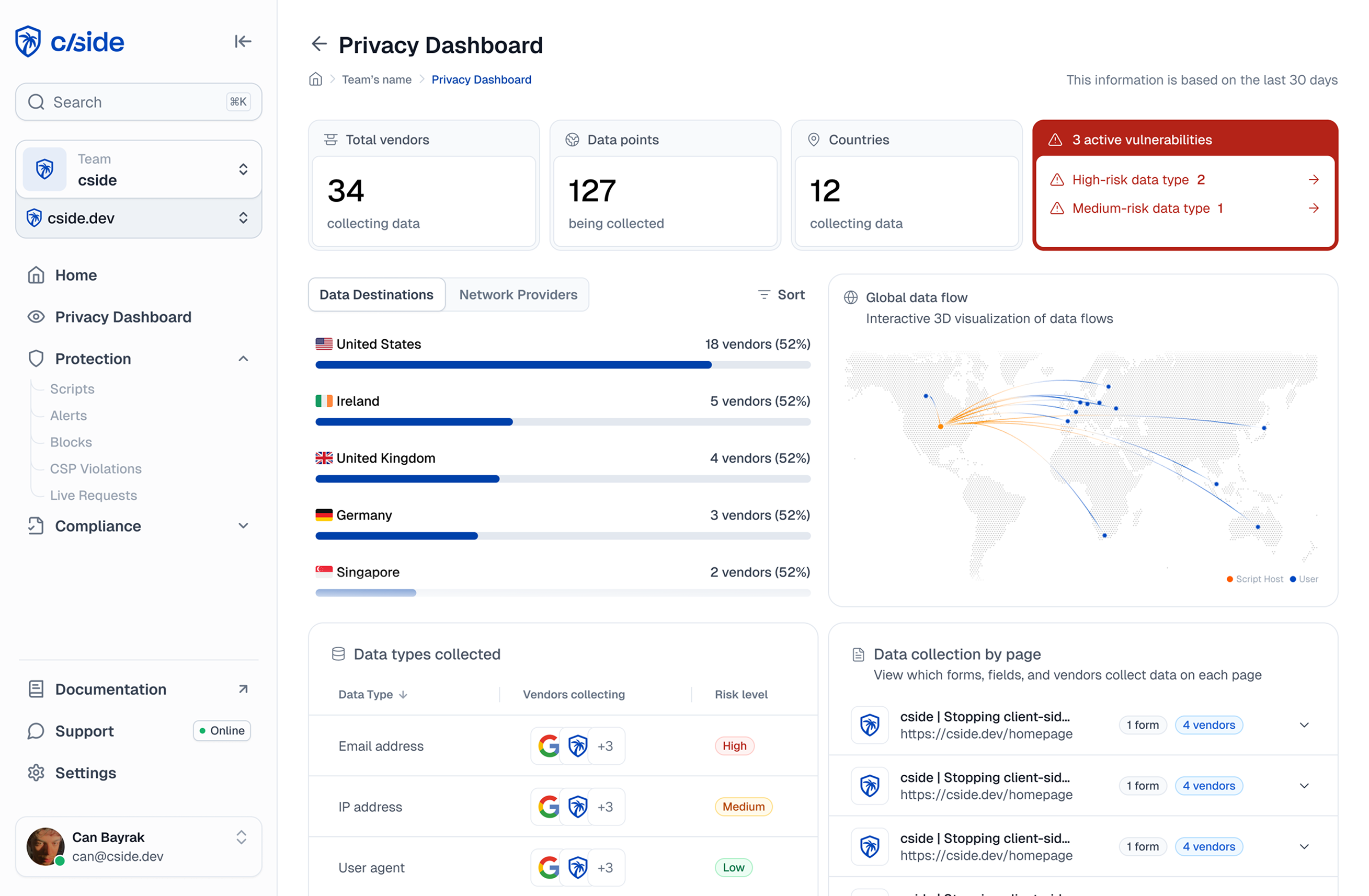
For forensics, cside keeps immutable archives of every script payload with full version history: the actual attack code, analysed on cside infrastructure whether it is obfuscated or not, rather than a behavioural change log. That is the evidence a QSA auditor or a regulatory notification needs. cside covers PCI DSS 6.4.3 and 11.6.1 natively, has been reviewed and approved by VikingCloud for PCI DSS 4.0.1 requirements 6.4.3 and 11.6.1, and publishes SOC 2 Type II certification and PCI DSS SAQ D through its Trust Center. It also covers HIPAA, GDPR, and CPRA. Pricing is public, there is a free tier, and a public status page plus a 99.9% uptime SLA let you verify reliability yourself. Its client-side security coverage extends beyond payment pages to the whole third-party script surface.
Source Defense - Best for: sandboxed third-party script isolation
Source Defense specialises in client-side script security and offers two methods. "Detect" is a crawler that mimics a user visiting the page; like any crawler it captures only one context and can be spotted, so an attacker can serve it the unaltered script. "Protect" is a JavaScript agent that builds a client-side sandbox around third-party scripts to control what they can access. The sandbox is a prevention-oriented control, but it runs in the same browser environment as the attacker, and the compare page notes it can add up to 100ms of latency.
Because the agent is trigger-based, anything that does not trip a trigger is treated as good, so "they do not know what they didn't catch", and those triggers are defined in the browser where a bad actor can study them. The per-script permission model also needs ongoing configuration as your scripts and dependencies change. Most importantly for incident response, Source Defense provides behavioural alerts when sandbox boundaries are crossed but cannot show you the script contents, which makes forensics and improving detections hard.
Source Defense targets enterprise merchants, but it has no public pricing or free tier, and it maintains a public changelog rather than a public status page or an uptime SLA.
Reflectiz - Best for: periodic third-party inventory scanning
Reflectiz is a periodic remote scanner. A cloud crawler visits your pages on a schedule, so coverage is limited to what it happens to see at scan time and to the single context that crawler receives. A browser running from a cloud provider IP is not equivalent to a script running inside the actual DOM of a real user session. A point-in-time scanner like Reflectiz sees even less than a sampled in-page agent, because it runs in no real user session at all, only what loads during its scheduled crawl.
That model has a structural limitation for conditional attacks. Attackers can vary scripts by IP, geography, device, user agent, login state, or time window, serving clean JavaScript to the scanner while a real shopper receives malicious code inside the actual DOM. This is the gap that lets a payload confirm "clean" in a controlled scan while it is actively exfiltrating from real sessions. Reflectiz's own G2 reviews (4.7/5, 31 reviews) also flag rudimentary reporting, a cluttered interface, and false positives on popular payment and tracking providers.
On assurance, Reflectiz's PCI reporting is self-described and may still need independent validation, and as of the May 20, 2026 review of public materials it did not publish equivalent SOC 2 Type II certification, a public status page, or an uptime SLA. It is a reasonable fit for mapping the third-party script inventory in controlled conditions; it is not a substitute for real-user session visibility on pages that process sensitive data.
Jscrambler - Best for: JavaScript obfuscation with in-browser integrity traps
Jscrambler started in JavaScript obfuscation and anti-tampering and added webpage integrity later. Its integrity approach injects decoy objects and monitoring code into your pages, traps, hoping a malicious script interacts with them after it has already loaded. The detections run client-side, in the browser, where a bad actor can find and avoid them, and traps that are designed around may never fire: like the others in this class, it does not know what it did not catch. Obfuscation itself is not a barrier either; LLMs and a large deobfuscation community routinely reverse it.
Crucially, Jscrambler does not track script contents at all, so it cannot show you the payload, and its monitoring layer relies on periodic scanning and does not preserve raw payloads. That makes forensics hard, bad actors often sample their attacks, so the malicious code can be impossible to recover after the fact. Jscrambler added a webpage-integrity monitoring layer on top of its obfuscation origins, and it integrates with Jira but not Linear. There is no public pricing or free tier. In the 2026 Globee Cybersecurity Awards for Client-Side Security, judges awarded cside Gold (Best of Category) and Jscrambler Silver.
DomDog - Best for: CSP reporting and violation triage
DomDog is tailor-made for PCI DSS 6.4.3 and 11.6.1 and installs as a single script in your header, similar to cside, though the two scripts do very different things. DomDog collects scripts, shows them in a dashboard, and asks you to review and allow- or block-list them. This is a JavaScript "agent" that operates within the JavaScript layer and cannot monitor code outside it: if a stored XSS script turns malicious, DomDog does not sit in the delivery flow to catch it.
Its secondary mechanism is a Content Security Policy, which acts like a firewall that trusts pre-approved script sources rather than their content. If the source stays the same but the content changes, exactly what happened in the 2024 Polyfill attack, a CSP will not catch it, and DomDog only sees what the CSP is configured to observe. It does not analyse payloads or archive attack code, so there is no raw evidence for incident response, and the compare page notes no SOC 2 or PCI DSS certification could be found.
DomDog's pricing is fully public and starts at $999 per year, similar to cside. It is a reasonable fit for CSP reporting and violation triage, not as the sole client-side control for payment-page security.
Feroot - Best for: JavaScript-agent behavioural monitoring with synthetic-user scanning
Feroot combines two products. PageGuard deploys permissions and an allow-list where you pre-approve which scripts may run, overwriting core JavaScript to enforce it. Because it checks the source of a script rather than the code that source serves, PageGuard would not have caught the 2024 Polyfill attack, where a domain changed ownership and started serving different code from the same source. Inspector deploys synthetic "honeypot" users to simulate real behaviour on a periodic schedule, effectively a crawler, which can be avoided by serving malicious scripts only to residential IPs, and which on its own cannot meet the PCI DSS requirement to prevent unauthorised scripts.
Feroot's agents flag behavioural anomalies after scripts have loaded and executed, and they sample a fraction of sessions rather than observing all of them. That gap matters most on conditional attacks: a payload served only to one geo, one device class, or logged-in users can sit inside the unsampled majority indefinitely. Feroot provides behavioural alerts but does not preserve the raw malicious payload, so the forensic-grade evidence auditors increasingly ask for is not there.
Comparison Table
| Platform | Monitoring model | Avg. detection latency | Behavioural deviation | Dynamic import detection | IR evidence |
|---|---|---|---|---|---|
| cside | Real-user session (Script Method) + server-side payload analysis; Scan Method fallback | Real-time, in-session | Yes, server-side analysis of served code, flags same-source deviations | Yes, analyses the actual code served to real users | Immutable raw payload archive with version history; QSA-grade |
| Source Defense | Client-side sandbox / JS agent (Protect) + crawler (Detect) | In-browser; sandbox adds up to 100ms | Trigger-based within sandbox policy; needs per-script config | Policy / allow-list controlled | Behavioural alerts; cannot show script contents |
| Reflectiz | Periodic remote scanner (cloud crawler) | Scheduled scan interval | Scanner-observed only; can be served clean code | Scan-time visibility only | Scan reports; self-described PCI evidence, no raw payload archive |
| Jscrambler | In-browser traps + periodic scanning (obfuscation origin) | Post-delivery / scan-based | Trap-triggered only; may not fire | No, does not track script contents | Trap alerts; no raw payload preserved |
| DomDog | JS agent + CSP reporting | Post-delivery | Detects script/page changes; CSP misses same-source content change | Only what the CSP is configured to observe | CSP violation reports; no payload analysis or archive |
| Feroot | JS agents (PageGuard) + synthetic-user scanner (Inspector), sampled sessions | Post-execution; sampled | Behavioural anomaly flags; allow-list checks source, not content | Source allow-list, not content-aware | Behavioural alerts; no raw payload archive |
How to Choose
Quick answer: Score each platform in the table against the criteria below and require every one that your threat model and regulatory obligations demand. The criteria are deliberately strict: a tool that misses even one leaves a window a conditionally activated payload can operate inside. Let the comparison table, not marketing copy, decide which platform clears the bar.
Require a platform that meets all of the following:
-
Real-user session instrumentation, not a scheduled crawler. The tool must observe the code that a genuine visitor's browser receives inside the actual DOM, not what a cloud-IP crawler is served at scan time. Scanners can be fingerprinted and handed a clean script.
-
No sampling. Coverage must span 100% of real user sessions. A payload served only to one geo, one device class, or logged-in users can hide indefinitely in the unsampled majority.
-
Server-side analysis that attackers cannot fingerprint. Detection logic that runs in the browser is visible to a bad actor who can study it and design around it. Analysis performed off the browser, on the actual served code, removes that "minesweeper with the bombs exposed" problem.
-
Content-level, sub-minute change detection. The tool must detect a script whose source and hash are unchanged but whose served code has been swapped, the Polyfill-class supply-chain case, within seconds to under two minutes, not on a daily or weekly scan cycle. Source allow-listing and CSP source checks do not clear this bar.
-
Behavioural deviation detection. Beyond change detection, the platform must know what each script ordinarily does and flag anomalous actions: new form-field reads, unexpected cross-origin exfiltration, dynamic imports of previously unseen modules.
-
IR-grade, deobfuscated payload evidence. When an attack is confirmed, you need an immutable archive of the actual malicious code with version history, readable whether or not it was obfuscated, not a behavioural change log or a trap alert that may never have fired.
-
QSA-validated PCI evidence and multi-framework coverage. PCI DSS 6.4.3 and 11.6.1 evidence should be independently QSA-validated rather than self-described, and the platform should extend to the other frameworks you carry (HIPAA, GDPR, CPRA) so you are not stacking tools to satisfy auditors.
Read each column of the comparison table above against this checklist and keep only the platforms that satisfy every line. If you are still scoping the wider landscape, our roundup of platforms for third-party script monitoring covers the category in more depth.
Try cside before you buy. cside has a free plan, so you can sign up, deploy, and explore the platform yourself, with no sales calls or procurement process. And our support team is one message away whenever you need a hand.