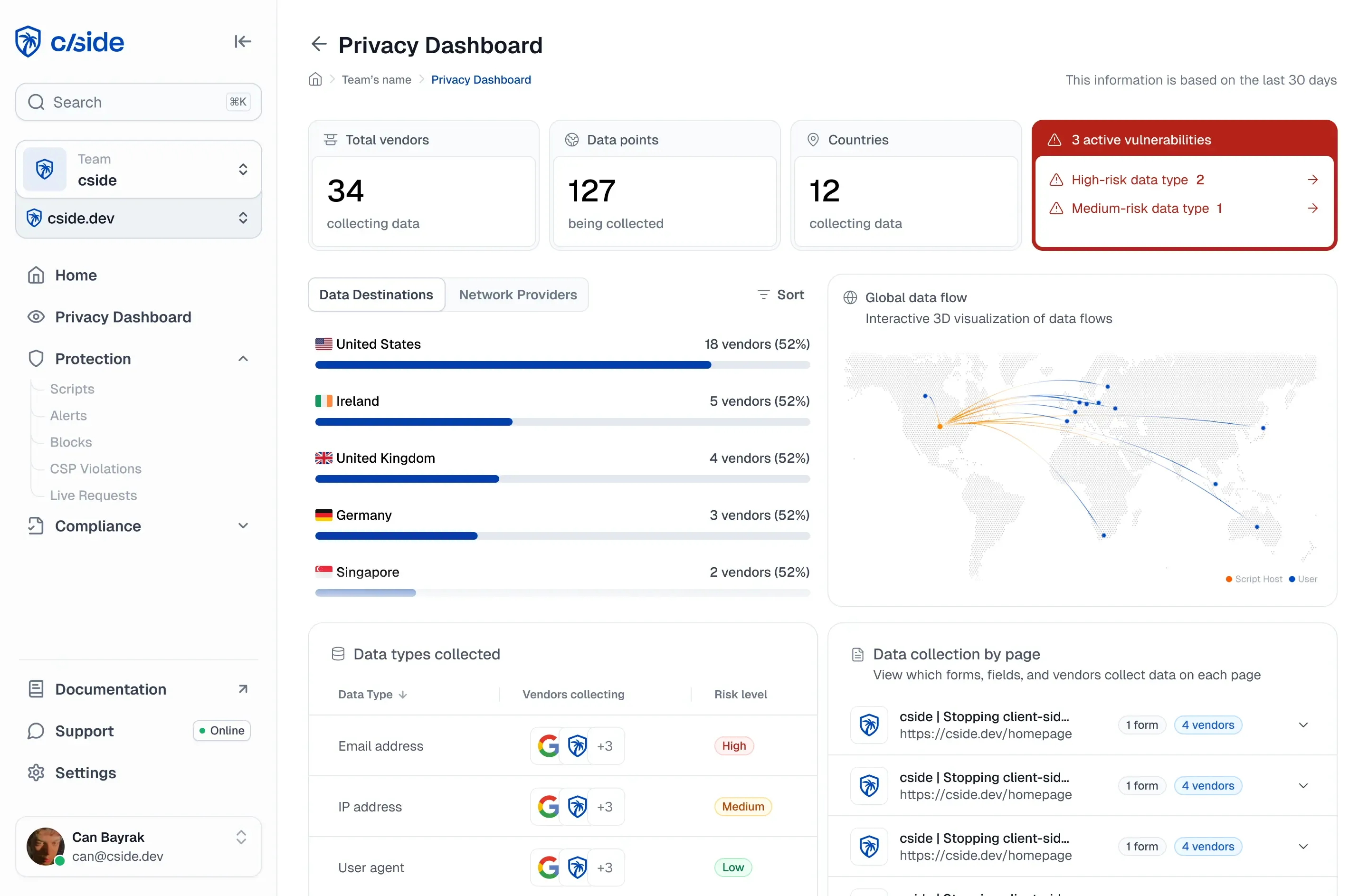

TL;DR: enforcing consent in the browser
- The blind spot: A consent management platform records what each visitor agreed to, but it cannot verify that every third-party script obeys those choices, tags fire before the banner renders, ignore Reject All through misconfigured consent mode, or load secondary code outside the CMP's scope.
- How cside verifies: cside Privacy Watch watches what trackers actually do in real visitor browsers, session by session, producing an audit log of whether consent was enforced rather than just what the CMP logged should happen.
- Why it matters: France's CNIL fined Google €100 million and Amazon €35 million for cookies set before visitors could refuse them, so decide whether you can prove enforcement in the browser or trust that a correct-looking banner is enough.
Short on time? See cside's Privacy Watch. It covers everything below in one deployment.
A consent management platform (CMP) handles your cookie banner and records what each visitor agreed to. What it cannot do on its own is verify that every third-party script on your site actually obeys those choices. Consent management monitoring fills that gap by watching what trackers do in real visitor browsers, not just what your CMP logs that they should do.
What consent management actually means
Consent management is the process of requesting, recording, and enforcing a visitor's permission to collect and process personal data. Under GDPR, this requires an unambiguous affirmative signal before any non-essential cookie or tracker touches the page. Under CCPA and U.S. state laws, it means honoring opt-out signals at the moment they are received. Under HIPAA, it governs which analytics and ad pixels are permitted on pages containing protected health information.
Three things must work together for consent management to hold up under regulatory scrutiny: the user sees a genuine choice, their decision is stored accurately, and every tracker on the page respects that decision in real time.
Most organizations manage the first two. The third is where compliance gaps appear.
Where consent management breaks in the browser
When a visitor clicks Reject All, the consent signal travels from the CMP to each tag on the page. Whether each tag actually stops depends on several factors the CMP cannot observe from its own logs.
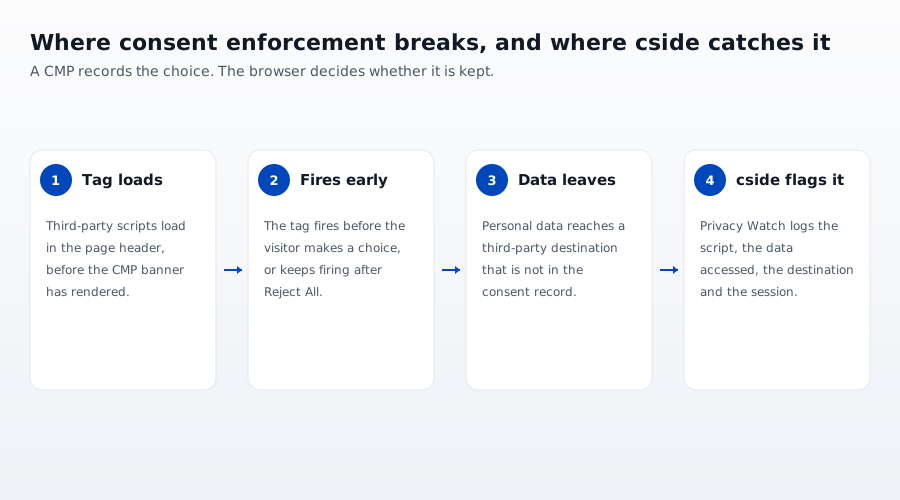
Script timing. Many third-party scripts are loaded in the page header, before the CMP banner has finished rendering. A tracker that fires in those first milliseconds does so before the user has had any chance to make a choice. This is a structural timing problem, not a CMP configuration bug.
Misconfigured consent mode. Google Consent Mode, IAB Transparency and Consent Framework signals, and similar mechanisms require each advertising or analytics vendor to integrate correctly with the CMP's output. A tag in Google Tag Manager without the correct consent trigger fires even when a user rejects all tracking. These misconfigurations are common and often persist undetected because the visible banner appears correct.
Secondary script injections. CMPs govern the tags explicitly placed in their container. A first-party tag that calls a third-party SDK, or a tag manager rule that loads external code, can fire outside the CMP's scope. These secondary executions do not appear in the consent record.
Enforcement has caught up. France's CNIL fined Google €100 million and Amazon €35 million in December 2021 because analytics cookies were placed before visitors had the chance to accept or refuse them, a direct result of the timing and misconfiguration problems above. Ireland's DPC fined Meta €17 million in 2022 for inadequate technical measures around personal data processing. Cookie consent and enforcement are among the most active GDPR enforcement areas in Europe, with regulators explicitly verifying whether what runs in the browser matches what the consent banner promises.
CMP vs. consent monitoring: what each one actually does
These are two distinct functions that most organizations assume a CMP covers in full.
| Function | Consent management platform (CMP) | Consent monitoring (cside Privacy Watch) |
|---|---|---|
| What it does | Presents banner, stores preferences, signals choices to tags | Watches what scripts do in real visitor browsers |
| Data source | Banner interactions and preference logs | Live browser execution across real visitor sessions |
| Blind spots | Pre-consent fires, secondary injections, vendor misconfiguration | None of the above |
| Evidence produced | Consent logs: what each user agreed to and when | Audit logs: whether consent was enforced session by session |
| Relationship | Front door: collects the consent record | Security camera: verifies the record was honored |
| Examples | OneTrust, Cookiebot, Usercentrics, Osano | cside Privacy Watch |
A CMP answers "what did this visitor agree to?" Consent monitoring answers "was that agreement actually kept?"
For GDPR compliance tool stacks, both layers are needed. The CMP satisfies consent collection and storage under Articles 7 and 13. Consent monitoring satisfies the accountability requirement under Article 5(2): that compliance can be demonstrated.
How cside monitors consent enforcement in real browsers
cside Privacy Watch deploys as a single first-party JavaScript snippet. No proxy, no DNS changes, no added latency. The snippet runs during real visitor sessions and observes what third-party scripts do at the moment they execute.
Periodic crawlers and consent scanners take a snapshot of a site from a server at a point in time. They see what the page looks like to a bot and miss trackers that only fire for real users, payloads gated on geolocation or login state, and vendor updates pushed between scan cycles. cside observes every session as it unfolds, seeing the same page your actual visitors see.
What cside flags automatically:
- Third-party scripts sending data before a visitor has interacted with the consent banner
- Data collection continuing after a user clicks Reject All or signals a Global Privacy Control or Do Not Sell preference
- New or changed third-party scripts accessing personal data outside the consent catalog
- Personal data or protected health information sent to undisclosed or unauthorized destinations
- Consent mode misconfigurations that allow tags to fire even when the CMP records a rejection
Each detection generates a record with the script identity, the data accessed, the destination, and the session context. These records route into existing GRC, privacy, or security workflows through cside's 50+ integrations.
Audit-ready documentation. cside generates evidence aligned to GDPR Articles 5, 28, and 32, CCPA technical safeguards, and HIPAA security controls, from real session data rather than policy templates.
Consent management requirements under GDPR, CCPA, and HIPAA
GDPR. Consent must be freely given, specific, informed, and revocable at any point. Withdrawal must be as easy as giving consent. What regulators verify in practice: that non-essential cookies are not placed before a visitor sees the banner, that opting out stops data collection, and that records document not just what was agreed to but that the agreement was honored. cside provides the session-level evidence that closes the documentation gap between preference records and enforcement reality.
CCPA and U.S. state privacy laws. California, Colorado, Connecticut, Virginia, and a growing number of U.S. states require organizations to honor opt-out signals including Global Privacy Control at the point of receipt. Consent monitoring verifies these signals are propagated to every third-party script in real time, producing forensic records for audits or regulatory reviews.
HIPAA. Healthcare websites regularly carry analytics and advertising pixels that, in a misconfigured state, transmit protected health information to third parties. cside Privacy Watch flags PHI exfiltration at the script execution level before it reaches a reportable threshold.
How consent monitoring fits your existing compliance stack
cside is not a replacement for a consent management platform. The two tools cover different parts of the consent compliance requirement.
Your CMP handles the banner UI, the preference database, and the consent signal. cside verifies that the signal was obeyed. For teams already using OneTrust, Cookiebot, Usercentrics, or Osano, cside is the independent verification layer that produces the audit evidence your CMP alone cannot generate.
Privacy Watch is one of four cside products running from the same single JavaScript snippet. Script Security handles PCI DSS 4.0.1 §6.4.3 and §11.6.1 requirements; PCI Shield targets payment page compliance; device intelligence covers bot detection and fraud signals. A CISO team and a DPO team use separate products from the same deployment without additional infrastructure.
For teams using AI tools for website privacy compliance, cside's browser-layer monitoring adds the enforcement verification that AI-assisted documentation tools and CMPs cannot access on their own.