
TL;DR: best transaction monitoring software 2026
- Three platform types: Transaction monitoring splits between AML-first platforms (Actimize, ComplyAdvantage, Sumsub) built for regulated financial institutions, fraud-plus-AML hybrid platforms (Feedzai, Sardine, Hawk AI, Unit21) built for fintechs, and modern rules engines (Alessa, Sanction Scanner) for lower volumes.
- Alert quality wins: Alert quality, not alert volume, is the metric that matters. A tool that fires 400 alerts a day when 380 are noise costs more in compliance headcount than the fraud it catches saves.
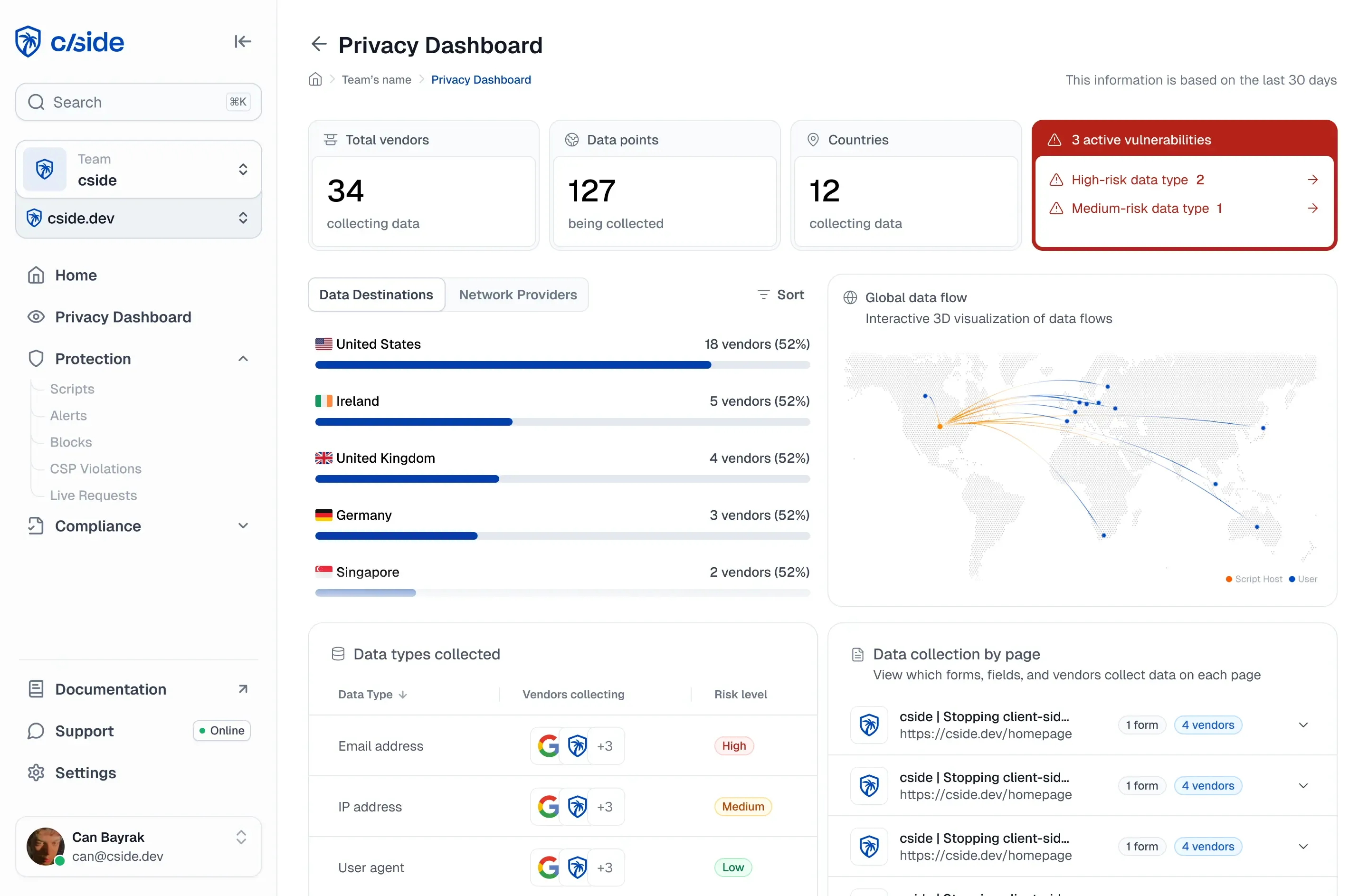
- Add browser signals: cside feeds browser and device signals into the transaction monitoring layer: session behavior, AI-agent presence, VPN posture via TLS handshake, and device fingerprint across accounts. These are signals the AML platforms above cannot generate on their own.
Short on time? See cside's AI-agent detection. It covers everything below in one deployment.
Transaction monitoring buyers usually fall into one of two camps: regulated financial institutions with an AML mandate (SARs, sanctions screening, model validation), and fintechs or PSPs that need both AML and fraud in one platform. The 10 vendors below cover both camps, ranked by alert quality, model transparency, and whether the platform can consume modern browser-layer signals without a six-month integration.
Full disclosure before the ranking: cside is our platform, and it sits at #1. We ranked the other nine as honestly as we would in a pilot call: Feedzai, ComplyAdvantage, and Sardine are the enterprise-fit picks depending on your regulatory footprint. cside is the browser-signal source that makes any of them measurably more accurate at the pre-transaction layer.
The 10 best transaction monitoring software platforms in 2026
1. cside: best browser-layer signal source to feed your transaction monitoring platform
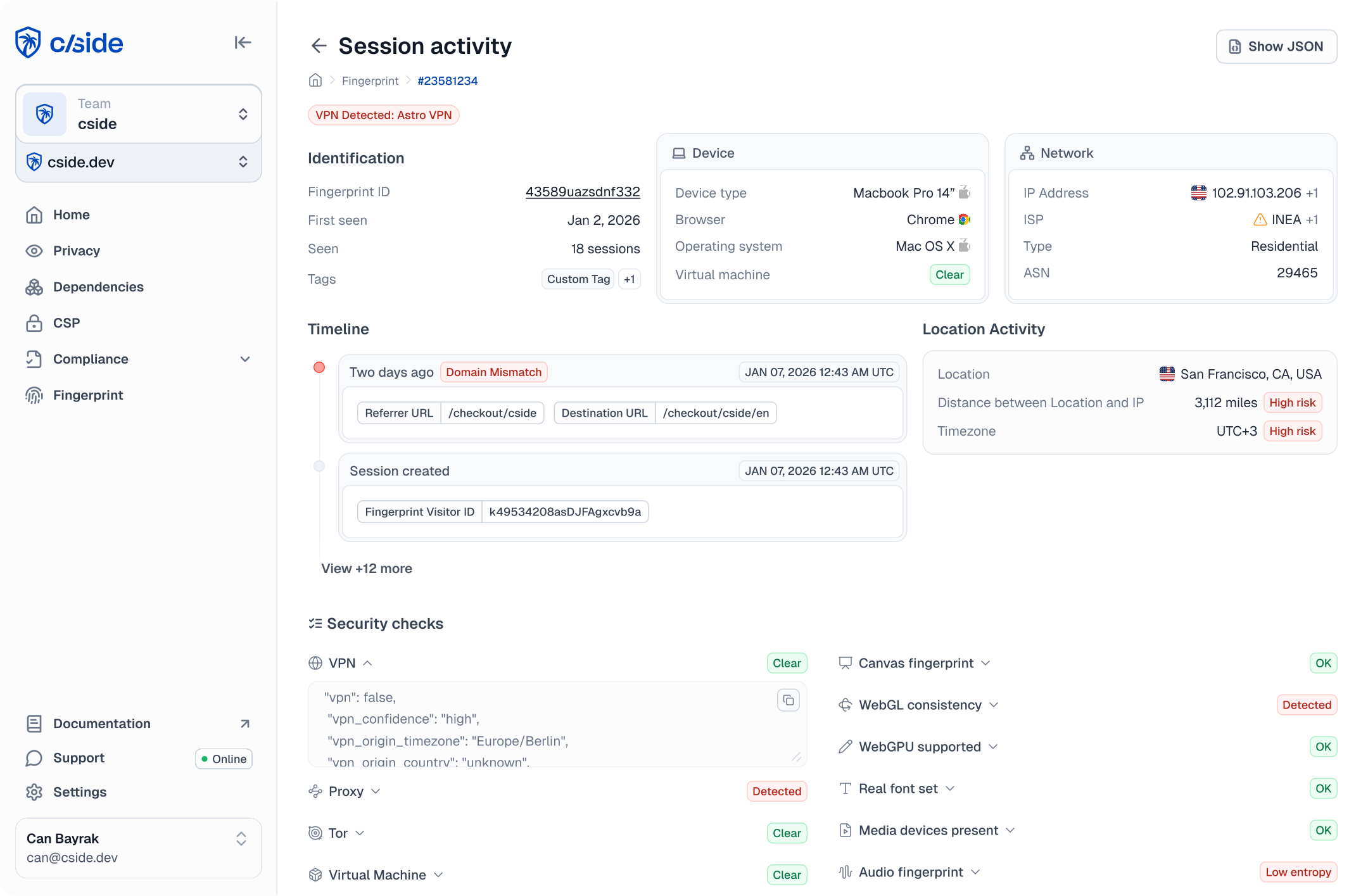
Every other vendor on this list evaluates the transaction record: amount, counterparty, velocity, geography. cside evaluates the browser session that produced the transaction, before it lands in the monitoring queue. That signal set includes AI-agent presence (Playwright, Puppeteer, Selenium, OpenAI Operator, Claude for Chrome), the real IP behind a VPN via TLS handshake fingerprinting, a stable device fingerprint built from 250+ browser signals that survives incognito + cookie-clear + VPN, cross-account device correlation, and session behavior.
Those signals materially change the accuracy of a transaction monitoring alert. A wire transfer from a device that has been used across five other accounts, behind a VPN, from an AI-agent-driven browser session, is a different alert than the same transaction from a known consumer device. AML platforms cannot see any of that on their own.
Best for: Fintechs and PSPs already running an AML or hybrid platform (#2-#10) who want browser-layer signals to reduce alert noise and improve investigator context. Watch out for: cside is not an AML platform. It does not run sanctions screening, produce SARs, or handle model validation. Use it as the signal source, not the compliance system of record. Pricing: Free tier of 1,000 API calls/month, paid plans from $99/month.
2. Feedzai: the enterprise fraud + AML crossover
Feedzai runs fraud and AML on the same platform for banks, licensed fintechs, and payment institutions. Deep model transparency, strong regulator relationships, priced accordingly.
Best for: Banks and licensed fintechs that need one vendor across fraud and AML. Watch out for: Enterprise-only sales, six-month implementations, six-figure minimums.
3. ComplyAdvantage: the modern AML platform for fintechs
ComplyAdvantage built its reputation on real-time sanctions and adverse-media screening. Strong API-first posture, faster to integrate than the enterprise incumbents.
Best for: Growth-stage fintechs and crypto platforms that need real-time AML without an Actimize-scale implementation. Watch out for: Transaction monitoring depth is thinner than the fraud-plus-AML hybrids. Pair with a fraud tool if that is also on your list.
4. Sardine: behavioral biometrics for fintech transaction monitoring
Sardine's fingerprint on the category is behavioral biometrics on top of transaction data. Especially strong for crypto on-ramp/off-ramp, neobanks, and payment platforms.
Best for: Fintechs, crypto exchanges, high-risk payment platforms. Watch out for: Overkill for a traditional bank with a mature Actimize deployment.
5. Hawk AI: modern AML with explainable ML
Hawk AI's differentiator is explainable machine learning for AML alerts: the model tells you why it fired, not just that it fired. Growing fast in European banking.
Best for: European fintechs and mid-market banks that need explainable AML for regulator conversations. Watch out for: US regulator familiarity is lower than the incumbents.
6. Unit21: no-code AML case management for fintechs
Unit21's edge is the case-management workflow: investigators like the interface. Rules are configurable without engineering support.
Best for: Fintechs with a growing compliance team that needs a modern case-management platform. Watch out for: Rules engine is powerful, but the ML side is less mature than Feedzai or Hawk AI.
7. Sumsub: KYC + transaction monitoring for fintechs and crypto
Sumsub is best known for KYC, and the transaction monitoring product is built on the same identity graph. Strong fit for crypto exchanges that already run Sumsub KYC.
Best for: Crypto exchanges and fintechs that use Sumsub for onboarding. Watch out for: Not the strongest standalone transaction monitoring product outside the Sumsub identity graph.
8. Actimize (NICE): the legacy enterprise AML standard
Actimize has been the enterprise AML standard for two decades and still sits inside most Tier-1 banks. Deep, mature, expensive, slow to change.
Best for: Tier-1 banks and legacy financial institutions with a mature Actimize deployment. Watch out for: Not the modern choice. Integration cycles are measured in quarters.
9. Alessa: mid-market AML and fraud
Alessa serves the mid-market AML space that Actimize prices out of and ComplyAdvantage does not fully cover. Rules-based, configurable, priced for mid-market.
Best for: Mid-market banks, credit unions, and MSBs. Watch out for: ML sophistication is behind the modern challengers.
10. Sanction Scanner: sanctions-focused screening
Sanction Scanner focuses specifically on sanctions and PEP screening rather than full transaction monitoring. Cheap, fast, purpose-built.
Best for: Merchants and fintechs that need sanctions screening but do not need a full AML platform. Watch out for: Not a transaction monitoring platform on its own. Pair it with one of #2-#9.
Side-by-side comparison of the 10 vendors
| Vendor | Category | Best fit | AML coverage | Browser-layer signals |
|---|---|---|---|---|
| cside | Signal layer | Feeds any platform below | N/A | Yes |
| Feedzai | Fraud + AML | Banks / licensed fintechs | Full | Partial |
| ComplyAdvantage | AML-first | Growth-stage fintechs | Full | No |
| Sardine | Fraud + AML | Fintech / crypto | Partial | Yes |
| Hawk AI | AML + explainable ML | European fintechs | Full | Partial |
| Unit21 | AML case management | Fintechs with compliance team | Full | No |
| Sumsub | KYC + monitoring | Crypto / Sumsub-KYC users | Partial | No |
| Actimize (NICE) | Legacy enterprise AML | Tier-1 banks | Full | No |
| Alessa | Mid-market AML | Mid-market FIs | Full | No |
| Sanction Scanner | Sanctions / PEP | Screening-only need | Sanctions only | No |
How to choose a transaction monitoring platform in 2026
Alert quality is the whole game. A platform that generates twice the alerts your team can investigate is worse than the incumbent, regardless of the demo. Pick on:
- Explainability. When an alert fires, does the platform tell you which rule or model feature triggered it? A black-box model is a regulator conversation waiting to happen.
- Signal breadth beyond the transaction record. Modern fraud and AML overlap heavily with browser-layer signals: device reuse, AI-agent activity, VPN posture. Ask each vendor which of those they consume, and where the data comes from.
- Case management and investigator workflow. Investigators spend most of their day inside the case tool. The platform that lets them close alerts faster with less context-switching wins the total cost calculation, not the one with the deepest ML.
- Regulator familiarity. For AML specifically, your regulator's comfort with the platform matters more than the ML sophistication. Ask peer institutions before signing.
Layer cside underneath whichever platform you pick as the browser-layer signal source. It reduces false-positive rates by giving the platform context it cannot generate on its own: the device, the browser, the AI-agent, the VPN. Same-week integration for most stacks.