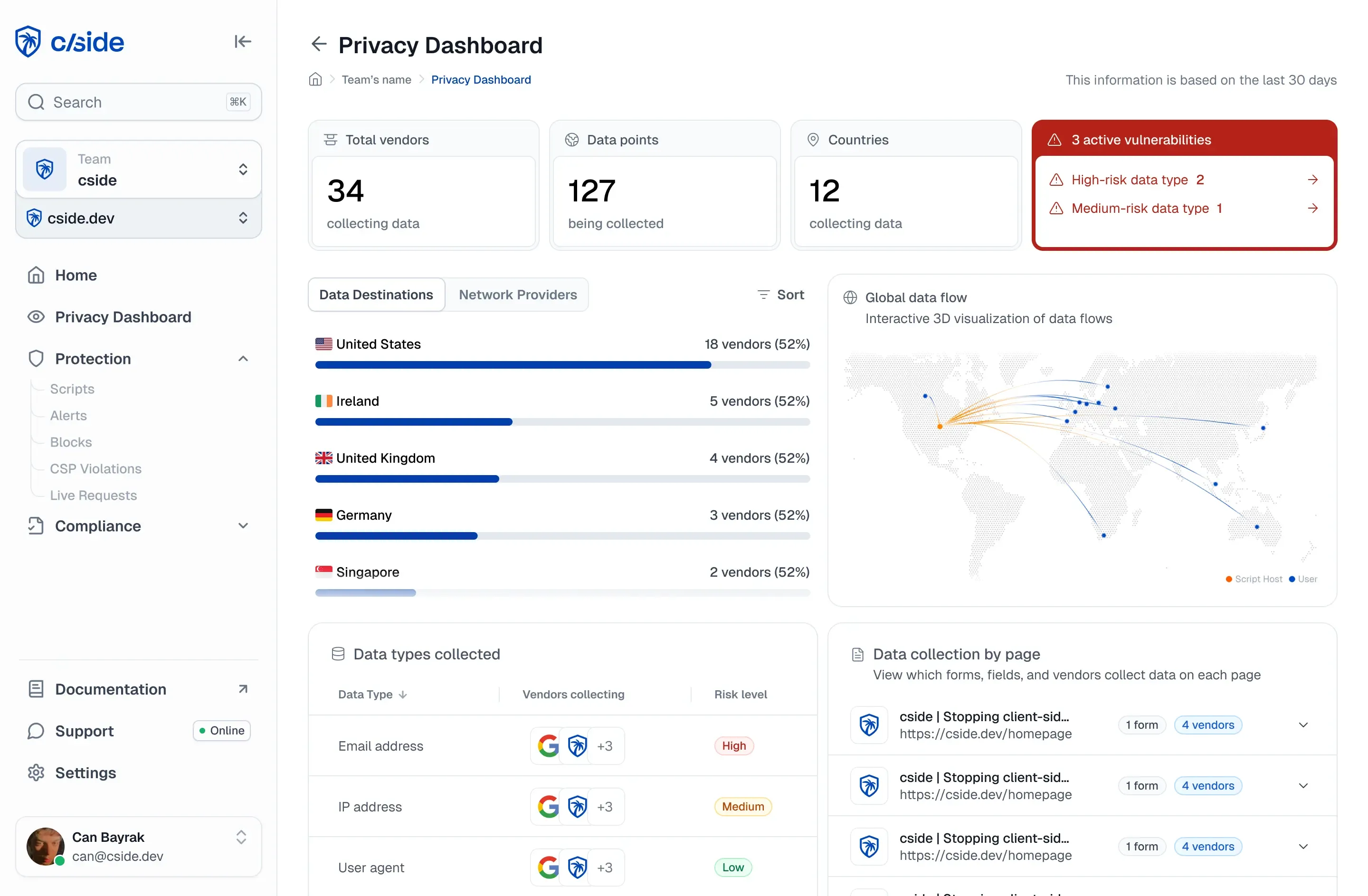
OpenAI Operator can browse your product catalogue, add items to cart, and initiate a purchase without a human touching a keyboard. Amazon Buy For Me does the same from inside the Amazon app, buying from third-party sites on a shopper's behalf. These are not hypothetical threats. Visa and Mastercard both launched agentic payment infrastructure in 2025 to support exactly this kind of agent-driven transaction. The same capabilities that make shopping agents commercially valuable also make them powerful tools for card testing, bulk account creation, and inventory manipulation.
If you run an eCommerce store or a digital product, AI agents will reach your site. The open question is which tool will tell you when they do, and let you decide what happens next. This guide is written for that decision: what to look for in an AI agent detection tool for websites, which products are capable of doing the job, and what eCommerce teams need to consider before deploying.
Related reading: if your priority is fraud prevention rather than tool selection, start with our companion guide on the best tools for AI agent detection to prevent website fraud.
Why existing defences fall short
Most websites are still running detection infrastructure built for a different era. The newer generation of LLM-powered agents operates inside real browsers, not the simple HTTP pipelines that most detection systems were designed to catch. Traditional tools were not built to tell the difference.
Why Websites Are the Primary Battleground for AI Agent Activity
Quick answer: Websites are the interface layer where AI agents take action. Unlike API-based automation, browser-driving agents interact with your product pages, cart, and checkout exactly the way a human would. That makes them both valuable as commerce tools and dangerous as fraud vectors. Existing bot defences mostly operate below the browser and miss this entirely.
The types of AI agent activity hitting websites today
As of early 2025, 63% of websites were already seeing traffic arrive via AI chatbot interfaces, according to Ahrefs research. Gartner predicts that 80% of product searches will be conducted through agentic AI by 2030, with 20% of online purchases completed by AI agents. Volume is no longer the feature that separates these sessions; intent is. For a deeper look at the signals involved, see our guide to detecting AI agent traffic on your website.
The categories of agent activity worth distinguishing:
- Shopping agents. Tools like OpenAI Operator, Amazon Buy For Me, and Perplexity Shopper browse product pages, compare prices, add items to cart, and initiate checkout. Visa and Mastercard have both launched agentic payment infrastructure to support this, and if you decide a given agent should not be allowed through, see how to block OpenAI Operator on your website.
- Content scrapers. Agents that consume pricing data, product descriptions, images, and reviews at scale. They often move faster than a crawl rate limiter would catch, because they operate in browser sessions rather than simple HTTP requests.
- Card testers. Automated agents that submit small payment attempts across multiple cards to identify which credentials are live, exploiting the fact that checkout forms are typically rate-limited by IP rather than by session behaviour. We cover this pattern in detail in how to block AI card-testing agents.
- Account creators. Agents that fill registration forms, solve CAPTCHAs via third-party services, and build synthetic identities for use in referral abuse, loyalty fraud, or credential stuffing staging.
The commercial and fraud risk
Both sides carry real money. McKinsey estimates agentic commerce will generate trillions of dollars in global revenue by 2030, so blocking all agent traffic indiscriminately is not a viable strategy. Yet Forrester's Q4 2025 category rename to "Bot and Agent Trust Management Software" signals how much the industry has had to adapt its threat model.
For eCommerce teams responsible for revenue, fraud rates, and customer experience simultaneously, this gap is not abstract.
What to Look for in an AI Agent Detection Tool for Your Website
Quick answer: The most important capability is where in the stack the tool operates. Network-layer tools read IP addresses and HTTP headers and miss most modern AI agents. Browser-layer tools read how a session behaves inside the page and can catch agents that have already passed every network check. Beyond architecture, look for page-level policy controls, named agent classification, and a non-binary action model.
Feature comparison for website teams
| Feature | Why it matters for websites |
|---|---|
| Browser-layer detection | AI agents use real or stealth browsers. Network headers alone do not reveal agent behaviour. |
| Session-level visibility | Agents operate across multiple page views. Per-request analysis misses multi-step fraud paths. |
| Named agent identification | Knowing whether traffic is OpenAI Operator or an unknown scraper changes the appropriate response. |
| Page-level policy rules | Product pages, cart, and checkout carry different fraud risk and need different controls. |
| Allow / block / guide actions | Blanket blocking harms legitimate agentic commerce. A graduated response is essential. |
| Intent classification | The tool should distinguish a shopping agent completing a purchase from a card tester. |
| VPN and proxy detection | Many agents rotate through residential proxies to avoid IP-based blocks. |
| Fingerprint anomaly detection | Agents often present browser fingerprints that do not match the claimed user agent or device. |
Why browser-layer detection is the non-negotiable baseline
Most bot management vendors operate at the CDN or WAF layer. They read network signals: IP reputation, headers, ASN, request rate. That is sufficient for simple bots running direct HTTP calls. AI agents using real browsers pass those checks routinely.
In cside's controlled testing, traditional tools missed AI agents in 81 out of 100 controlled test scenarios. The gap comes from architecture, not configuration. Network tools do not see what is happening inside the browser session.
What the gap looks like for an eCommerce site
Picture an Amazon Buy For Me session arriving on a footwear retailer's product page. The agent loads in a genuine browser environment, navigates from a search results page to a product detail page, selects a size from a dropdown, and proceeds to checkout, all at timing intervals that sit comfortably within the normal human range. The CDN edge sees a clean residential IP. The WAF records no anomalous request headers. No rate limit is approached. But at the browser layer, the agent skips all hover events on product images, directly accesses the cart API endpoint without triggering the add-to-cart animation, and completes the address form using a typing cadence with zero inter-field pauses. These patterns are invisible at the network layer. cside's browser instrumentation flags them as non-human interaction in real time, before the order is placed, giving the security team the option to challenge, guide, or block the session rather than processing a transaction they cannot attribute to a verified human.
The Best Tools to Detect AI Agents on Your Website
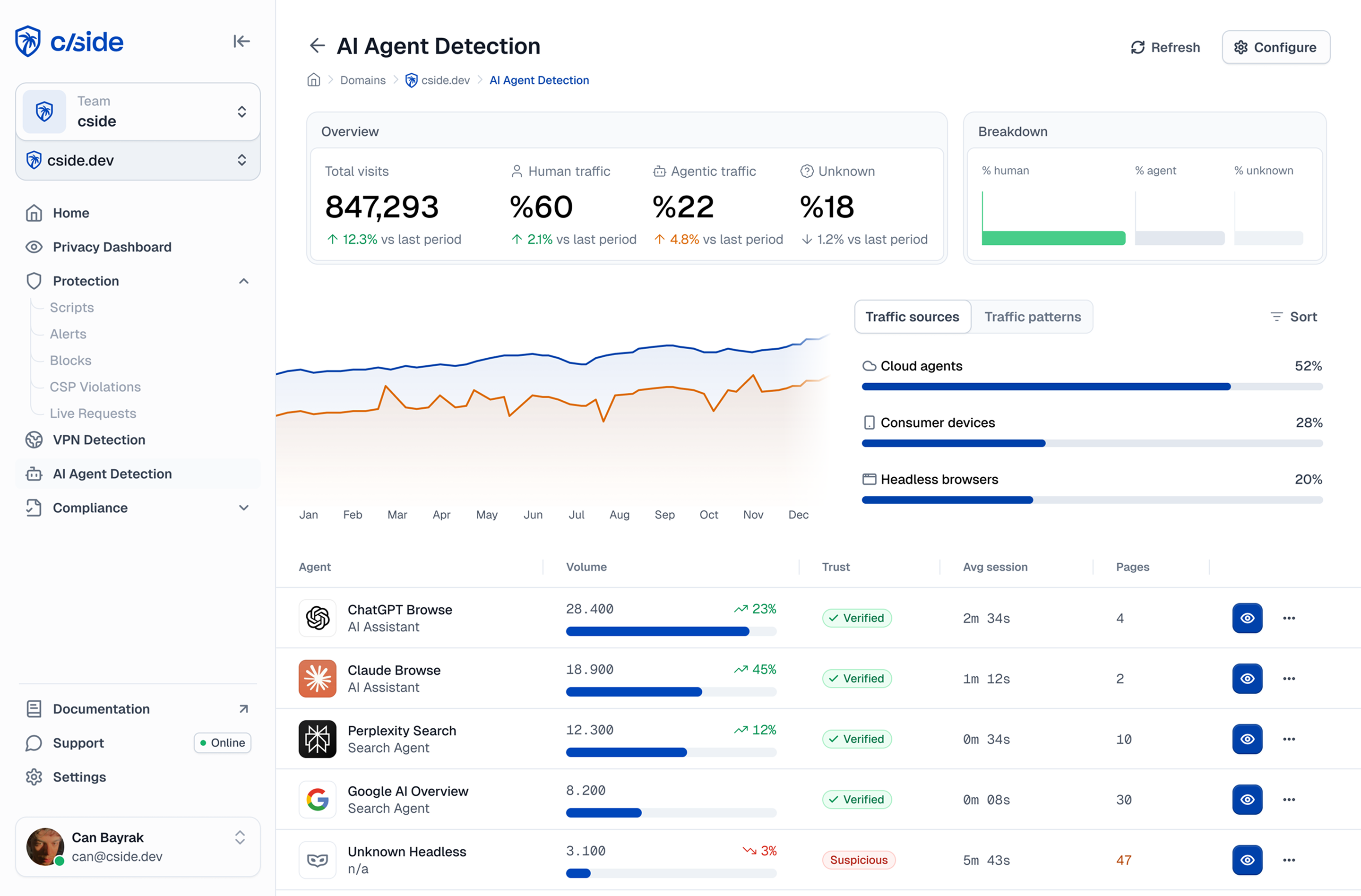
Quick answer: cside is the only browser-native AI agent detection platform purpose-built for this problem. DataDome Agent Trust and HUMAN Security AgenticTrust lead the network-layer category. Imperva, Cloudflare, Akamai, and AWS WAF Bot Control offer broader bot management with varying levels of AI agent-specific capability.
cside
Approach: Browser-layer. cside sits inside the browser session and analyses interaction patterns, timing signals, UI behaviour, fingerprint anomalies, and network requests in real time.
Key capabilities for websites:
- Detects named agents including OpenAI Operator, Amazon Buy For Me, and Perplexity Shopper
- Applies page-level guardrails so product pages, cart, and checkout can carry different policies
- Classifies agent intent and deanonymises AI sessions
- Supports allow, block, and guide actions rather than binary blocking
- Flags VPN and proxy use, fingerprint mismatches, and suspicious timing patterns
- Tracks agentic conversion events for commercial optimisation
Best fit: eCommerce teams and digital product owners who need to govern both fraudulent and legitimate AI agent traffic at the browser level.
Notable gap: Purpose-built for web applications. Not a general-purpose WAF or CDN product.
See how cside compares directly with DataDome, HUMAN Security, Cloudflare, Imperva, and Akamai. The full cside AI agent detection product page covers the browser-layer approach in detail.
DataDome Agent Trust
Detection layer: Network and CDN layer, with dedicated agent classification built on top of their bot protection engine.
DataDome Agent Trust classifies agents into four categories (AI Crawler, AI Assistant, Agentic Browser, and Autonomous Agent) using identity, reputation, and behavioural signals at the network layer.
Best fit: Teams already using DataDome for bot protection who want to extend AI agent coverage without changing vendors.
Notable gap: Network-layer architecture misses browser-side signals. Agents using stealth browsers or residential proxies may still bypass detection.
HUMAN Security AgenticTrust
Detection layer: Network layer, backed by HUMAN's threat intelligence network.
HUMAN AgenticTrust uses cryptographic digital signatures for agent verification alongside session-level visibility into agent actions across the customer journey, from product discovery to checkout.
Best fit: Enterprise teams with existing HUMAN deployments who want AI agent coverage folded into an existing security stack.
Notable gap: Network-layer only. Browser-native agents operating with clean IPs and valid headers remain hard to catch at the edge.
Imperva Advanced Bot Protection
Approach: WAF and network layer. Imperva's bot protection is one of the longest-established in the category and covers a broad range of automated threats.
Key capabilities for websites:
- Extensive bot signature database
- Behaviour-based anomaly detection at the request level
- Integration with Imperva WAF for combined application and bot control
Best fit: Security-led organisations already running Imperva's WAF stack.
Notable gap: Not designed specifically for AI agent classification. AI agent-specific detection is limited.
Cloudflare Bot Management
Approach: CDN and network layer. Cloudflare's bot management uses machine learning models trained on their global traffic to classify requests.
Key capabilities for websites:
- Global IP reputation and pattern matching at CDN scale
- Machine learning scoring per request
- Bot Fight Mode for low-friction deployment
Best fit: Teams already on Cloudflare's network who want baseline bot coverage with minimal integration work.
Notable gap: Network-layer detection has no visibility into in-browser interaction. Agents running inside real browser environments with residential proxies are not reliably caught at the CDN edge.
Akamai Bot Manager
Approach: CDN and network layer. Akamai pairs its edge platform with bot management that scores traffic using behavioural and reputation signals at scale.
Key capabilities for websites:
- Edge-scale traffic analysis across Akamai's network
- Behavioural and reputation-based bot scoring
- Integration with Akamai's broader application security stack
Best fit: Teams already running on Akamai's CDN who want bot coverage close to their existing edge.
Notable gap: Edge and network architecture cannot observe in-browser interaction. Agents inside real browser sessions remain difficult to attribute from the network layer.
AWS WAF Bot Control
Approach: Network layer with a dedicated AI activity dashboard launched in February 2026. AWS now classifies over 650 known bots and agents.
Key capabilities for websites:
- Broad bot signature coverage (650+ bots and agents)
- AI Activity Dashboard for visibility into agent traffic patterns
- Native integration with AWS infrastructure and CloudFront
Best fit: Teams running primarily on AWS infrastructure who want agent visibility without adding a separate vendor.
Notable gap: Coverage is signature-based. Unknown or lightly disguised agents will not appear in the known-agent catalogue. Browser-level signals are not available.
Vendor comparison at a glance
| Tool | Detection layer | Named agent ID | Browser interaction signals | Per-page policy | Allow / guide / block |
|---|---|---|---|---|---|
| cside | Browser | Yes | Yes | Yes | Yes |
| DataDome Agent Trust | Network / CDN | Yes (4 categories) | No | No | Partial (trust score) |
| HUMAN AgenticTrust | Network | Yes (SATORI) | No | No | Partial (session intent) |
| Imperva Advanced Bot Protection | WAF / Network | Limited | No | No | No |
| Cloudflare Bot Management | CDN / Network | Limited | No | No | No |
| Akamai Bot Manager | CDN / Network | Limited | No | No | No |
| AWS WAF Bot Control | Network | Yes (650+ catalogue) | No | No | No |
How to Deploy AI Agent Detection Without Hurting Legitimate Users
Quick answer: Deploy in observe mode first. Spend two to four weeks building a baseline of your agent traffic mix before writing any block rules. Then classify by intent, not just by detection, and apply graduated responses: guide legitimate agents, block abusive ones, and escalate ambiguous sessions for human review.
The false positive problem
Every detection system produces false positives. For an eCommerce site, a false positive on a legitimate shopping agent costs you a transaction and degrades the customer experience, particularly as agentic commerce grows and more users delegate purchases to AI assistants.
A meaningful share of US consumers are already interested in using AI agents to handle transactions in specific categories, according to Forrester. That is not a fringe use case any longer. A website that blocks all agent traffic will increasingly block real commerce.
A layered approach: detect, classify, then decide
The right deployment sequence is:
- Detect all agent traffic, including named commercial agents and unknown headless browsers.
- Classify by intent: is this a shopping assistant, a scraper, a card tester, or something unknown?
- Apply a policy matched to the classification: allow, guide, block, or escalate.
Skipping step two leads to either permissive stances that let fraud through, or aggressive stances that damage conversion rates for legitimate agent-driven purchases. Our guide to choosing an AI agent detection solution walks through this evaluation in more depth.
Layered policy: allow, guide, and block
Any detection platform worth deploying should support a graduated policy model rather than binary allow/block decisions. The framework has three modes: allow known-good agents to proceed, guide ambiguous sessions through controlled paths, and block or escalate sessions with high-confidence fraud signals. Per-page rules are essential. Product pages, cart, and checkout carry different risk profiles and need different policies.
cside implements this model at the browser layer, letting teams define per-page rules matched to the actual risk profile of each site section. A known shopping agent on a product page can be allowed or guided. An unknown agent on a checkout page with fingerprint anomalies can be escalated or blocked.
Special Considerations for eCommerce Websites
Quick answer: Checkout is the highest-risk surface and needs page-specific rules, not site-wide policies. AI agents will initiate real purchases through agentic payment infrastructure, not just browse. The commercial case for letting legitimate agents complete transactions is growing fast, which means detection without classification is insufficient.
Checkout page protection
The checkout page sits at the intersection of the highest conversion value and the highest fraud risk. Card testing, payment credential stuffing, and inventory lock-up attacks all concentrate here. AI agents can run all three at a volume and speed that human-operated fraud cannot match.
Page-level guardrails, separate from your product page policy, are not optional on a checkout flow. An agent that passes detection on the homepage can still be caught and interrogated at the cart or checkout stage if your rules are granular enough.
Agent-enabled shopping assistance versus agent-enabled fraud
Not every agent reaching your checkout is a threat. Visa and Mastercard launched agentic payment infrastructure in 2025 specifically to enable legitimate AI-driven purchases. The job is to distinguish the legitimate transactions from the fraudulent ones, not to decide whether to allow agent-initiated transactions at all.
That distinction requires session-level intent data, not just a network-layer risk score.
Which pages did the agent visit? How did it interact with form fields? Did the timing patterns match a known shopping agent or an unknown headless browser? These signals that give AI agents and stealth browsers away are only available at the browser layer.
The commercial upside of getting this right
Agentic commerce is projected to move into the trillions of dollars of global revenue by 2030, according to McKinsey. Teams that build detection infrastructure now, before agent-driven transactions become mainstream, will be positioned to convert that traffic rather than block it indiscriminately.
The eCommerce teams best placed to benefit will be those running detection that classifies intent, not just presence.