
TL;DR: enterprise AI agent traffic monitoring
- See across properties: For a CISO, the first question is whether you can see agents across dozens of properties. A dashboard that counts blocked requests will not survive an audit that asks which agent did what on which subdomain last quarter.
- Runtime and SIEM export: Forrester renamed the category to Bot and Agent Trust Management Software in Q4 2025 for a reason. cside's controlled testing showed traditional tools missed AI agents in 81 of 100 scenarios, so it reads runtime signals and exports session-level events to Splunk, Sentinel, and CrowdStrike.
- Contract for compliance: If you own PCI DSS or GDPR obligations across multiple properties, demand data residency in the MSA and native SIEM export. If Visa and Mastercard agentic payment infrastructure applies to your checkout, document policy per page before procurement, not after.
Short on time? See cside's AI-agent detection. It covers everything below in one deployment.
AI agent traffic is already happening at scale, across every property enterprise security teams own. For a CISO, the first question is whether you can see it at all: observe which agents are arriving, report on what they are doing across dozens of properties, and trend that activity over time in a way the board and the auditors will accept. As of early 2025, Ahrefs research found that 63% of websites were already seeing traffic arrive via AI chatbot interfaces. The monitoring challenge is structurally different from what tools built for a single site are designed to handle.
If your priority right now is identifying agent traffic on a specific property rather than monitoring it across a fleet, start with our guide to detect AI agent traffic on your website, then return here for the enterprise-scale view.
Enterprise environments face a compounding problem. Multiple web properties, complex API surfaces, tiered checkout flows, and regulatory obligations all demand audit trails rather than simple block lists. You need to understand what agents are doing, not whether they showed up. This guide covers what enterprise-grade AI agent monitoring requires, how the leading platforms perform against those requirements, and the procurement considerations that matter when buying for scale.
The enterprise-scale AI agent problem
Quick answer: AI agent traffic is already arriving at enterprise scale, and the trajectory has continued upward. Enterprises with large web footprints are absorbing that volume across properties that existing network controls were not designed to monitor.
Volume is only part of the problem
The trajectory has continued upward since that measurement. Visa and Mastercard both announced agentic payment infrastructure in 2025, and analysts at McKinsey have projected that agentic commerce could move trillions of dollars annually before the end of the decade. Whatever the precise figure, this traffic is not going to recede.
The harder challenge is that AI agents are not monolithic. OpenAI Operator, Amazon Buy For Me, and Perplexity Shopper each behave differently, and all differ from LLM crawlers or MCP-connected automation. A monitoring architecture that treats all agent traffic as a single category produces signal too coarse to act on. For a deeper breakdown of how these named agents differ and how to tell them apart, see our roundup of the best bot detection software.
Why enterprise environments are particularly exposed
Enterprise web properties span multiple domains, country-specific subdomains, partner portals, and API gateways, each potentially carrying different security controls or none at all. AI agents do not confine themselves to your main site. They follow product links into checkout flows, traverse partner integrations, and hit APIs never designed for public access at scale.
Complex checkout flows are especially vulnerable. An agent that browses, adds items to a basket, and initiates payment is indistinguishable from a high-value human customer, until it behaves like an AI-agent based credit card testing bot and tests multiple payment methods in rapid succession, or extracts price data across thousands of SKUs in a single session.
The compliance and governance dimension
Enterprise security teams are accountable for more than blocking threats. They must demonstrate to regulators, auditors, and boards that they have visibility into machine-to-machine traffic and a documented policy for managing it.
Forrester renamed its coverage category to "Bot and Agent Trust Management Software" in Q4 2025, reflecting how rapidly the threat model has evolved beyond what legacy network controls were designed to handle. That evolution is not an acceptable gap for any enterprise with PCI DSS obligations, GDPR data-handling requirements, or sector-specific compliance frameworks. Monitoring is a prerequisite for governance, and governance is a regulatory requirement.
What enterprise AI agent monitoring requires
Quick answer: Enterprise AI agent monitoring goes well beyond detection. Volume handling at scale, cross-property visibility, policy management, full audit logging, SIEM integration, and contractual SLAs are all baseline requirements. Most point solutions built for SMB or mid-market customers do not meet all of them.
Enterprise-specific requirements include the following:
- Volume handling at scale: the platform must process millions of requests per day without latency impact on production traffic.
- Cross-property visibility: a unified view across all domains, subdomains, and API endpoints, not per-site dashboards.
- Policy management at scale: the ability to define, version, and deploy rules across all properties from a central control plane.
- Agent classification, not just detection: distinguishing between known agents (Googlebot, OpenAI Operator), unknown agents, and malicious bots, with intent scoring for each.
- Audit logging: timestamped, tamper-evident logs of all agent interactions for compliance and incident response.
- SIEM and SOC integration: webhook or API-based export of signals into Splunk, Cribl, Microsoft Sentinel, CrowdStrike, or equivalent platforms.
- Contractual SLAs: uptime guarantees, incident response times, and escalation paths documented in a master services agreement.
- Data residency controls: the ability to specify where agent interaction data is stored and processed, particularly relevant for EU and regulated-sector deployments.
Enterprise requirement vendor assessment table
| Enterprise Requirement | What to Ask Vendors |
|---|---|
| Volume handling | What is your peak requests-per-second capacity? What is the documented latency impact at P99? |
| Cross-property visibility | Can all our domains be managed from a single pane? How are multi-tenant environments handled? |
| Policy management | Can we version-control and roll back detection rules? Is there a staging environment? |
| Agent classification | Do you identify named agents individually (Operator, Buy For Me) or only by category? |
| Audit logging | Are logs tamper-evident? What is the retention period? Can we export to our SIEM? |
| SIEM integration | Which SIEM platforms do you support natively? Is there a REST API for custom integrations? |
| SLA | What is the uptime guarantee? What are the remediation obligations if thresholds are breached? |
| Data residency | Where is detection data processed and stored? Can we specify a region? |
| Vendor maturity | Are you a named vendor in the Forrester "Bot and Agent Trust Management Software" category? |
How the leading platforms handle enterprise AI agent traffic monitoring
Quick answer: The leading platforms differ in detection layer, enterprise feature depth, and named-agent coverage. Network-layer tools are broadly deployed but share a structural limitation: they see headers and IP addresses, not what agents do inside your pages. Browser-layer platforms close that gap but may require additional integration work to fit enterprise security stacks.
cside
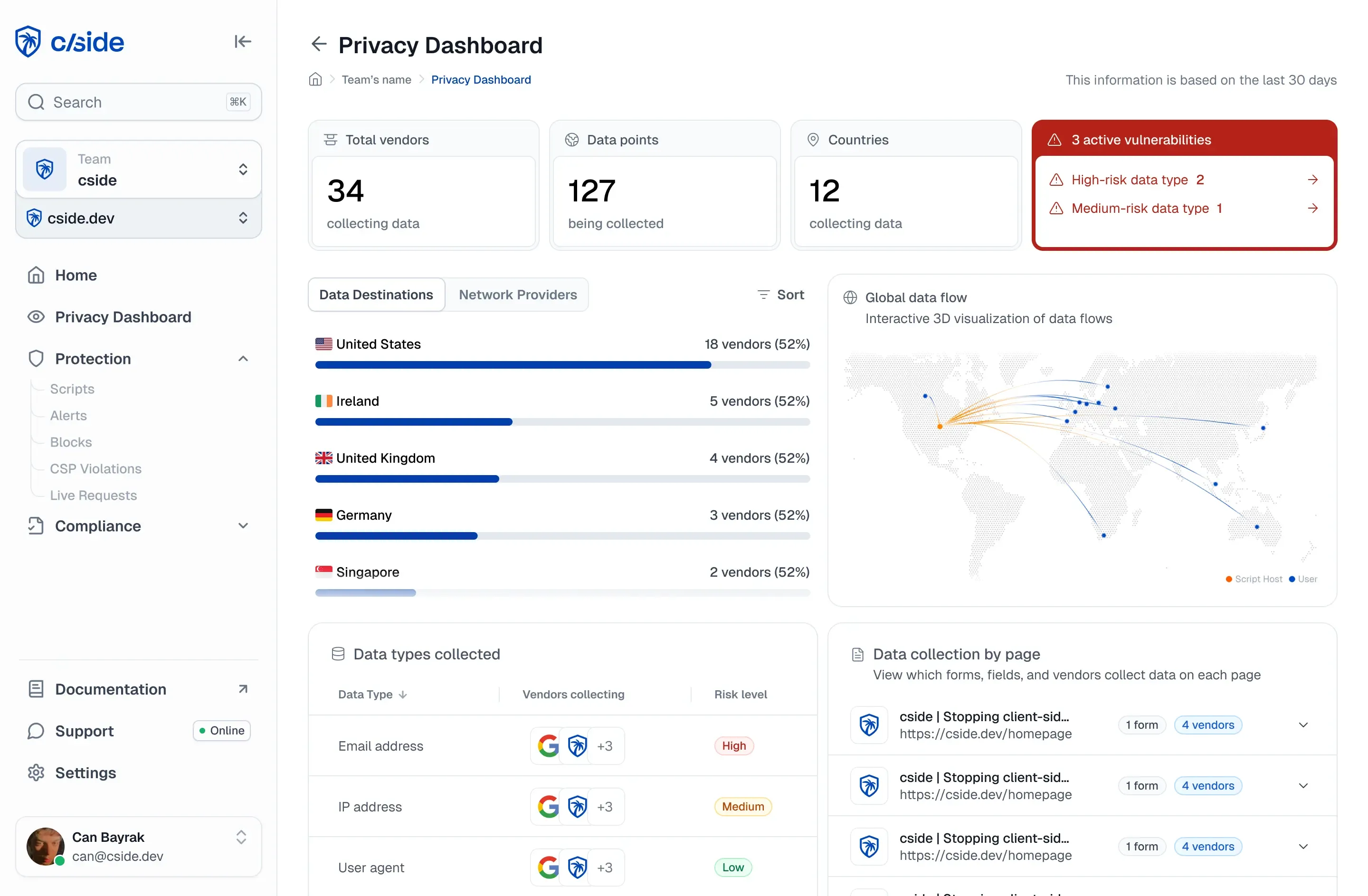
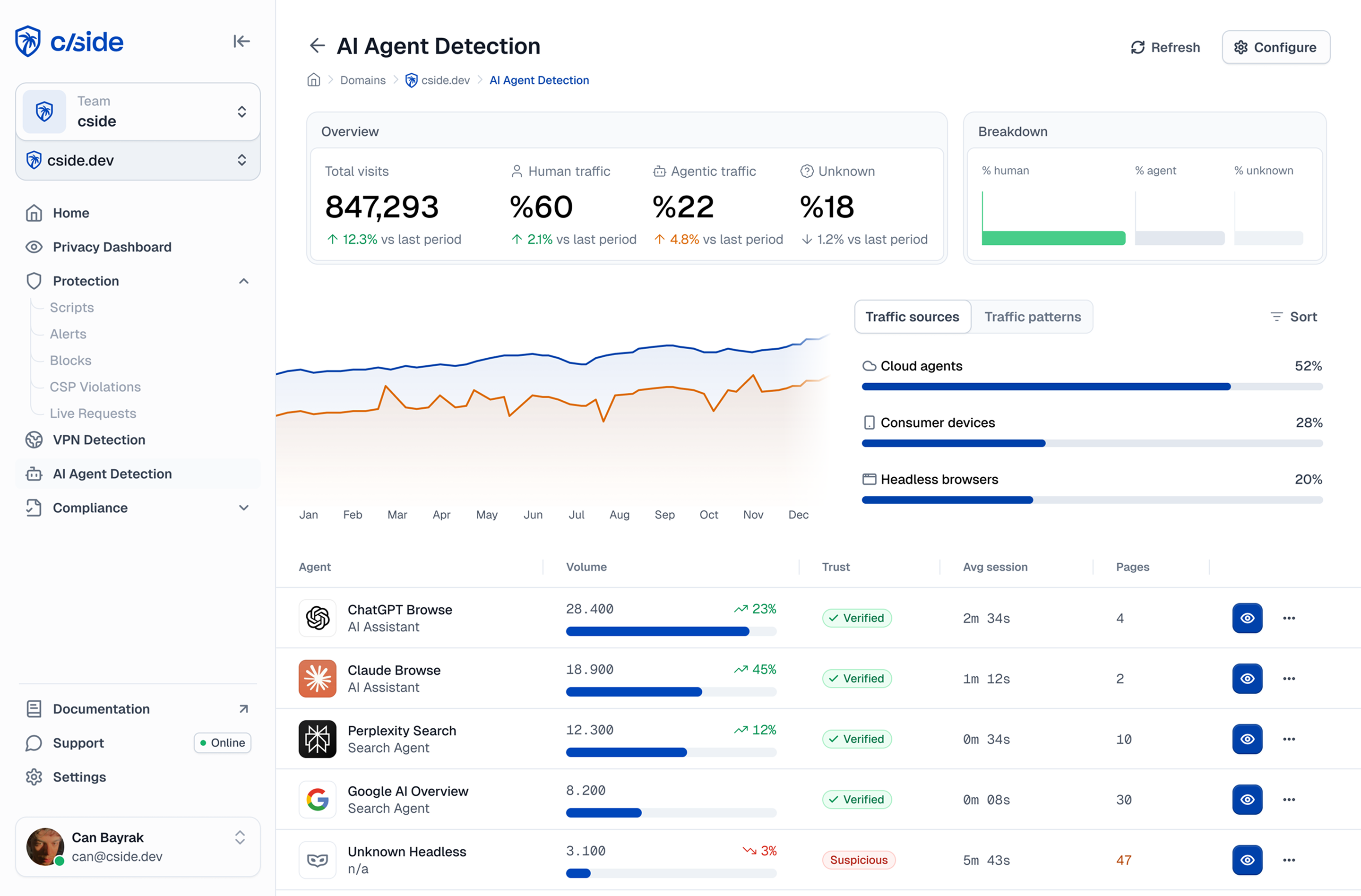
cside operates at the browser layer. Detection happens inside the page, not at the network edge, giving it access to interaction patterns, timing signals, fingerprint mismatches, and UI behaviour that network-layer tools cannot observe. That is also what makes it a monitoring tool rather than a gate: a CISO gets session-level records of what each agent did, not a count of requests that were allowed or denied.
For enterprise deployments, cside provides intent classification, deanonymisation of AI sessions, and custom guardrails configurable per page. Product pages, cart, and checkout can each carry different policies. The allow/block/guide model supports escalation to human approval, directly relevant where an enterprise wants to permit agents to browse but requires human confirmation before a transaction completes.
cside detects named agents including OpenAI Operator, Amazon Buy For Me, Perplexity Shopper, Googlebot, and unknown agents that do not self-declare. In cside's controlled testing, traditional tools missed AI agents in 81 out of 100 controlled test scenarios. That is the gap browser-layer architecture is built to close. To see how cside lines up against the major network-layer vendors below, compare it directly with DataDome, HUMAN Security, Cloudflare, Imperva, and Akamai.
DataDome Agent Trust
DataDome operates at the network and CDN layer. Agent Trust is among the most mature products in terms of volume. It classifies agents into four categories: AI Crawler, AI Assistant, Agentic Browser, and Autonomous Agent. Every session receives a dynamic 100-point Agent Trust score based on identity strength, reputation, and behavioural intent. Identity signals include DNS and IP ranges, Web Bot Auth cryptographic signatures, and Know Your Agent (KYA) frameworks. Agent Trust is included in all Bot Protect plans at no additional cost.
The limitation at enterprise scale is the same as all network-layer tools: DataDome cannot see what happens inside the page.
HUMAN AgenticTrust
HUMAN Security's AgenticTrust combines network-layer detection with SATORI threat intelligence and cryptographic digital signature verification, providing session-level visibility across the customer journey. SOC teams benefit from threat actor correlation across advertising, applications, and payment fraud.
Enterprise integration is well supported through HUMAN's customer base in financial services and e-commerce. The platform does not operate at the browser layer, so the structural gap for dynamic page interactions remains.
Imperva Advanced Bot Protection
Imperva delivers bot protection via its WAF and network infrastructure. For enterprises already running Imperva for DDoS or application security, adding bot protection to the existing deployment is operationally straightforward. Imperva's enterprise licensing includes SLAs, data residency options, and SIEM integration. The browser-layer gap remains.
Akamai Bot and Abuse Protection
Akamai's bot protection runs on its CDN, giving it extensive reach. The platform published agentic AI guidance in October 2025. For enterprises already using Akamai for content delivery, the integration path is well defined.
Akamai's enterprise support model, contractual flexibility, and global infrastructure make it a viable candidate for large deployments. Detection is network-layer. Intent classification and named-agent identification are less granular than browser-layer alternatives.
AWS WAF Bot Control
AWS WAF Bot Control integrates natively with the existing IAM, CloudWatch, and Security Hub stack for enterprises running workloads on AWS, and AWS has added agent-focused activity reporting to its WAF tooling. The reporting surfaces which agents are hitting AWS-hosted properties and covers the major named agents. Detection remains at the WAF layer. The tool is most effective for API and origin-layer traffic rather than client-side browser sessions.
Platform comparison at a glance
| Capability | cside | DataDome | HUMAN | Imperva | Akamai | AWS WAF |
|---|---|---|---|---|---|---|
| Detection layer | Browser | Network / CDN | Network | Network / WAF | Network / CDN | WAF |
| Named agent identification | Yes | Yes (4 categories) | Yes (SATORI) | Partial | Partial | Yes |
| Unknown agent detection | Yes (behavioural) | Partial | Partial | Partial | Partial | Partial |
| In-page behavioural signals | Yes | No | No | No | No | No |
| Per-page governance | Yes | No | No | No | No | No |
| Session intent classification | Yes | Partial | Yes | No | No | No |
| Audit logging for compliance | Yes | Yes | Yes | Yes | Yes | Yes (CloudWatch) |
| Native SIEM export | Yes | Yes | Yes | Yes | Yes | Yes (Security Hub) |
Browser-layer vs network-layer monitoring at enterprise scale
Quick answer: Most enterprises already have network-layer tools in place. The browser layer is where the monitoring gap lives. Autonomous AI agents click, scroll, fill forms, and trigger JavaScript exactly as users do. Those signals are only visible from inside the browser environment. Browser-layer monitoring is additive, not a replacement for existing network controls.
The blind spot in complex web applications
Network tools see the request. Browser-layer tools see what happens after the request is served. In a multi-step checkout, a dynamic product configurator, or a login flow with progressive disclosure, the most informative signals about agent behaviour occur after the page loads.
An AI agent that loads a product page, waits for JavaScript to resolve, scrolls through specifications, and adds an item to a basket looks like a user at the network layer. Interaction timing, the absence of mouse movement entropy, fingerprint characteristics, and the specific sequence of UI events are only visible to a tool with access to the browser.
What this looks like in practice: Consider an OpenAI Operator session targeting a mid-market electronics retailer. The agent loads the product detail page over a residential proxy IP, waits for JavaScript to fully render (replicating the pause a human would take while reading), scrolls through three specification sections, and adds a high-value item to the basket. At the network layer, the WAF logs a single clean session from an unblacklisted IP with a standard Chrome user-agent and no rate anomalies. It passes every legacy rule. cside reads a baseline of 250+ browser, device, and network signals per session, enough to tie the session to the device behind it and hold a persistent fingerprint as the agent moves through the funnel. At the browser layer, cside's instrumentation detects the absence of natural mouse movement entropy between scroll events, identifies the IP range as associated with OpenAI infrastructure, matches the interaction timing signature to LLM reasoning latency, and flags a fingerprint inconsistency between the declared Chrome version and the actual rendering behaviour. The session is classified as an autonomous agent and routed through the enterprise's configured checkout guardrail, requiring human confirmation before the transaction proceeds. The network tool saw nothing. The browser layer caught it at the moment of intent, and logged the whole sequence for later review.
For the CISO, that log is the point. Monitoring covers more than real-time enforcement. It is the trend line that shows which agents are growing as a share of traffic, which properties they concentrate on, and whether a new agent type has appeared since last quarter. In cside's controlled testing, traditional tools missed AI agents in 81 out of 100 controlled test scenarios. The gap is architectural: network-layer tools cannot see inside the browser session where agents operate, so they cannot report on it either.
Integration considerations for enterprise SIEM and SOC teams
Browser-layer detection generates a different class of signal than network tools. Interaction timing, DOM event sequences, and fingerprint anomalies are not natively understood by Splunk or Sentinel without configuration. Enterprise SIEM integration from a browser-layer platform typically requires a structured event export that maps agent session signals to common event formats.
When evaluating browser-layer vendors, SOC teams should request documented integration guides for their specific SIEM platform, example event schemas, and reference deployments at comparable scale. Signal quality from browser-layer tools is high, but it requires configuration before it becomes actionable in an existing SOC workflow.
The most effective architecture is complementary: network-layer tools handle known bad actors at the edge, while browser-layer tools classify intent and analyse behaviour for traffic that passes initial network checks.
Building an AI agent monitoring policy for enterprise
Quick answer: An effective enterprise AI agent monitoring policy runs through four stages: inventory what agents are hitting your properties, classify what they are doing, score trust or risk, then govern with allow/guide/block decisions backed by a full audit trail. Each stage requires tooling, process, and clear accountability.
The inventory-classify-score-govern framework
Inventory: Establish visibility across all properties. Which domains and APIs are receiving agent traffic? Which named agents are present? Are there unknown agents that match no known signature? Without a complete inventory, policy decisions rest on incomplete information.
Classify: For each agent or category, determine intent. Is this a legitimate shopping agent acting on behalf of a customer? An LLM crawler indexing content? A scraper extracting pricing data at scale? Intent classification is where most network-layer tools fail, because intent is expressed through behaviour inside the page. Our breakdown of bot versus AI agent detection platforms covers how vendors draw these distinctions.
Score: Assign a trust or risk score to each session based on classification signals, known agent identity, and contextual factors such as request volume, pages visited, and checkout attempts. Scoring enables graduated responses rather than binary block decisions.
Govern: Apply policy based on score. Allow permits the session to proceed. Guide routes the agent through a modified flow, requiring CAPTCHA confirmation at checkout or a terms-of-service acceptance before bulk pricing is accessible. Block terminates the session. Every decision should generate an audit log entry. If you are building this framework from scratch, our walkthrough on how to choose an AI agent detection solution maps these stages onto concrete vendor capabilities.
cside's allow/block/guide model in enterprise context
cside's control model maps directly onto this framework. Per-page guardrails let an enterprise apply different policies at different points in the user journey. A shopping agent can be permitted to browse product pages, guided through a confirmation step at the cart, and blocked from automated checkout completion. That granularity matters: the payment infrastructure for AI agents that Visa and Mastercard announced in 2025 makes checkout-layer policy a live commercial and compliance question right now. cside's product approach is described on the AI agent detection solution page.
Governance considerations for agentic commerce
The question of whether an enterprise permits AI agents to transact on behalf of customers has moved from product roadmap to governance requirement. Enterprises need a documented policy position on agentic transactions: what is permitted, what requires human confirmation, and what is prohibited. That policy must be technically enforceable, auditable, and revisable as the regulatory environment develops.
Procurement considerations for enterprise AI agent monitoring
Quick answer: Enterprise procurement for AI agent monitoring must address five areas beyond feature comparison: contract terms and data rights, SLA commitments, data residency, vendor maturity and roadmap, and alignment with the Forrester category definition. Skipping these leads to operational problems after deployment.
Enterprise procurement teams should evaluate the following:
- Contract terms and data rights: who owns the agent interaction data generated during monitoring? Can the vendor use it to train models or improve products without your consent? Ensure data rights are explicit in the MSA.
- SLAs: what uptime is guaranteed? What are the credits or remediation obligations if SLAs are breached? At enterprise scale, a monitoring outage during a high-traffic event has direct commercial consequences.
- Data residency: for EU-based enterprises or those operating in regulated sectors, the location of processing and storage for agent interaction data must be specified and contractually guaranteed. GDPR obligations apply to this data.
- Vendor maturity: the "Bot and Agent Trust Management Software" Forrester category (Q4 2025) provides a useful framework for assessing vendor maturity. Vendors named in Forrester research have undergone independent validation of their capabilities and market position.
- Roadmap alignment: AI agent behaviour is evolving rapidly. MCP-connected agents, multi-model orchestration, and agentic payment flows are changing the threat surface quarterly. Evaluate vendors on their published roadmap and their track record of keeping pace with agent capability changes.
- Proof of concept terms: request a time-bounded proof of concept against your production traffic before committing to a multi-year contract. A tool that performs well in a vendor demo environment may behave differently against your specific property mix and traffic patterns.
- Integration support: enterprise deployments require dedicated implementation support. Confirm what professional services are included, what the implementation timeline looks like, and what escalation paths are available during and after deployment.
Forrester's formal recognition of "Bot and Agent Trust Management Software" as a category means analyst validation is available to support internal procurement justifications. CISOs and procurement teams can use this category definition as a baseline for vendor evaluation criteria.