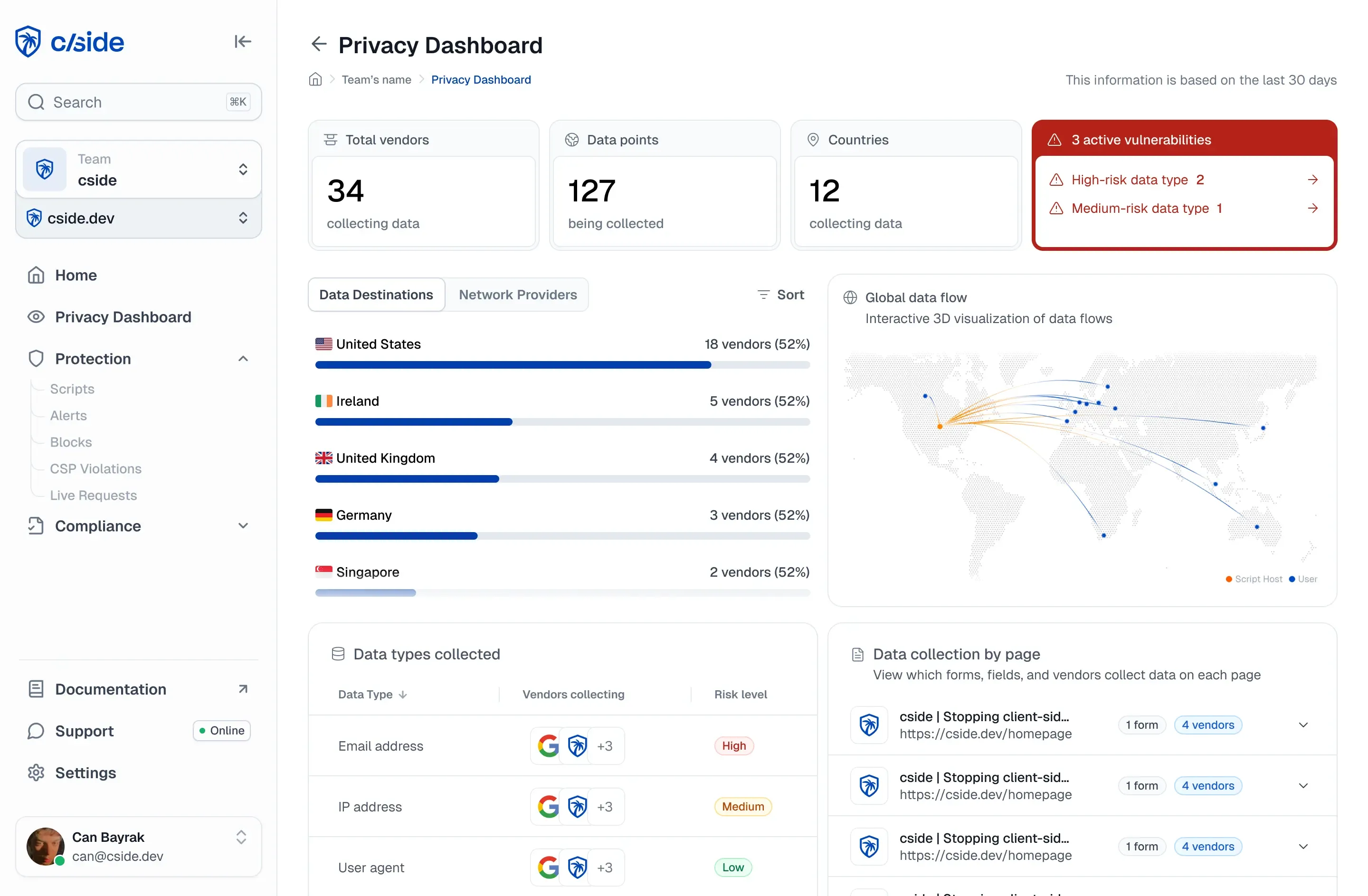
AI agents are not browsing your site for information any more. They are checking out, testing payment cards, creating accounts at scale, and scraping prices to undercut you by morning. As of early 2025, Ahrefs research found that 63% of websites were already seeing traffic arrive via AI chatbot interfaces. Visa and Mastercard both launched agentic payment infrastructure in 2025. McKinsey projects $3 to $5 trillion in global revenue flowing through agentic commerce by 2030. Gartner predicts that 80% of product searches will be conducted through agentic AI by 2030, with 20% of online purchases completed by AI agents. The commercial infrastructure is already live.
If you run fraud operations, the question in front of you is narrower: which AI agent detection software is worth paying for? Most teams are still running detection stacks built for scripted bots, not for agents that reason, adapt, and mimic human behaviour inside a live browser session. Vendor claims are loud, and the gap between marketing and runtime detection is wide.
There is also a labelling problem. Most software now sold as "AI agent detection" is repurposed bot detection with a new product name. The underlying mechanisms (network-layer inspection, IP reputation scoring, user-agent matching) were not built for the current generation of agents. The detection gap is architectural, not configurational, and it should make any fraud team pause before renewing a licence.
This guide evaluates the leading tools on the market: what they actually detect, where they fail, and what genuine AI agent detection requires at the browser layer. If you want a wider survey of the same vendors framed around fraud prevention, see our companion guide to the best tools for AI agent detection to prevent website fraud.
What AI Agent Detection Software Actually Needs to Do
Quick answer: At minimum, AI agent detection software must go beyond IP and header inspection. It needs to identify named commercial agents, classify session intent, detect browser-layer mimicry, and give operators per-page controls. Tools that only score requests at the network edge will miss agents designed to look like legitimate users.
Minimum detection capabilities
A tool earns the label "AI agent detection" only if it can do the following.
- Identify known named agents such as OpenAI Operator, Amazon Buy For Me, and Perplexity Shopper by their actual infrastructure and session behaviour, not just by self-declared user-agent strings.
- Detect unknown or unnamed agents through timing anomalies, fingerprint mismatches, and interaction pattern analysis.
- Classify session intent so operators can distinguish a shopping agent from a scraper or a card-testing bot.
- Apply controls at a granular level, for example different guardrails on a product page versus a checkout flow.
Network-layer vs browser-layer detection
The table below shows where the gap is.
| Capability | Network-layer tools | Browser-layer tools |
|---|---|---|
| IP signature matching | Yes | Yes |
| User-agent and header inspection | Yes | Yes |
| Known LLM infrastructure detection | Partial | Yes |
| Timing pattern analysis | No | Yes |
| Browser fingerprint consistency checks | No | Yes |
| UI interaction behaviour analysis | No | Yes |
| VPN and residential proxy detection | Partial | Yes |
| Per-page custom guardrails | No | Yes |
| Session intent classification | No | Yes |
| Named agent identification | Partial | Yes |
| Escalation to human approval | No | Yes |
| Deanonymisation of unknown agents | No | Yes |
Network-layer tools see the front of the envelope. Browser-layer tools read what is inside. If you want a structured way to turn this distinction into a shortlist, our guide on how to choose an AI agent detection solution walks through the same evaluation in buying terms.
The Tools Most Commonly Evaluated
Quick answer: The AI agent detection market is new and vendor claims vary widely. Most established players have extended existing bot protection products rather than built from the browser layer up. Evaluate each tool on what it can observe at runtime, not on what its marketing page says it covers.
This is a breakdown of the tools fraud teams most commonly consider, ordered by how much of the runtime picture each one can see.
cside
Core approach: Browser-layer detection and agent trust management. cside operates inside the session rather than at the network edge.
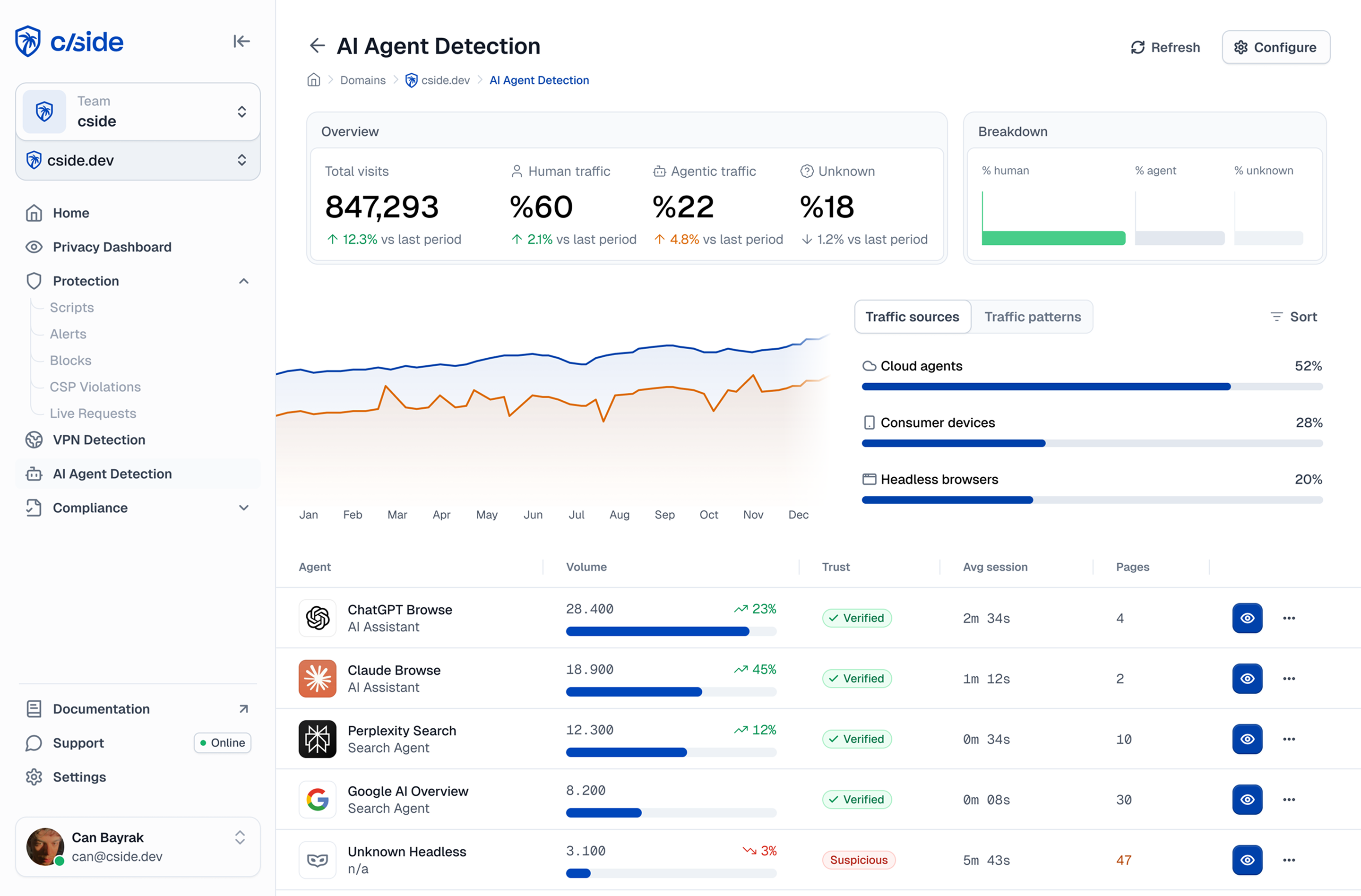
What it detects: OpenAI Operator, Amazon Buy For Me, Perplexity Shopper, Googlebot, and unidentified agents. Detection signals include IP signatures from LLM platforms, timing patterns, browser fingerprint mismatches, suspicious network requests, VPN and proxy indicators, and UI interaction analysis.
Key strength: The only platform in this comparison that classifies session intent and enforces custom guardrails per page type (product, cart, and checkout). It supports deanonymisation of unknown agents and escalation to human approval. It also covers commercial use cases such as agentic conversion tracking and checkout guardrails for legitimate agent commerce.
Key gap: Newer to market than the network-layer incumbents. The enterprise sales motion is still developing.
You can read more on the cside AI agent detection page. For head-to-head detail against the network-layer incumbents, see how cside compares with DataDome, HUMAN Security, Cloudflare, Imperva, and Akamai.
DataDome Agent Trust
Core approach: Network-layer. DataDome applies a multi-signal classification model to identify and score AI agent sessions at the request layer.
What it detects: Known crawlers and LLM-based agents across four categories (AI Crawler, AI Assistant, Agentic Browser, and Autonomous Agent). Identity signals include DNS and IP ranges plus client and server-side signals.
Key gap: Network-layer architecture cannot observe inside the browser session. Agents routing through residential proxies or spoofing standard browser fingerprints are harder to catch at the edge.
HUMAN Security AgenticTrust
Core approach: Network-layer, backed by a cross-vertical threat intelligence network. HUMAN has deep experience in sophisticated bot detection across advertising and payment fraud.
What it detects: Agents operating from known infrastructure, coordinated bot activity, and fraudulent automation. AgenticTrust applies cryptographic agent verification and provides session-level visibility across the customer journey from product discovery to checkout.
Key gap: Session-level blind spots remain. Browser-based agents mimicking human interaction patterns are not fully covered at the network edge.
Imperva Advanced Bot Protection
Core approach: WAF and network-layer. Imperva's bot protection sits upstream of the application, inspecting requests before they reach the server.
What it detects: Scripted bots, known bad IP ranges, and agents matching signature libraries.
Key gap: WAF positioning means it cannot see browser-layer session data. Intent classification is not available.
Cloudflare Client-Side Security
Core approach: CDN and network-layer, with a client-side script-monitoring component. Cloudflare detects automated traffic at the edge and surfaces information on the third-party scripts running in the page.
What it detects: High-volume automated traffic, known bot signatures, and changes to client-side scripts and connections on monitored pages.
Key gap: Edge detection inherits the same blind spots as any network-layer approach for agents that arrive clean. Session intent classification of AI agents is not its primary function.
Akamai Bot and Abuse Protection
Core approach: CDN-layer. Akamai detects bots based on network characteristics, request timing at the CDN level, and known bot signatures.
What it detects: High-volume automated traffic, known scraper signatures, and some behavioural anomalies based on CDN-visible patterns.
Key gap: CDN-layer detection inherits the same blind spots as any network-layer approach. It cannot classify intent or observe browser-level mimicry.
AWS WAF Bot Control
Core approach: Managed rule group within AWS WAF. It includes an AI Activity Dashboard and tracks over 650 bots.
What it detects: Bots on AWS's managed list, common crawler signatures, and targeted bot categories through the targeted inspection tier.
Key gap: Coverage depends heavily on whether the agent self-identifies or operates from a trackable IP range. Unknown or novel agents operating from clean infrastructure will not be caught.
Vendor comparison at a glance
| Vendor | Detection layer | Named agent ID | Session intent classification | Per-page guardrails |
|---|---|---|---|---|
| cside | Browser | Yes | Yes | Yes |
| DataDome Agent Trust | Network / edge | Yes (4 categories) | No | No |
| HUMAN Security AgenticTrust | Network | Yes | Yes (session-level) | No |
| Imperva Advanced Bot Protection | WAF / network | Partial | No | No |
| Cloudflare Client-Side Security | CDN / network | Partial | No | No |
| Akamai Bot and Abuse Protection | CDN | Partial | No | No |
| AWS WAF Bot Control | Network | Partial | No | No |
Where Most AI Agent Detection Tools Fall Short
Quick answer: The core failure is architectural. Network-layer tools cannot see inside a browser session. Agents that mimic human interaction, rotate through residential proxies, or arrive with clean fingerprints pass through network inspection largely undetected. Adding intent governance on top of signature-matching is not possible when the session itself is invisible.
Forrester's Q4 2025 category rename to "Bot and Agent Trust Management Software" reflects the gap between current detection tooling and the problem it now needs to solve. That failure has a specific cause: most detection happens at the edge, before there is enough session data to make a meaningful classification.
Why mimicry defeats signature-based detection
AI agents are not scrapers running fixed request patterns. The current generation (OpenAI Operator, Perplexity Shopper, Amazon Buy For Me) launches from real browser environments, follows normal page load sequences, and can be configured to slow down and randomise behaviour to match human timing profiles.
A network-layer tool receives a request, checks it against known bad IPs, inspects the user-agent string, and scores the request. An agent arriving from a clean residential IP with a standard Chrome user-agent and a realistic request cadence will score as human at the network edge. The people building these agents design them around exactly that blind spot.
cside's own engineers deployed AI agent-based bots against two major bot detection platforms and found that traditional tools missed AI agents in 81 out of 100 controlled test scenarios. That failure rate is not a fringe case. It reflects how agents are designed today.
What the detection gap looks like for a fraud team
Take a card-testing scenario against a subscription e-commerce checkout. An AI agent, configured to rotate residential IPs and vary submission timing between 4 and 12 seconds per attempt, launches a series of small-value payment attempts across 40 stolen card numbers. Each attempt originates from a different residential IP, uses a standard Firefox user-agent, and falls well below any per-IP rate limit threshold. The network-layer WAF sees 40 isolated requests, each clean by every signature check, and passes them all. The fraud team's chargeback queue fills overnight.
At the browser layer, the picture is entirely different. Each session shows zero hover events on form labels, a typing cadence with sub-100ms keystroke intervals, and identical DOM traversal sequences across all 40 sessions. cside's browser instrumentation identifies the shared interaction fingerprint, correlates the sessions, and flags the cluster as coordinated card-testing activity in real time, long before a chargeback is triggered. The fraud team receives a session-level report identifying the agent type, the page path, and the number of attempts, rather than a list of declined transactions after the fact.
Why blocking alone is insufficient
Blocking is a binary response. It stops the session and moves on. For AI agents, that approach is increasingly inadequate on two counts.
First, not all AI agents are malicious. A shopping agent completing a legitimate transaction on behalf of a verified customer is something merchants should want to enable, not block. Blocking indiscriminately will damage conversion as agentic commerce scales. Forrester research found that 36% of US consumers are interested in using AI agents to handle transactions in specific categories. That is a material share of future purchasing behaviour.
Why classification must come before a decision
Second, blocking without classification means you learn nothing. If you cannot identify which agent type arrived, what it was attempting, and whether it succeeded, you cannot improve your defences or understand your fraud surface.
Effective AI agent detection requires classification first, then a decision. The response options are:
- Allow: verified agent acting on behalf of a legitimate user
- Block: agent matching known malicious patterns
- Guide: unknown agent routed to a sandboxed or verified flow
- Escalate: ambiguous session flagged for human review
That decision should be configurable per page and per agent type. A checkout page needs different rules than a product listing page.
What Fraud Teams Specifically Need from AI Agent Detection Software
Quick answer: Fraud teams need detection that maps to specific fraud vectors, not general bot scores. Each fraud type requires a different layer of visibility. Card testing and account fraud require browser-layer intent analysis. Scraping and scalping need real-time session classification. CAPTCHA bypass requires fingerprint and interaction analysis that sits below the CAPTCHA layer itself.
The following fraud types are most directly amplified by AI agents in 2026, along with what each requires from a detection layer.
-
Card testing at checkout. Agents submit card numbers in rapid succession, often with randomised amounts and billing details. Network-layer detection catches high-volume requests from single IPs. Browser-layer detection is needed to catch agents that throttle their rate, rotate proxies, and simulate natural checkout behaviour between attempts. Intent classification at the checkout page is the only way to reliably identify a card-testing session that looks human at the network level.
-
Account creation fraud. Agents create accounts using generated or stolen identity data at scale. Stopping AI-powered fake account creation requires browser-layer fingerprinting to identify device reuse across accounts, timing analysis to flag non-human form completion speeds, and VPN and proxy detection to surface coordinated infrastructure. Network scoring alone misses agents that rotate clean residential IPs per account.
-
Scraping for competitive pricing. Agents systematically pull product and pricing data to feed competitor intelligence tools. Detection needs real-time session classification to identify scraping patterns, and per-page guardrails to restrict data access on product listing pages without affecting real buyers. Network-layer tools can block known scraper IPs but miss agents operating from distributed clean infrastructure.
-
Scalping and inventory manipulation. Agents hold items in carts or complete purchases at scale for resale. This requires cart and checkout page guardrails with intent classification, so the system can distinguish a legitimate rapid purchase from an agent holding inventory. Browser-layer interaction analysis is necessary to catch agents that simulate normal cart behaviour.
-
CAPTCHA bypass. Modern agents use vision models to solve CAPTCHAs, or route challenges to human solvers. Detection cannot rely on CAPTCHA alone. Browser-layer signals (fingerprint consistency, pre-CAPTCHA interaction patterns, and timing data) are needed to flag sessions that are likely agent-driven before the CAPTCHA is even presented.
Each of these fraud types requires detection below the network layer. A WAF or CDN solution will catch the unsophisticated edge of each category. The rest gets through.
How to Assess Whether a Tool Is Actually Detecting AI Agents
Quick answer: The most reliable test is to run a modern agent through a residential proxy with a spoofed fingerprint and see whether the tool catches it. If it does not, the tool is signature-based only. Ask vendors for per-session intent logs, named agent classifications, and false-negative rates in controlled tests, not just aggregate block counts.
Evaluation criteria
When assessing any AI agent detection tool, ask the following questions.
- Can it identify named agents by name, not just by broad category?
- Does it produce per-session intent classifications, or only aggregate traffic scores?
- Can it detect an agent arriving from a clean residential IP with a valid browser fingerprint?
- Does it provide per-page governance controls, or a single site-wide block or allow rule?
- Can it differentiate a legitimate shopping agent from a malicious scraper or card tester?
- Does it support escalation workflows for unknown or ambiguous agents?
- What is the false-negative rate against agents that use browser automation with human-mimicry features?
Red flags to watch for
- The vendor cannot demonstrate detection of a modern headless browser agent routed through a residential proxy.
- Detection relies entirely on user-agent string matching or IP reputation lists.
- The product dashboard shows block counts but no session-level classification or intent data.
- The vendor conflates LLM crawler detection with AI agent detection. Crawlers and transactional agents are different threat types.
- No per-page granularity. A product that applies the same rule to a homepage and a payment page is not built for fraud operations.
What good detection looks like in practice
A well-functioning AI agent detection deployment produces session-level records that identify the agent type, classify what it was attempting, note which signals triggered the classification, and log what action was taken. Fraud operations teams can query those records to understand which agent types are active, which fraud vectors they are probing, and whether their guardrails are firing correctly.
It also supports a commercial allow-list. As agentic commerce grows, blanket blocking becomes a revenue problem. A mature platform lets you allow verified shopping agents at checkout while blocking unverified agents on the same page. That distinction requires browser-layer visibility. A network tool cannot make it. For a category-level view of how these platforms line up, see our roundup of the best bot and agent trust management platforms compared.