AI agents are no longer an edge case. OpenAI Operator, Amazon Buy For Me, Perplexity Shopper, and a growing number of unnamed autonomous agents are hitting web applications at scale, executing tasks that look nothing like traditional human browsing or legacy bot traffic.
Most detection tooling was not built for them. According to cside research, traditional bot detection tools missed AI agents in 81 out of 100 controlled test scenarios. For web applications, the risk is concentrated on individual page surfaces: login, product, cart, and checkout. As of early 2025, the majority of websites were already seeing traffic arrive via AI chatbot interfaces, according to Ahrefs research, and Gartner predicts that agentic AI will drive a large share of product searches by 2030.
This guide covers what AI agent detection actually means for a web application, how the leading tools approach the problem differently, and how to choose the right solution for the surfaces that matter most. For a narrower, traffic-first walkthrough, see our guide to detecting AI agent traffic on your website.
What is AI agent detection and why does it matter for web applications?
Quick answer: AI agent detection identifies autonomous software agents, driven by large language models, that interact with web applications without a human in the loop. Unlike legacy bots, these agents reason, adapt, and mimic human behaviour in ways that bypass traditional bot defences. For any web app handling sensitive transactions, inventory, or content, undetected agent activity translates directly into fraud, data loss, and competitive exposure.
Why AI agents break traditional detection
AI agent traffic differs from the bot traffic that detection tools were designed to catch. A rule-based scraper follows predictable patterns. An LLM-powered agent adapts its strategy mid-session, retries failed steps, solves CAPTCHAs, and makes contextual decisions about which page elements to interact with.
Web applications are exposed at every critical surface. Login flows can be targeted for credential stuffing. Product pages are scraped to feed competitor pricing engines. Cart and checkout flows are exploited for card testing and scalping. Content APIs are mined to train or feed other AI systems.
The Merchant Risk Council reports that first-party misuse represents a large share of all fraud-related chargebacks for member merchants, a growing attack surface now increasingly exploited by AI agents rather than manual operators.
Forrester renamed its bot management coverage category to "Bot and Agent Trust Management Software" in Q4 2025, reflecting how rapidly the threat model has evolved and why legacy bot tools miss AI agents. McKinsey projects that several trillion dollars in global revenue will be orchestrated by agentic commerce by 2030, meaning the volume of agent traffic hitting your web properties is only going to increase.
The difference between bot detection and AI agent detection
Traditional bot detection looks for signatures that have remained relatively stable for years: known crawler user agents, high-velocity request patterns, missing browser APIs, suspicious header combinations, and IP addresses belonging to data-centre ranges.
AI agents break most of these assumptions. They run inside real browser environments, generate plausible interaction timing, use residential or rotating proxies, and produce the same browser fingerprints as genuine users. The signals that reliably identify them are different in nature: LLM platform IP ranges, reasoning-shaped timing gaps between actions, mismatches between declared and behavioural fingerprints, and the specific sequence of network requests an agent makes when exploring a page's structure.
Detection tools that rely solely on network-layer signals will miss the majority of sophisticated agents. Effective detection requires visibility inside the browser session itself.
What this looks like in practice
Consider an OpenAI Operator session targeting a mid-market fashion retailer. The agent launches inside a real Chromium environment, navigates to a product listing page, scrolls through results, selects a size, and adds the item to cart, all within natural timing ranges designed to mimic a human shopper. At the network layer, the request arrives from a residential IP with a standard Chrome user-agent and a realistic TLS fingerprint. Every network-layer check passes. The WAF sees a clean request. The CDN assigns a low bot-risk score. But inside the browser, the agent's DOM interaction sequence follows a non-human pattern: it accesses structured data attributes directly, skips hover states that a real user would trigger, and fires a sequence of network calls that map precisely to the page's product data schema rather than to visual browsing. cside's browser-layer instrumentation catches this fingerprint mismatch and the anomalous interaction pattern, classifying the session as an autonomous agent before checkout is reached. A network-only tool would have let it through entirely.
How AI agent detection tools work
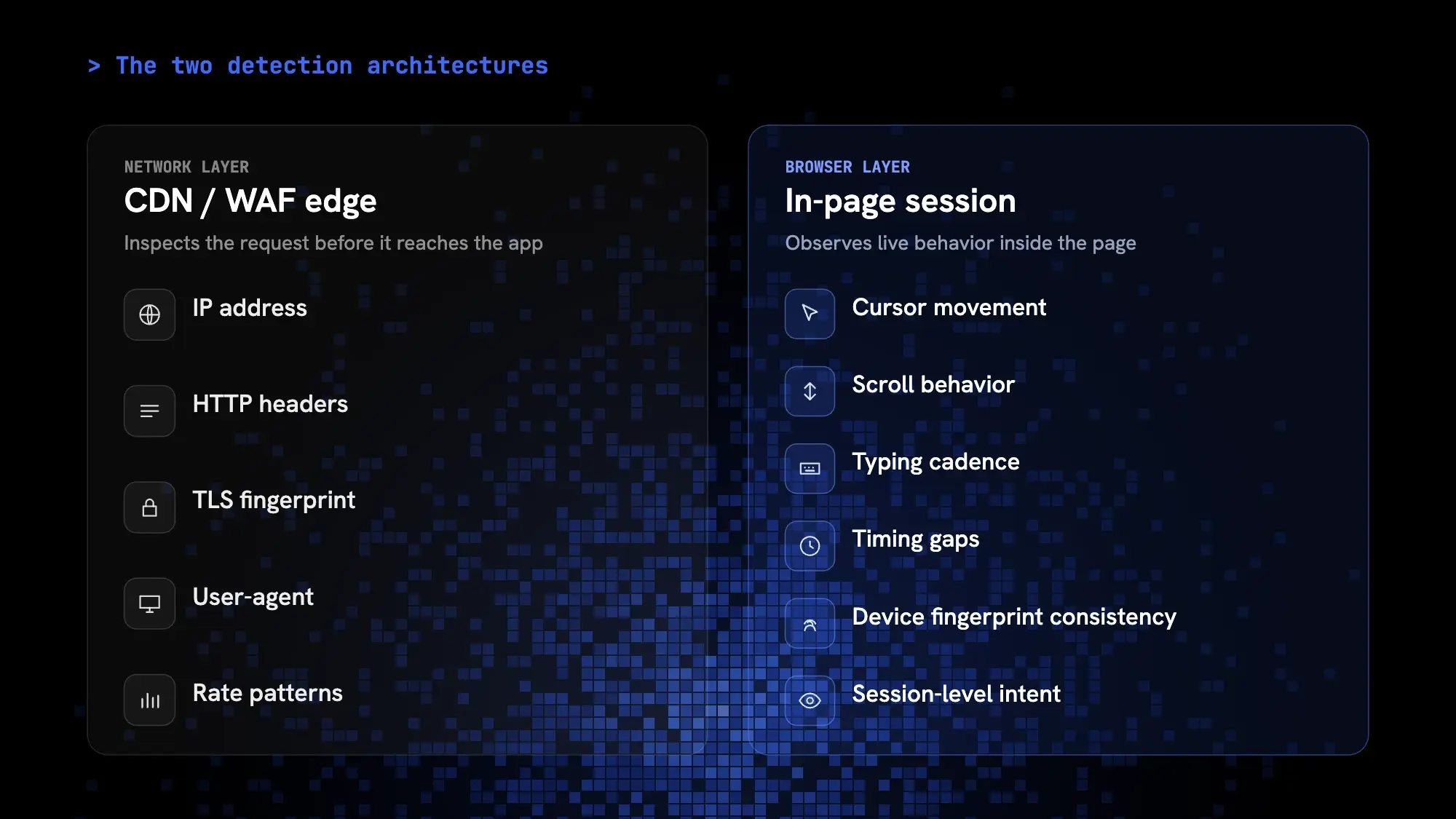
Quick answer: AI agent detection tools operate at two distinct layers: the network layer, which inspects HTTP headers, IP reputation, and TLS fingerprints before a request reaches your application; and the browser layer, which runs inside the page and analyses DOM interaction, JavaScript execution, timing patterns, and UI behaviour. Browser-layer detection sees significantly more signal and is substantially harder for agents to evade.
In practice, the edge sees IP address, HTTP headers, TLS fingerprint, user-agent, and rate patterns; the browser layer sees cursor movement, scroll behavior, typing cadence, timing gaps, device fingerprint consistency, and session-level intent.
Network-layer detection
Network-layer detection sits between the internet and your application, typically at the CDN, WAF, or reverse proxy. It evaluates each incoming request based on information available in the HTTP exchange: IP address and ASN, user-agent string, TLS fingerprint, request headers, and rate patterns.
The advantage is low latency and easy deployment. The limitation is fundamental: by the time a request arrives at the network layer, much of the information that distinguishes a human from an AI agent is not yet visible. An agent running in a real browser with a residential IP address looks identical at the network layer to a legitimate user.
Browser-layer detection
Browser-layer detection loads a lightweight script inside the page itself, before and during page interaction. It observes how the agent navigates the DOM, the precise timing of mouse movements and clicks, which JavaScript APIs are called and in what order, what network requests the agent initiates, and whether behavioural fingerprints match what the browser declares.
This approach exposes a much wider surface of detectable signals. AI agents leave distinctive traces in how they interact with page elements, handle asynchronous content loading, and respond to friction such as form validation or dynamic content.
Intent classification and trust scoring
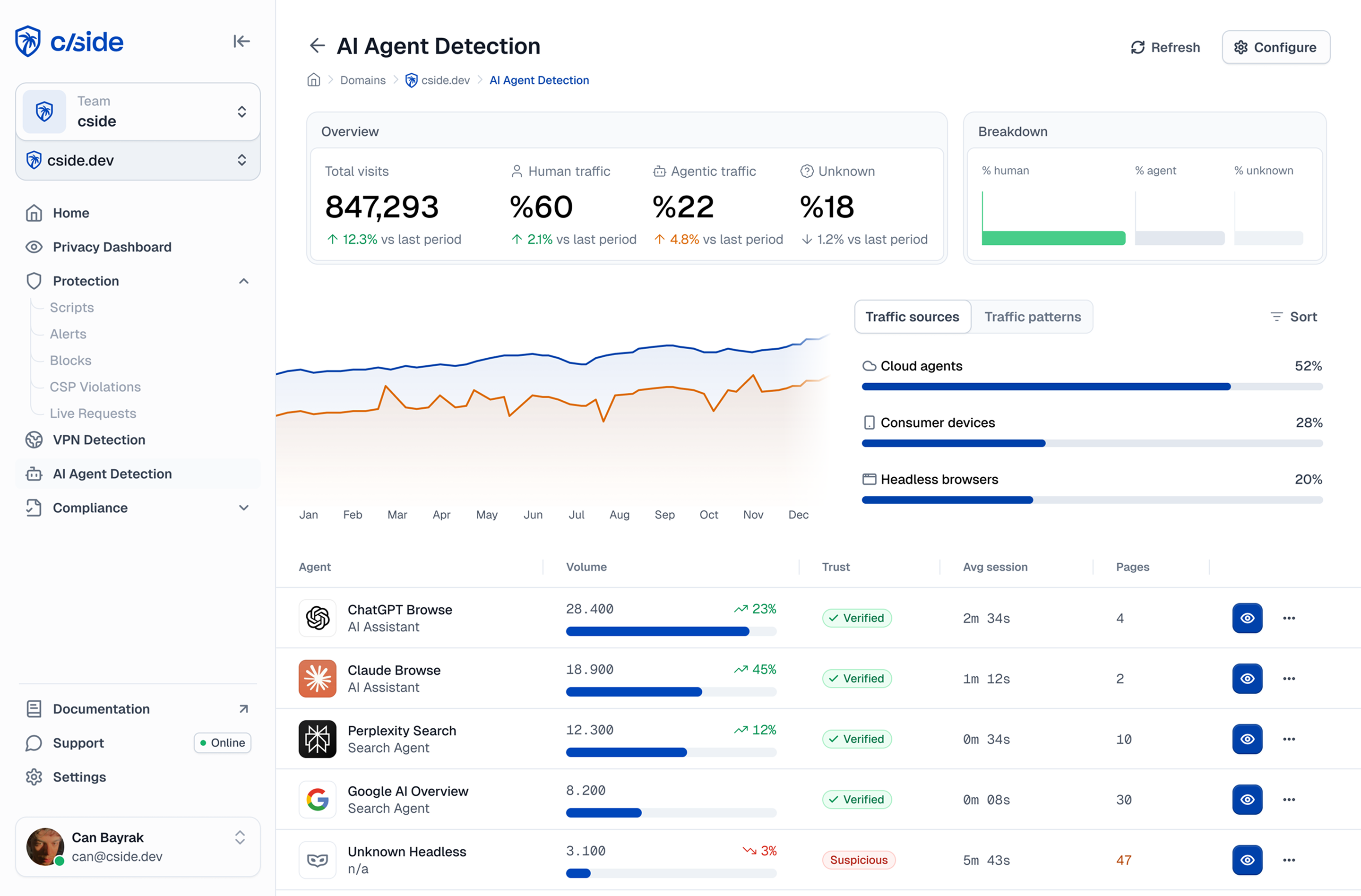
Beyond detecting that a session is non-human, more advanced tools classify what the agent is trying to do. An agent browsing product pages to compare prices represents a different risk profile from one testing payment instruments at checkout. Intent classification allows for proportionate responses, such as rate limiting a scraper while blocking a card tester outright.
Detection layer comparison
| Detection Layer | What It Sees | What It Misses | Best For |
|---|---|---|---|
| Network / CDN | IP, headers, TLS fingerprint, rate patterns | In-page behaviour, DOM interaction, JS execution | Known bad IPs, volumetric attacks, simple bots |
| WAF | Request payloads, URL patterns, header anomalies | Browser-level fingerprinting, behavioural signals | Signature-based rules, known exploit patterns |
| Browser / client-side | DOM interaction, JS calls, timing, UI behaviour, network requests | Pre-request signals (blocked before page load) | Sophisticated AI agents, evasion-aware detection |
| Combined | Full-stack signal correlation | Nothing significant | High-assurance environments requiring layered defence |
The best AI agent detection tools for web applications
Quick answer: The leading AI agent detection tools are cside, DataDome Agent Trust, HUMAN Security AgenticTrust, Imperva Advanced Bot Protection, Akamai Bot and Abuse Protection, AWS WAF Bot Control, and Cloudflare Bot Management. They differ primarily in detection layer, signal depth, and the controls available once an agent is identified. Browser-layer solutions see significantly more of the attack surface than network-only products.
The market has moved fast. Established bot-management vendors have added AI agent-specific capability in 2025 and 2026, typically as extensions of existing network-layer products. The tools below reflect the current state of the market for protecting web application surfaces.
1. cside
Approach: Browser-layer AI agent detection and agent trust management.
Key capabilities:
- Detects named agents including OpenAI Operator, Amazon Buy For Me, and Perplexity Shopper, as well as unknown and emerging agents
- Detection signals span IP signatures from LLM platforms, timing pattern analysis, fingerprint mismatches, suspicious network requests, VPN and proxy detection, and UI interaction analysis
- Intent classification and deanonymisation of AI sessions
- Custom guardrails configurable per page type, including product pages, cart, and checkout
- Rule-based allow, block, and guide actions with escalation to human approval
- Supports agentic conversion tracking and checkout guardrails for commercial use cases
Best for: Engineering and security teams that need deep visibility into AI agent behaviour inside the page, granular per-page controls, and the ability to distinguish between agents they want to allow, guide, or block.
Notable limitation: Browser-layer detection requires a script to be loaded on the page. It does not intercept requests that hit your APIs directly without first loading a page. Layering with network-level controls addresses this gap.
Full details are available on the cside AI agent detection solution page. See how cside compares directly with DataDome, HUMAN Security, Cloudflare Page Shield, Imperva, and Akamai Page Integrity Manager.
2. DataDome Agent Trust
Detection layer: Network and CDN layer.
Key capabilities:
- Classifies AI agent traffic into four categories: AI Crawler, AI Assistant, Agentic Browser, and Autonomous Agent
- Generates a dynamic 100-point Agent Trust score per session based on identity strength, reputation, and behavioural intent
- Identity verification using DNS and IP range analysis, Web Bot Auth cryptographic signatures, and Know Your Agent (KYA) frameworks
- Agent Trust is included in all Bot Protect plans at no additional cost
Key limitation: Network-layer positioning limits visibility into in-page agent behaviour and interaction patterns. Agents operating from clean residential infrastructure remain harder to classify.
3. HUMAN Security AgenticTrust
Detection layer: Network layer, with SATORI threat intelligence and cryptographic agent verification.
Key capabilities:
- Provides session-level visibility into agent actions across the full customer journey, from product discovery to checkout
- Cryptographic agent verification using digital signatures for agent identity confirmation
- SATORI threat intelligence network for cross-vertical threat actor correlation
- Named a 2026 G2 Best Security Software Product
Key limitation: Network-layer positioning means the platform relies on IP reputation and cryptographic signals rather than in-page behavioural analysis of interaction patterns.
4. Imperva Advanced Bot Protection
Detection layer: WAF and network layer, drawing on Imperva's Global Security Network threat intelligence.
What it classifies: Identifies AI bot traffic alongside traditional bot and DDoS activity, with rule sets updated as new agent sources are identified.
Key limitation: WAF-layer deployment shares the same fundamental limitation as other network-layer solutions regarding in-page behavioural signals.
Best for: Organisations already running Imperva for DDoS and WAF protection who want to consolidate AI agent detection into an existing security stack without adding a separate vendor.
5. Akamai Bot and Abuse Protection
Detection layer: CDN edge, delivered across Akamai's global network with reputation-based and behavioural signals.
What it classifies: Identifies bot and AI agent traffic at the CDN layer, integrated with Akamai's broader application and API protection portfolio.
Key limitation: CDN-edge detection cannot observe what happens inside the browser once a page is served.
Best for: Enterprises with large, high-traffic properties that are already on Akamai's CDN and want AI agent detection as part of a unified edge security and performance platform.
6. AWS WAF Bot Control
Detection layer: WAF layer, tightly integrated with AWS infrastructure including CloudFront, API Gateway, and ALB.
What it classifies: Tracks a large catalogue of known bots and agents via an AI Activity Dashboard, with categorised managed rule groups.
Key limitation: WAF-layer detection carries the same architectural constraints as other network-layer tools. Coverage depends on the managed rule group being updated to include new agents, which introduces lag for emerging threats.
Best for: Teams running applications natively on AWS who want bot and agent controls without introducing an external vendor, accepting the trade-off of managed rule group coverage over deeper behavioural detection.
7. Cloudflare Bot Management
Detection layer: Network and CDN layer, using machine learning-based scoring across Cloudflare's network-wide traffic data.
What it classifies: Assigns a bot score to every request for threshold-based policy decisions, with integration into Cloudflare's firewall, rate limiting, and Workers.
Key limitation: Bot scores are generated at the network layer. Agents that exhibit plausible human-like request patterns and use non-flagged infrastructure can achieve scores that do not trigger blocks.
Best for: Teams already on Cloudflare who want a first layer of agent traffic scoring and policy enforcement with minimal additional setup, and who are comfortable with threshold-based blocking rather than deeper intent classification.
Key features to look for in an AI agent detection tool
Quick answer: Prioritise detection layer depth, agent classification granularity, per-page control flexibility, and deployment complexity. Network-layer tools are easier to deploy but miss the signals that identify sophisticated AI agents. Browser-layer tools require script deployment but provide significantly more detection surface. The right choice depends on your threat model, your existing security stack, and your tolerance for integration overhead.
When evaluating tools, assess them against the following criteria:
- Detection layer: Does the tool operate at the network layer only, or does it also run inside the browser? What signals does each layer contribute?
- Agent identification: Can the tool name specific agents such as OpenAI Operator or Amazon Buy For Me, or does it only classify traffic as "bot-like"?
- Intent classification: Does the tool assess what the agent is trying to do, not just whether it is an agent?
- Granularity of controls: Can you apply different rules to different pages or endpoints, such as stricter controls at checkout than on informational content?
- Response options: Does the tool support allow, block, rate limit, guide, and escalate actions? Can responses be conditional on intent classification?
- Evasion resistance: How does the tool respond when an agent uses a residential proxy, a real browser environment, or deliberately paced interaction timing?
- Coverage of unknown agents: Can the tool detect agents it has not seen before based on behavioural signals, or does it rely on a known-agent database?
- Commercial use support: If you want to allow and track legitimate agent traffic, does the tool support that workflow?
- Reporting and observability: What visibility does the tool give you into agent traffic volume, types, and behaviour over time?
Our guide to choosing an AI agent detection solution walks through how to weight these criteria against your own stack.
Detection layer: network vs browser
The detection layer is the single most important architectural decision. Network-layer tools are simpler to deploy, cover API traffic that never loads a page, and add minimal latency. Browser-layer tools are harder to evade and expose signals that network-layer tools cannot see.
For most web applications handling sensitive user journeys, the highest-risk surfaces involve real page interactions: login, product discovery, cart, and checkout. These are exactly where browser-layer detection provides the most value, because agents operating on these pages leave behavioural traces that are invisible at the network layer.
A layered approach, combining network-layer coverage for known bad infrastructure with browser-layer analysis for in-page behaviour, provides the widest detection surface.
Agent classification and intent scoring
Not all AI agent traffic presents the same risk. A Googlebot crawling your content for indexing is different from an unknown agent systematically extracting your entire product catalogue, which is different again from an agent probing your checkout flow with stolen card data.
Tools that collapse all of these into a binary "bot or not" decision force a choice between over-blocking legitimate traffic and under-blocking malicious traffic. Intent classification, which analyses what the agent is doing rather than just what it is, enables proportionate and accurate responses. For a fraud-focused breakdown, see our roundup of the best tools for AI agent detection to prevent website fraud.
Integration and deployment complexity
Browser-layer detection requires deploying a JavaScript snippet on your pages, which involves change management, performance testing, and potentially tag manager configuration. For teams with established deployment processes, this is manageable. Teams with strict content security policies or complex single-page application architectures will need additional planning.
Network-layer detection typically requires a DNS change or proxy configuration to route traffic through the vendor's infrastructure, or integration via a native cloud marketplace offering. This is generally lower complexity but carries its own operational considerations, particularly around latency and failover.
Assess the realistic deployment path for each tool in your environment before making a decision based on feature capability alone.
How to evaluate AI agent detection tools for your web application
Quick answer: Evaluate tools against your specific threat model, not generic feature matrices. Define the agent behaviours that represent the greatest risk to your application, then test candidate tools against those scenarios directly. Pay particular attention to detection rates on agents using residential proxies and real browser environments, as these are the evasion techniques most commonly used by sophisticated actors.
A structured evaluation process for AI agent detection tools:
-
Map your threat surface first. Identify the specific pages, APIs, and user journeys in your application that are most exposed to AI agent abuse. Checkout flows, login endpoints, content APIs, and search interfaces typically carry the highest risk.
-
Define your agent scenarios. Articulate the specific agent behaviours you need to detect. Pricing scraping, inventory monitoring, credential stuffing, card testing, and fake account creation each have different detection signatures.
-
Test with real agents, not synthetic traffic. Request proof-of-concept testing using actual AI agent frameworks operating in real browser environments. Synthetic bot traffic from simple HTTP libraries will not reveal whether a tool can detect sophisticated agents.
-
Test evasion resistance specifically. Configure test agents to use residential proxies, real browser engines, and paced interaction timing. These are the conditions under which most network-layer tools will fail.
-
Evaluate false positive rates in your context. Run detection tools against legitimate user sessions and measure how often genuine users are incorrectly flagged or challenged. High false positive rates translate directly into conversion loss.
-
Assess control granularity. Confirm that the tool allows different policies on different parts of your application. A single global policy is rarely appropriate for a complex web application.
-
Review the response option set. Ensure the tool supports the responses you need, including the ability to allow known legitimate agents, rate limit scrapers, block fraud attempts, and escalate ambiguous sessions for human review.
-
Evaluate reporting depth. Confirm you will have sufficient visibility into agent traffic to detect trends, investigate incidents, and report to stakeholders.
-
Assess integration with your existing stack. Determine how the tool interacts with your current CDN, WAF, SIEM, and incident response tooling.
-
Plan for the unknown. AI agent capabilities are evolving rapidly. Evaluate how each vendor updates detection coverage for new agents and what their track record has been on emerging threats.