De beste software om accountdeling te voorkomen kiezen komt neer op hoeveel controle je team wil over detectie en handhaving, en wat er al in je stack zit. Deze gids vergelijkt de belangrijkste tools om accountdeling te voorkomen voor bedrijven, fingerprinting-platforms, hybride rules engines en volledige antifraudesuites, op functies, prijzen en reviews, zodat je een tool kunt afstemmen op je team.
Kort samengevat: tools om accountdeling te voorkomen
- De typische stack: De meeste teams combineren een fingerprinting/detectietool met een MFA-provider en hun eigen sessiebeheerlogica.
- Het spectrum: Tools voor het voorkomen van accountdeling bevinden zich op een spectrum: fingerprinting-platforms (ruwe signalen, controle voor ontwikkelaars) en volledige antifraudesuites (uitgebreid maar duur).
- Kies een fingerprinting-platform (zoals cside) als: je ontwikkelaars hebt die signalen kunnen koppelen aan je bestaande auth/fraudeflows en je controle wilt over detectieregels. Deze platforms hebben de laagste instapkosten.
- Kies een volledige antifraudesuite (zoals Sift) als: je een dedicated fraudeoperationsteam hebt dat casebeheer, dashboards en ML-scoring nodig heeft. Reken op een enterprise-budget voor deze opties.
Weinig tijd? Bekijk cside's frictieloze detectie van accountdeling. Dit dekt alles hieronder in één deployment.
Snelle vergelijkingstabel: tools voor het voorkomen van accountdeling
| Leverancier | Tooltype | Wat het doet | Reviews | Prijzen | Implementatie |
|---|---|---|---|---|---|
| cside | Fingerprinting / Device Intelligence | 250+ signalen omgezet in een persistent bezoeker-ID. Ruwe signalen via API/webhooks. Activeert verdedigingsmechanismen op basis van impossible travel, gebruik van meerdere apparaten en andere verdachte indicatoren. | 4,8/5 op G2 | Gratis (1K API-aanroepen/maand). Betaald vanaf $99/maand. | JS-snippet toegevoegd aan je site. Direct dashboard en dataverzameling. Integreer via API of Webhook. De meeste teams zijn binnen een dag live. |
| Fingerprint | Fingerprinting / Device Intelligence | 70+ signalen voor apparaatidentificatie. Kijkt naar apparaatlimieten en impossible travel. Smart Signals-add-ons beschikbaar. | 4.7/5 op G2 | Gratis tier. Pro Plus vanaf $99/maand (20K verzoeken). | JS-agent + REST API. Uitgebreide documentatie. |
| Castle | Hybride (Device Intel + Rules Engine) | Apparaat-fingerprinting met ingebouwde beleidsengine. Definieer delingsdrempels, velocity-regels en gekoppelde entiteitsdetectie in een UI. | 3.7/5 op G2 (beperkt aantal reviews) | Gratis tier (1 RPS). Betaald vanaf $200/maand. | Server-side SDK + client-side fingerprinting. |
| Sift | Volledige antifraudesuite | ML-modellen op 16,000+ signalen. Realtime risicoscoring, Global Identity Search voor gekoppelde accounts, workflowtemplates en casebeheer-dashboards. | 4.6/5 op G2 | Alleen enterprise, niet openbaar vermeld. | JS-snippet + server-side API. Dedicated onboardingteam voor enterprise-contracten. |
Typen tools voor het voorkomen van accountdeling
Welk type tool je nodig hebt, hangt af van hoeveel controle je wilt over de detectielogica en wat er al in je stack zit.
Fingerprinting / Device Intelligence-platforms
- Fingerprinting-platforms verzamelen browser-, apparaat- en gedragssignalen via een script dat wordt uitgevoerd bij het laden van de pagina of bij inloggen. Ze combineren tientallen van deze signalen tot een persistent bezoeker-ID.
- Hoe ze helpen bij accountdeling: deze platforms vormen de detectielaag. Ze brengen de patronen in kaart die erop wijzen dat deling plaatsvindt: impossible travel (hetzelfde account benaderd vanuit twee steden die 3,000 miles van elkaar liggen, binnen een uur), snelle apparaataccumulatie (een account dat maandenlang twee apparaten gebruikte en er plotseling drie nieuwe aan toevoegt in een week) en gelijktijdige toegang vanaf meerdere locaties. De ruwe signalen worden geleverd via API of webhooks, zodat je ze kunt invoeren in je auth-flow, MFA-tools of sessiebeheerlogica.
- Populaire tools: cside en Fingerprint vallen in deze categorie.
Het meest geschikt voor teams die volledige controle willen over detectiedrempels en handhavings-UX en ontwikkelaars hebben om signalen te integreren in een bestaande auth-stack.
MFA / Identity Providers
- MFA-tools zoals Okta, Auth0 en Duo zijn aanwezig in elke stack voor het voorkomen van accountdeling. Zij vormen de handhavingslaag.
- Hoe ze helpen bij accountdeling: MFA voegt wrijving toe die deling van nature ontmoedigt (de accounthouder moet elke keer betrokken zijn wanneer iemand inlogt), maar het vertelt je niet of deling daadwerkelijk plaatsvindt. Aanvullende step-up verificatie-uitdagingen kunnen worden geactiveerd wanneer accountdeling wordt vermoed.
- Populaire tools: Okta, Auth0 en Duo.
In een typische opzet detecteert een fingerprinting-platform verdachte delingspatronen en activeert vervolgens een MFA-uitdaging via je identity provider.
Volledige antifraudesuites
Volledige antifraudesuites zijn uitgebreide platforms die fingerprinting, gedragsanalyse, ML-gebaseerde risicoscoring en casebeheer bundelen in één systeem. Detectie van accountdeling is één module onder vele.
- Populaire tools: voor accountdeling specifiek bieden suites zoals Sift voorgeconfigureerde regels en machine learning-modellen die delingspatronen automatisch markeren.
De afweging zit in kosten en flexibiliteit. Volledige suites hebben enterprise-prijspunten en zijn ontworpen voor organisaties die meerdere fraudevectoren op schaal beheren. Je betaalt voor veel functionaliteit die je niet zult gebruiken, en de voorgeconfigureerde regels kunnen moeilijker af te stemmen zijn op productspecifieke handhavingsbeslissingen.
Het meest geschikt voor grote organisaties met dedicated fraudeoperatieteams en meerdere fraudevectoren die tegelijkertijd beheerd moeten worden.
Een typisch draaiboek voor het voorkomen van accountdeling
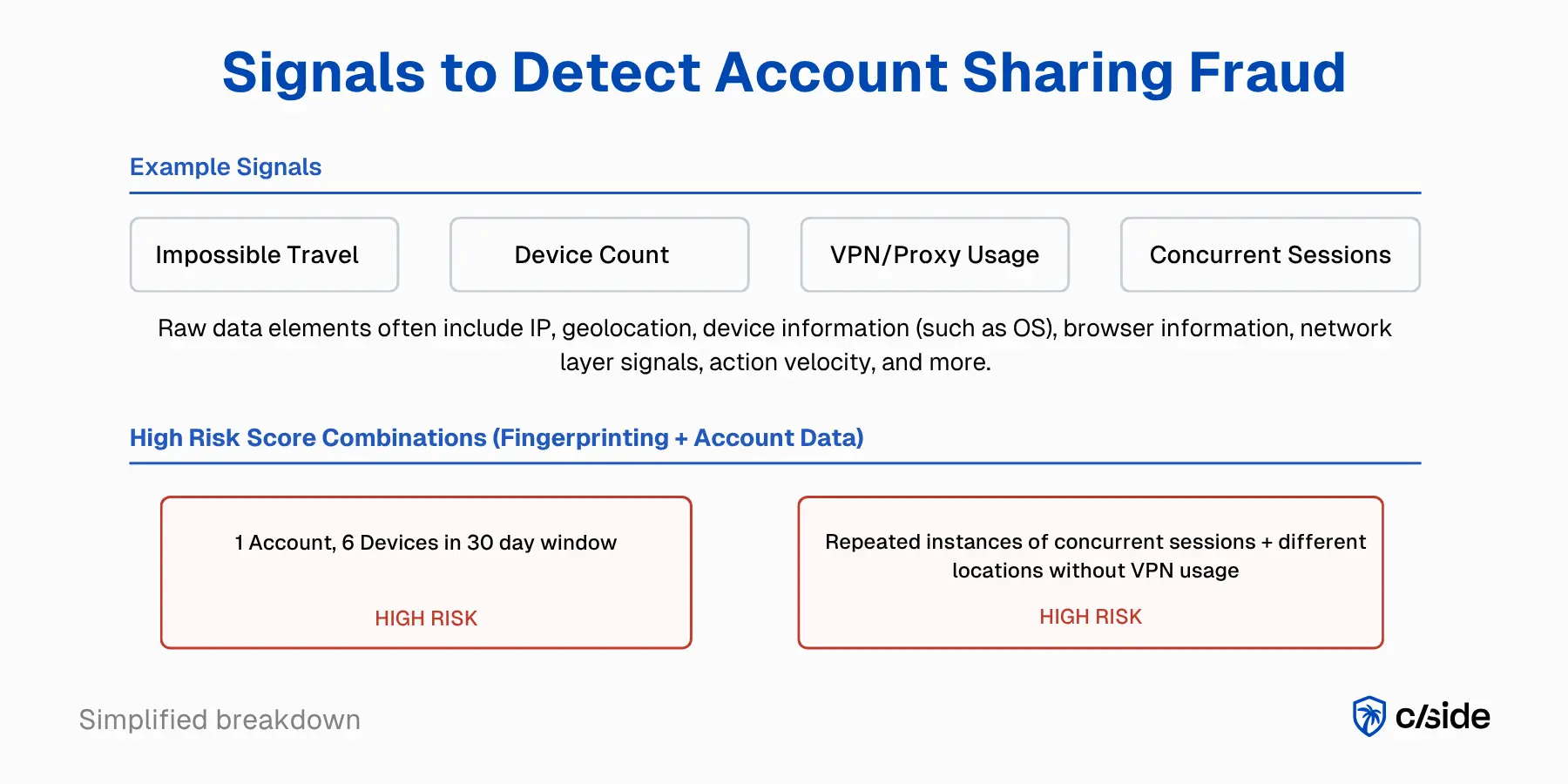
In de praktijk werkt preventie als een drielaagse stack: detecteren, beslissen, handhaven. Zo verbinden de tools zich:
De detectielaag
- Een fingerprinting-script verzamelt signalen bij elke paginalading of inlogpoging: apparaat-ID, browserconfiguratie, geolocatie, VPN/proxy-status, gedragspatronen.
- Gelijktijdige actieve sessies worden doorgaans bijgehouden met je eigen productcode.
- Fingerprinting-scripts gebruiken vaak dezelfde signalen om botgestuurde misbruik of andere vormen van fraude zoals account takeover te identificeren.
- Dezelfde signalen vangen ook het verwante voorliggende probleem van valse nieuwe accounts bij de registratiestap, waar cside Signup Shield van elke aanmelding een vertrouwensoordeel in realtime maakt.
De beslissingslaag
- Ruwe signalen worden geëvalueerd aan de hand van je drempelwaarden. Hoeveel apparaten zijn normaal voor jouw product? Wat is je limiet voor gelijktijdige sessies per plantier?
- Het is doorgaans het beste om deze logica in je backend te bouwen. Dit vermindert fout-positieven en zorgt ervoor dat je accountdeling met vertrouwen kunt handhaven.
De handhavingslaag
Zodra een beslissing is genomen, wordt een step-up actie afgedwongen:
- MFA-uitdaging: bij een gemarkeerde inloggebeurtenis roept je backend de API van de MFA-provider aan om een tweede factor te vereisen (sms-code, pushmelding) voordat sessietoegang wordt verleend.
- Sessiebeëindiging: beëindig de oudste of meest verdachte actieve sessie. Je backend bevraagt je sessiestore (doorgaans Redis of een database met sleutel op gebruikers-ID), identificeert de te beëindigen sessie en maakt het token ongeldig.
- Upgrade-prompt: toon een in-app bericht, e-mail of apparaatbeheerscherm wanneer te veel apparaten toegang krijgen tot één account.
Voor een uitgebreidere bespreking van responsstrategieën zonder klanten te verliezen, zie onze volledige gids voor het voorkomen van accountdeling.
Vergelijking van tools voor het voorkomen van accountdeling (functies, reviews)
1. cside
cside is een client-side beveiligings- en device intelligence-platform. Fingerprinting is een kernfunctionaliteit binnen een breder product dat ook AI-botdetectie, scriptmonitoring (PCI DSS 4.0.1) en bewijs voor chargebackfraude omvat.
cside publiceert regelmatig websitebeveiligingsonderzoek en draagt bij aan brancheorganisaties zoals het W3C. Hun engineers spreken regelmatig op branche-evenementen om bedrijfsleiders te informeren over moderne webaanvallen.
Tooltype:
- Fingerprinting / Device Intelligence
cside-functies voor het voorkomen van accountdeling:
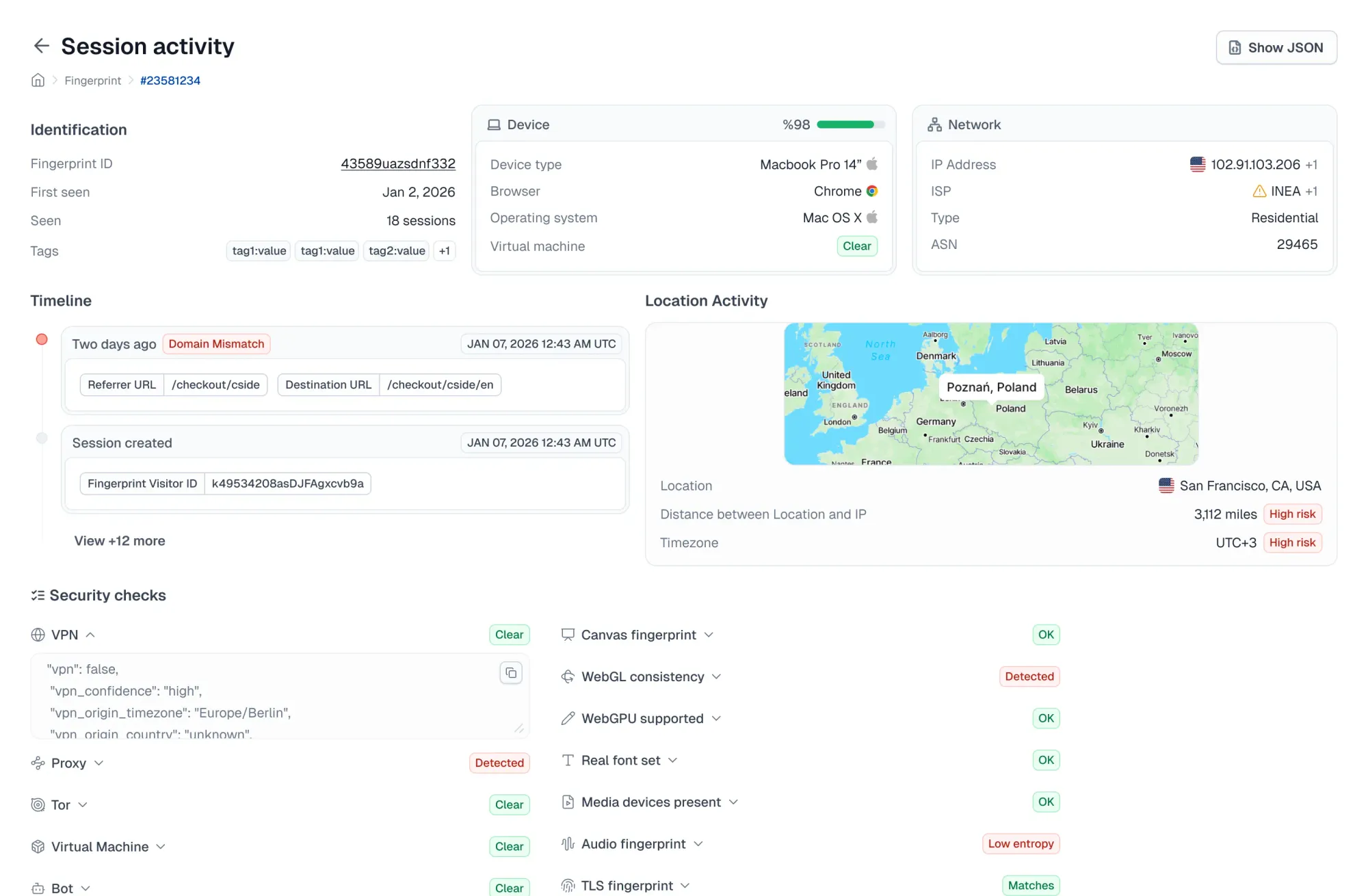
- Verzamelt 250+ browser-, apparaat- en gedragssignalen en zet deze om in een persistent bezoeker-ID dat stand houdt over sessies, incognitomodus, gewiste opslag en VPN-gebruik.
- Ruwe signalen toegankelijk via API en webhooks. Apparaat-ID's, geolocatie, VPN/proxy-detectie, impossible travel en velocity-data klaar om in te voeren in je MFA- of sessiebeheerlogica.
- AI-botdetectielaag die headless stealth-browsers en geautomatiseerde toegang identificeert, die anders accountdelingspatronen in je data kunnen nabootsen.
- Één script dekt meerdere fraudevectoren: account takeover, multi-accounting en chargebackfraude naast accountdeling. Één integratie, meerdere toepassingen.
Prijzen:
- Gratis tier met 1,000 API-aanroepen/maand. Betaalde plannen starten vanaf $99/maand en schalen mee met gebruik.
Reviews:
| Reviews | Beoordeling |
|---|---|
| cside-reviews op SourceForge | 4,9/5 sterren (37 reviews en beoordelingen weergegeven: 25 native SourceForge-reviews plus 12 geverifieerde third-party ratings die daar worden weergegeven) |
| cside-reviews op G2 | 4,8/5 sterren |
Implementatie:
De installatie van cside duurt vaak minder dan een dag, maar kan langer duren in complexe omgevingen.
- Volledig zelfbedieningsoptie of begeleide implementatie.
- Stappen: voeg een JavaScript-snippet toe aan je website. Dataverzameling begint onmiddellijk en je krijgt een dashboard op het cside-platform met signalen en meldingen. Integreer signalen in je eigen stack via API of webhook-levering.
Het meest geschikt voor: door ontwikkelaars geleide SaaS-teams die volledige controle over ruwe signalen willen en de flexibiliteit om detectie te koppelen aan hun eigen handhavingslogica. Sterke match als je ook botdetectie of chargebackbewijs nodig hebt vanuit dezelfde integratie.
2. FingerprintJS
FingerprintJS (commercieel bekend als "Fingerprint") is een apparaatidentificatieplatform gebouwd rond de nauwkeurigheid van bezoekersidentificatie. Preventie van accountdeling is een gebruiksscenario-product binnen hun aanbod.
Tooltype:
- Fingerprinting / Device Intelligence
Functies voor het voorkomen van accountdeling:
- 70+ signalen voor apparaat- en browseridentificatie, omgezet in een persistent bezoeker-ID (
visitorId) voor elk uniek apparaat. - Signalen voor het voorkomen van accountdeling zoals apparaatlimieten, impossible travel-detectie en VPN/IP-geolocatiedetectie ingebouwd.
- Smart Signals-add-ons: VPN-detectie, IP-geolocatie, browser-botdetectie, incognitomodus-detectie. Je schakelt in wat je nodig hebt.
- Cross-platform ondersteuning: JavaScript-agent voor web, native SDK's voor iOS en Android.
Verwante lectuur: onze complete gids voor het voorkomen van account sharing voor bedrijven
Prijzen:
- Gratis tier beschikbaar.
- Betaalde tiers starten met Pro Plus op $99/maand voor 20,000 API-verzoeken.
Reviews:
| Reviews | Beoordeling |
|---|---|
| Fingerprint-reviews op G2 | 4.7 / 5 sterren |
Gebruikers merken op: VPN/proxy-detectie kan onbetrouwbaar zijn zonder aanvulling met externe API's, en de prijzen worden als hoog beschouwd voor kleinere teams.
Implementatie:
- JavaScript-agent integratie met uitgebreide documentatie.
- REST API voor server-side queries.
Het meest geschikt voor:
Teams die een apparaatidentificatieplatform willen voor zowel web- als mobiele apps (iOS, Android).
3. Castle
Castle is een accountbeveiligingsplatform dat apparaat-fingerprinting combineert met een ingebouwde beleidsengine. Het zit tussen pure fingerprinting-tools en volledige fraudesuites in. Je krijgt ruwe device intelligence plus configureerbare regels die in realtime worden uitgevoerd.
Tooltype:
- Hybride (Device Intelligence + Rules Engine)
Functies voor het voorkomen van accountdeling:
- Apparaat-fingerprinting wordt ingevoerd in een Metrics and Policies-engine waar je drempelwaarden voor accountdeling definieert (apparaten per account, sessies per tijdvenster).
- Realtime velocity-queries en geavanceerde filtering. Regels worden uitgevoerd in milliseconden en retourneren allow/deny/challenge-beslissingen.
- Detectie van overlappende activiteit: markeert gelijktijdige sessies van meerdere apparaten en locaties op hetzelfde account.
Prijzen:
- Gratis tier beschikbaar (limiet van 1 RPS). Betaalde plannen starten vanaf $200/maand.
Reviews:
| Reviews | Beoordeling |
|---|---|
| Castle-reviews op G2 | 3.7 / 5 sterren (beperkt aantal reviews) |
Opmerking: Castle heeft een beperkt aantal reviews op de verschillende platforms.
Implementatie:
- Server-side SDK-integratie plus client-side fingerprinting.
Het meest geschikt voor:
Goede keuze als je delingsdrempels wilt definiëren en verfijnen in een kant-en-klare UI.
4. Sift
Sift is een op enterprise gericht platform voor digitale vertrouwen en veiligheid. Detectie van accountdeling is één functionaliteit binnen een fraudepreventiesuite die betalingsfraude, account takeover, contentmisbruik en promotiefraude omvat.
Tooltype:
- Antifraudesuite
Functies voor het voorkomen van accountdeling:
- ML-modellen getraind op een wereldwijd datanetwerk met 16,000+ signalen. Realtime risicoscoring over accountgebeurtenissen.
- Global Identity Search onthult gekoppelde accounts en brengt verbanden in kaart tussen accounts die apparaten, betaalmethoden of gedragspatronen delen.
- Casebeheer en fraudeoperaties-dashboards voor teams die een gestructureerde beoordelingsworkflow nodig hebben.
Prijzen:
- Enterprise-prijzen, niet openbaar vermeld.
- Branchebronnen schatten ~$200K/jaar als gemiddelde contractomvang.
Reviews:
| Reviews | Beoordeling |
|---|---|
| Sift-reviews op G2 | 4.6 / 5 sterren |
Implementatie:
- JavaScript-snippet plus server-side API-integratie.
- Complexere onboarding dan tools die alleen fingerprinting bieden, enterprise-contracten bevatten doorgaans een dedicated onboardingteam.
Het meest geschikt voor:
Grote organisaties met dedicated fraudeoperatieteams die betalingsfraude, ATO en promotiemisbruik naast accountdeling beheren. Als je een volledige antifraudesuite aanschaft, is accountdeling onderdeel van een bredere investering.
IP-based detectietools zijn niet voldoende:
Op IP gebaseerde detectie was een van de vroegste benaderingen voor het markeren van gedeelde accounts, maar het is op zichzelf onbetrouwbaar. VPN's maskeren echte locaties, mobiele netwerken wisselen voortdurend van IP, en legitieme gebruikers veroorzaken fout-positieven simpelweg door op dezelfde dag in te loggen vanaf werk, thuis en een koffieshop.
Elke hierboven vergeleken tool combineert IP-data met apparaat-fingerprints, gedragssignalen en geolocatie. Voor meer informatie over de beperkingen van handhaving op basis van alleen IP, lees onze volledige gids voor het voorkomen van accountdeling.
Waarom het voorkomen van accountdeling belangrijk is
- Het is laaghangende vrucht voor omzetbehoud: gebruikers die accounts delen zijn al actief op je product. Ze hebben de onboarding doorlopen en zijn actief. Zelfs conservatieve conversiepercentages (10 tot 20%) vertalen zich naar betekenisvolle ARR-terugwinning.
- Gedeelde inloggegevens zijn een beveiligingsrisico: gedeelde inloggegevens leven in kanalen met lage beveiliging: Slack-berichten, gedeelde documenten, groepschats. Gedeelde accounts vernietigen ook je audittrail, wanneer meerdere mensen één login gebruiken, kun je acties niet aan individuele gebruikers toeschrijven.
Het Netflix-voorbeeld: Synoniem met accountdeling is Netflix' aanpak van wachtwoorddeling in 2023, die leidde tot negatieve reacties en annuleringsdreigementen. De werkelijke resultaten: miljoenen nieuwe betaalde abonnees en een netto-inkomensverbetering die de verwachtingen van analisten overtrof.
Accountdeling in verschillende sectoren:
- SaaS (seat sharing): per-seat-prijzen creëren een directe prikkel om te delen. Teams delen één login om te voorkomen dat ze voor extra seats moeten betalen.
- Streaming (abonnementsdeling): het meest zichtbare accountdelingsprobleem. Deling is genormaliseerd bij streaming, de meeste gebruikers beschouwen het niet als een overtreding.
- Betaalde content (accountdeling): nieuwssites, onderzoeksplatforms en uitgevers van premium content worden geconfronteerd met deling die het abonnementsmodel direct ondermijnt.
- Ledenplatforms (ledensdeling): online communities, professionele netwerken en premium ledenplatforms lopen omzet en zichtbaarheid mis door accountdeling.
- Onderwijssoftware: studenten delen regelmatig licenties voor leerplatforms, testvoorbereiding en online cursustoegang, vaak gedreven door kostenbewustzijn.
Hoe kies je de beste software om accountdeling te voorkomen
De beste software om accountdeling te voorkomen voor jouw team hangt af van hoe je team is ingericht en welk niveau van flexibiliteit je wilt:
Kies een fingerprinting-platform (cside) als: je ontwikkelaars hebt die signalen kunnen koppelen aan je bestaande auth-flow en je volledige controle wilt over detectiedrempels en handhavings-UX. Deze platforms hebben de laagste instapkosten.
Kies een hybride platform (Castle) als: je een development SDK wilt met kant-en-klare beleidsregels voor accountdeling. Castle laat je delingsdrempels definiëren en verfijnen in een UI. Deze extra functies brengen extra kosten met zich mee ten opzichte van fingerprinting-platforms.
Kies een volledige antifraudesuite (Sift) als: accountdeling één van meerdere fraudeproblemen is die je tegelijkertijd aanpakt en je een dedicated fraudeoperatieteam hebt dat casebeheer, dashboards en ML-scoring nodig heeft.
Het is mogelijk, en gebruikelijk, om fingerprinting-platforms te combineren met antifraudesuites.
Verdedig je tegen accountdeling met cside
De fingerprinting van cside verzamelt 250+ browser-, apparaat- en gedragssignalen en retourneert persistente bezoeker-ID's via API en webhooks. Één integratie dekt detectie van accountdeling naast account takeover, multi-accounting en botdetectie.
Gratis tier met 1,000 API-aanroepen/maand. Betaalde plannen vanaf $99/maand. De meeste teams zijn binnen een dag live.
Om te beginnen, meld je aan of boek een demo.