
Key points
- AI agents are used by fraudsters to create fake accounts. These use real browsers with residential IPs and in some cases LLM-generated identities.
- Stopping AI agent based fake account creation requires four signal layers: identity, network, browser environment, and behavioral signals.
- Most companies use an AI agent detection tool like cside or Castle to collect these signals and feed them into enforcement workflows.
- Traditional bot detection like CAPTCHAs are not effective against AI agent based bots. AI agents running on stealth browsers are purpose built to evade these detection methods and modern AI solves CAPTCHAs more accurately than humans.
What are AI fake account bots?
AI-agent based fake account bots use browser automation frameworks and AI capabilities to register accounts on your platform at scale. The goal can be attack based (ramping up your infrastructure costs) or incentive based (referral bonuses).
Unlike traditional account creation bots, AI-powered account creation bots run inside real Chrome instances and better mimic human behavior including the ability to solve CAPTCHAs. An industry analyst report found that AI-powered fraud rose by 1,210% in 2025 compared to a 195% rise in traditional fraud.
Signals to detect AI agents creating fake accounts
A combination of network, browser, and behavioral signals are needed
No single signal catches a sophisticated fake account bot. The detection methodology used at cside (for our own sign up flow and for our customers) looks at four signal layers:
- Identity signals; check who the visitor says they are. Known automation tools leave traces in the browser runtime. Bots from platforms like Browserbase have signatures you can verify.
- Network signals; look at where the traffic comes from. Datacenter IPs, known proxies, and mismatches between claimed location and browser timezone all flag basic setups. Sophisticated operations rotate residential IPs that look clean.
- Browser/device signals; inspect whether the browser environment tells a consistent story. Automation tools like Playwright leave artifacts. When fingerprinting details (graphics rendering, audio processing, screen specs) contradict each other, something has been tampered with.
- Behavioral signals; watch how the visitor interacts with your registration flow. Form fill timing, keystroke patterns, mouse movement, error correction behavior, and navigation sequencing. AI agents are better at masking this than traditional bots, but with session-level monitoring they still get caught.
We go deeper into each of these signal layers and the specific detection techniques cside engineers deploy in our guide to detecting AI agent traffic.
In a recent industry survey we ran, more than a third of web developers said they are implementing additional defenses against AI agent bots like behavioral analysis.
Session signals that reveal AI account creation
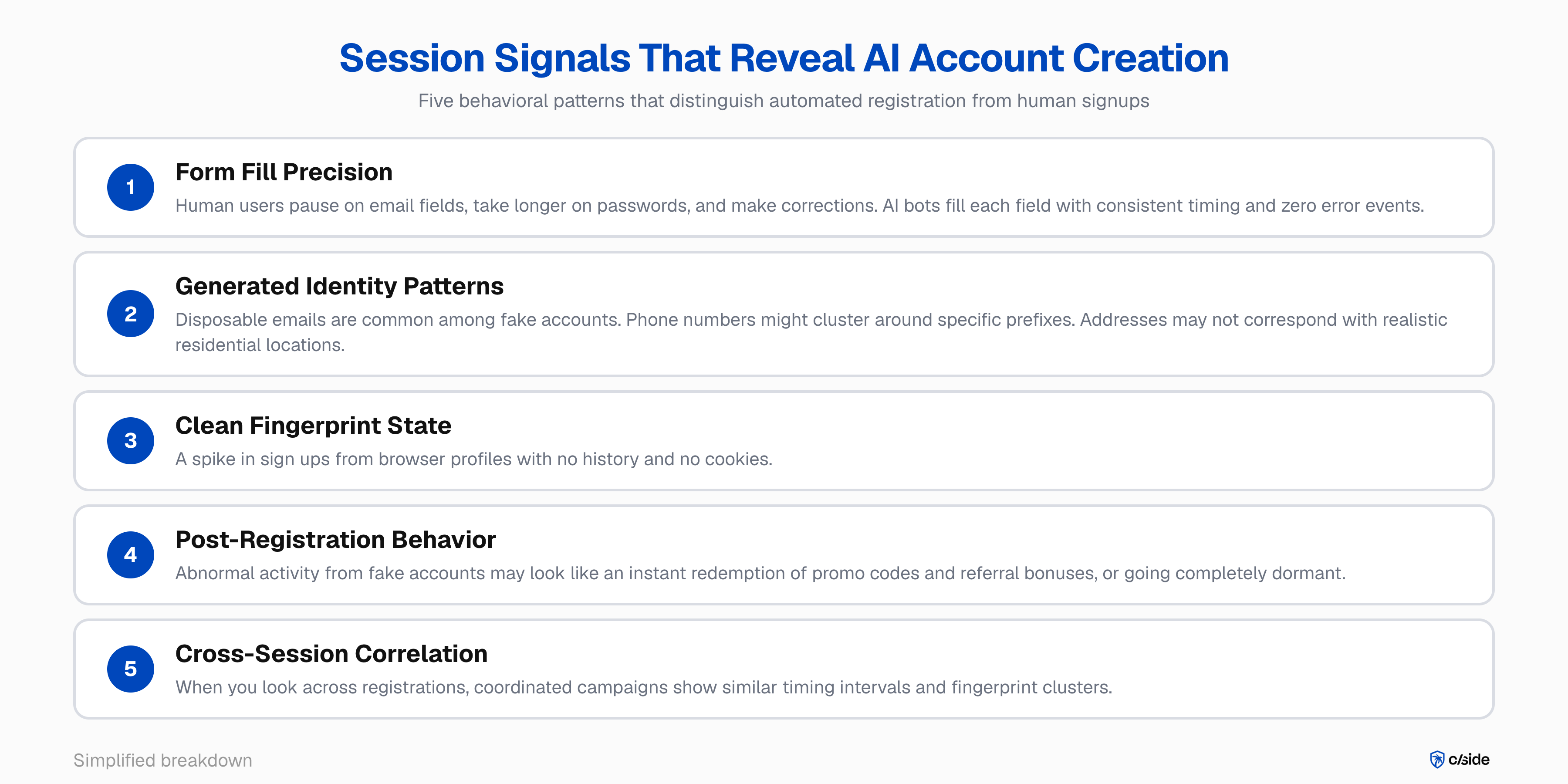
- Form fill precision: Human users pause on email fields, take longer on passwords, and make corrections. AI bots fill each field with consistent timing and zero error events.
- Generated identity patterns: Disposable emails are common among fake accounts. Phone numbers might cluster around specific prefixes. Addresses may not correspond with realistic residential locations.
- Clean fingerprint state: A spike in sign ups from browser profiles with no history and no cookies.
- Post-registration behavior: Abnormal activity from fake accounts may look like an instant redemption of promo codes and referral bonuses, or going completely dormant.
- Cross-session correlation: When you look across registrations, coordinated campaigns show similar timing intervals and fingerprint clusters.
Specialized vendor tools to detect AI fake account creation
If you're worried about AI agents creating fake accounts and want to stop them, you have two choices. Buy, or DIY. Our perspective on DIY: don't. Bot security software is a category that teams do not often try to engineer for straightforward reasons.
Your detection approach will be reverse engineered by the automation platforms. Your team has to continuously update the detection philosophy. An AI agent detection tool focused on fraud detection is a much easier approach.
cside is one of those vendors, but to keep our educational articles objective we frequently mention other vendors (such as HUMAN and Fingerprint).
But aren't vendor tools extremely expensive and meant for enterprises?
Some are (DataDome, HUMAN). We broke down the pricing and trade-offs in our comparison: 4 Tools To Detect AI Agents On Your Website. Vendors like cside and Fingerprint offer business-tier plans (from $99/month) that expose detection signals through an API so you can wire them into your existing anti-fraud workflows.
You pay for the signals you consume and can run a pilot without signing an annual contract.
Why bad actors create fake accounts on your website or web app
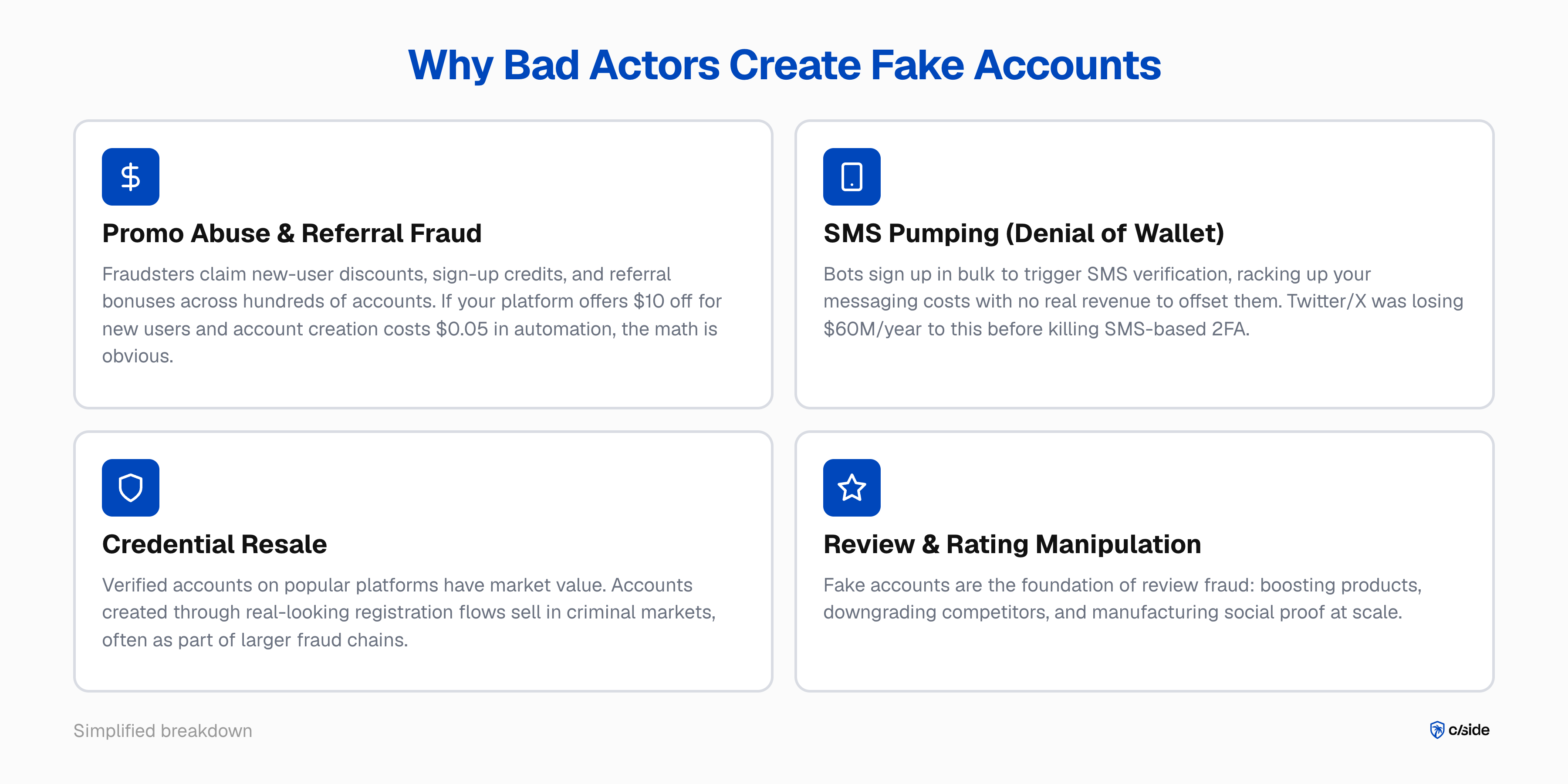
Fake accounts enable a range of fraud schemes and the economics have shifted heavily in the attacker's favor as AI has made bulk creation cheaper.
- Promo abuse and referral fraud: Fraudsters claim new-user discounts, sign-up credits, and referral bonuses across hundreds of accounts. If your platform offers $10 off for new users and account creation costs $0.05 in automation, the math is obvious.
- SMS pumping (denial of wallet): Bots sign up in bulk to trigger SMS verification, racking up your messaging costs with no real revenue to offset them. Twitter/X was losing $60M/year to this before killing SMS-based 2FA.
- Credential resale: Verified accounts on popular platforms have market value. Accounts created through real-looking registration flows sell in criminal markets, often as part of larger fraud chains.
- Review and rating manipulation: Fake accounts are the foundation of review fraud: boosting products, downgrading competitors, and manufacturing social proof at scale.
Example breakdown: fake accounts used in a DoW attack on a creator tool SaaS
We recently helped a creator tool (startup with fewer than 50 employees) deploy defensive measures against a DoW (Denial of Wallet) attack:
- A wave of bots signed up for the platform triggering SMS verification for each account. The bill to send those SMS messages racked up fast with no real revenue to offset the costs.
- Traditional bot detection was already in place (Cloudflare's "prove you are not a bot") but the bots were still getting through. That led to the suspicion that these were AI agent bots, not the scripted kind that Cloudflare's standard checks were built for.
- The creator tool implemented cside's AI Agent Detection and Fingerprinting data signals. Immediately they could see a dashboard of AI agent traffic hitting their registration flow. Over time detection strengthened as historical data revealed patterns in the targeted attacks.
- These signals were fed into a risk score for enforcement action. Sessions with a high confidence score of malicious behavior (multiple accounts created on the same device with rotating IPs/locations) were blocked through a Cloudflare Workers integration.
The creator tool curbed the targeted attacks within days. That saved thousands to potentially tens of thousands of dollars in infrastructure costs that would have kept climbing if the issue had stayed unresolved.
Why CAPTCHA fails against AI account creation
CAPTCHA was designed to separate humans from bots at a single checkpoint. That model has broken down.
- Locally hosted automation. AI scraping agents increasingly run on real consumer hardware rather than cloud servers. A Playwright instance running on a Mac Mini sends requests from a residential IP with authentic device fingerprints.
- They use real browsers. They run inside actual Chrome instances that render your pages, execute your JavaScript, and behave exactly like a customer's browser would.
- They are built to act like people. AI agents randomize their timing, vary their scrolling, and even solve CAPTCHAs.
Enforcement strategies for AI agents who create fake profiles
| Risk score | Action | Why |
|---|---|---|
| Low (minor anomalies) | Allow, log for review | Single signals fire on real users too. Logging builds your baseline without blocking revenue. |
| Medium (multiple signals) | Step-up challenge | Add a verification step (email confirm, phone verify) that real users pass in seconds but adds cost and friction for bots at scale. |
| High (strong cluster match) | Silent throttle | Slow the session down instead of blocking it outright. The attacker doesn't know they've been caught, so they don't adapt. |
| Very high (known pattern) | Block + fingerprint | Block the session and store the device fingerprint. Future attempts from the same profile get blocked before they reach your registration flow. |
Do not default to blocking everything. The instinct is to block any session that looks automated, but that creates two problems. You tip off the attacker that your detection works, so they adapt. And you block real customers, especially during high-traffic periods when false positive rates climb.
How cside protects your website from fake account creation
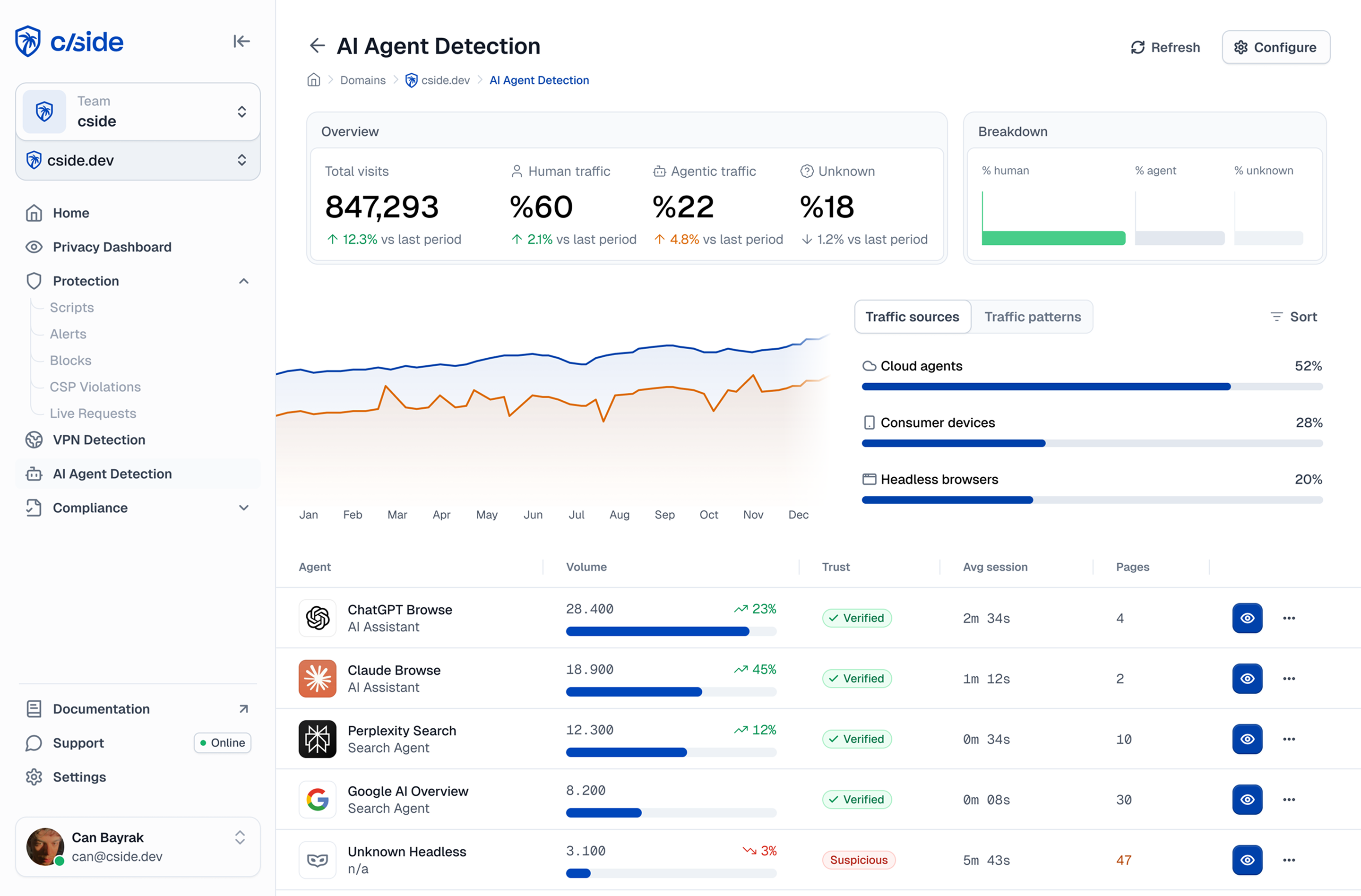
cside is a web security platform specialized in watching the browser runtime. cside's AI agent detection is purpose-built to identify fraudulent AI agents on your website. With cside:
- Get a dashboard of which agents are accessing your site and what they are doing
- Automatic risk scores from behavioral signals to catch bad AI agents (including browser-based and locally hosted ones) that evade traditional bot defenses
- Feed detection signals into your own enforcement action workflows
- Prevent AI agent fraud such as promo code abuse, fake account creation, credit card testing, vulnerability discovery, and advanced scraping