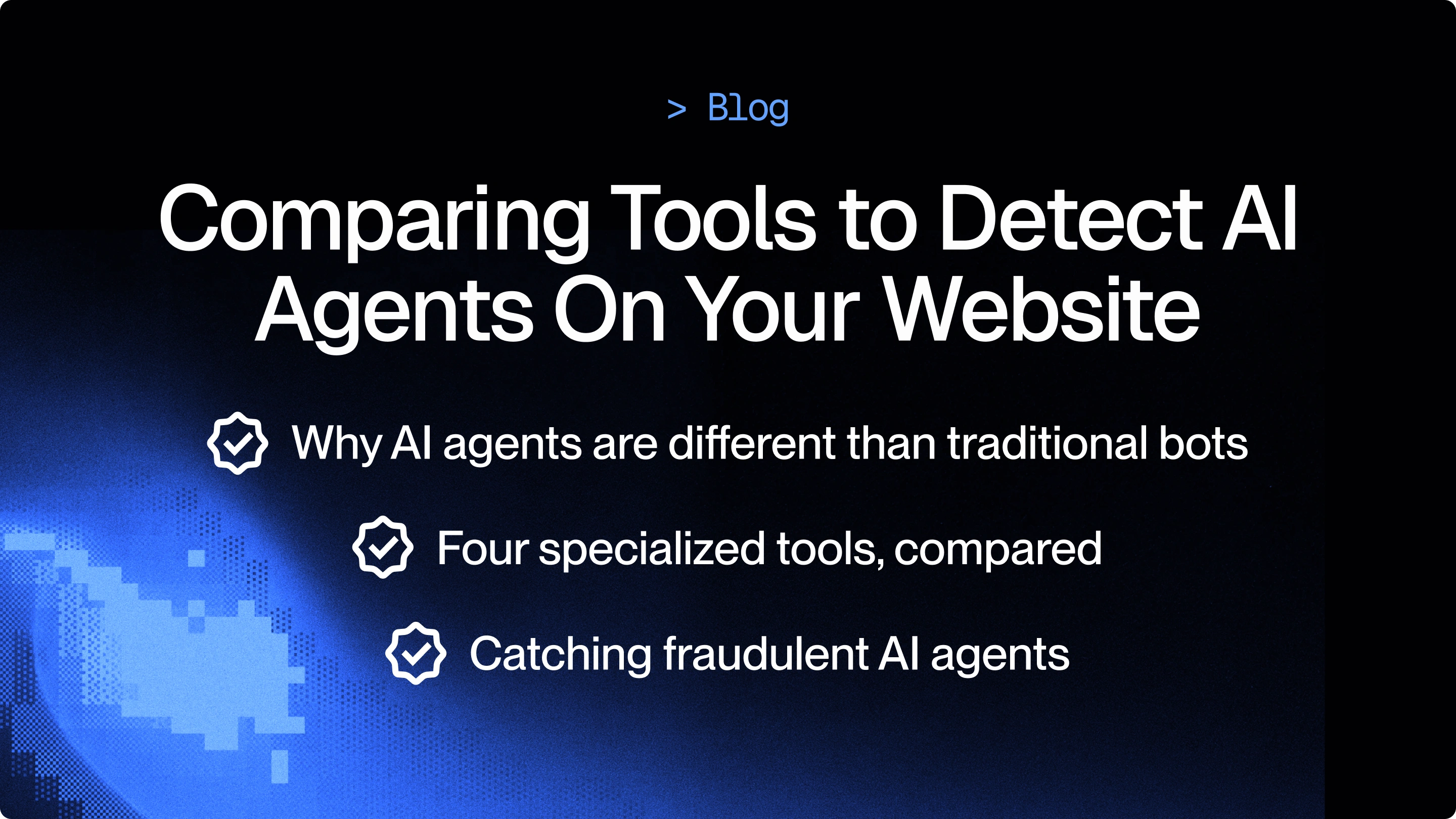
TL;DR
- AI agent detection tools differ from bot management tools. AI agents operate inside real browsers and stealth browsers were built to solve CAPTCHAs and rotate IPs. These agents slip past traditional bot detection. Specialized tools are needed to catch them.
- This guide compares four tools: cside AI Agent Detection, HUMAN Security AgenticTrust, DataDome Agent Trust, and Cloudflare Bot Management. We look at their detection approach and best-fit use cases.
- A specialized AI agent detection tool matters if you are looking to reduce fraud vectors like card testing, multi-accounting, and promo code abuse, all of which AI agents automate at scale in browser sessions that look human.
- Forrester renamed the category to "Bot and Agent Trust Management" in Q4 2025. The question is no longer "bot or not." It is "how much do I trust this agent, and what should it be allowed to do?"
Comparison table: AI agent detection tools
| cside (AI Agent Detection) | HUMAN Security (AgenticTrust) | DataDome (Agent Trust) | Cloudflare (Bot Management) | |
|---|---|---|---|---|
| Detection approach | Browser and behavior signal focus, with network layer signals as well | Network layer, limited browser layer visibility | Network layer, limited browser layer visibility | Network layer, limited browser layer visibility |
| Key features | Agent dashboard, behavioral risk scores, API/webhook output, fraud detection | Cryptographic agent verification, named agent detection, session tracking | 4-category agent classification, intent verification, zero sampling | AI Crawl Control, per-customer ML models, Turnstile, AI Labyrinth |
| Pricing | Free tier available. Plans from $99/mo. Enterprise packages available. | Enterprise only. Not published. Sales call required. | Enterprise only. Not published. Demo required. | Free basic tier. Business $200/mo. Full Bot Mgmt requires Enterprise. |
| Implementation | Self-service JS snippet. Guided PoC available on request. | Vendor-assisted. CDN or server-side integration. Multi-week onboarding. | CDN partner or server-side modules. Vendor-assisted. Days to weeks. | Config toggle if already on Cloudflare. DNS migration if not. |
| Best fit | Organizations focused on stopping fraud: scraping, content piracy, card testing, payment fraud. | Enterprises needing deep threat intelligence and advertising fraud protection. | Teams wanting trust-based agent classification with zero-sampling coverage. | Sites already on Cloudflare wanting CDN-scale bot protection with low friction. |
What are AI agent detection tools (and how they differ from bot detection)
Bot detection tools were built for a simpler era. Automated scripts would hit your server with suspicious requests, and tools would block them based on IP addresses and request patterns. AI agents are different. They use real web browsers and navigate your site like a customer would.
The difference between AI agent detection tools and bot detection tools
- Why the miss rate is so high: AI agents use real browsers and residential IP addresses. Their network traffic looks human. In controlled testing, cside found that traditional bot detection tools missed AI agents 81 out of 100 times.
- What AI agent detection adds: Instead of just reading network signals, these tools monitor the browser session itself. They check whether the browser is what it claims to be, whether interactions follow human patterns, and whether the session behavior matches a known agent.
AI agent detection tools for fraud prevention
"AI agent detection" is often abstracted to "search crawlers and LLM trainers". These are easy to detect (and we break down how in our guide how to detect AI agent traffic). What requires a specialized tool are the agents that were designed to be stealthy and perform abusive actions on your website:
- Credit card testing: An army of AI agents can test hundreds of cards across browser sessions.
- Fake accounts created automatically. Agents can sign up for accounts, bypass CAPTCHAs using solving services, and build fake identities for referral abuse or loyalty fraud.
- More chargebacks, faster. When agents make purchases with stolen credentials, chargebacks pile up. Without a way to tell shopping agents from fraudulent ones, you are left choosing between blocking all agent traffic (losing legitimate sales) or allowing it (absorbing the fraud).
Comparison of AI agent detection tools
cside (AI Agent Detection)
cside was born as a web security company focused on the browser runtime layer. The company was founded to close the gap that WAFs and network-centric security tools have: limited visibility into client-side signals. That is where fraudulent AI agents leave important clues. cside's AI agent detection platform is a dedicated product purpose-built to detect, classify, and govern AI agent traffic at the browser layer.
cside actively co-chairs the W3C Anti-Fraud Community Group and regularly publishes website security research.
Features
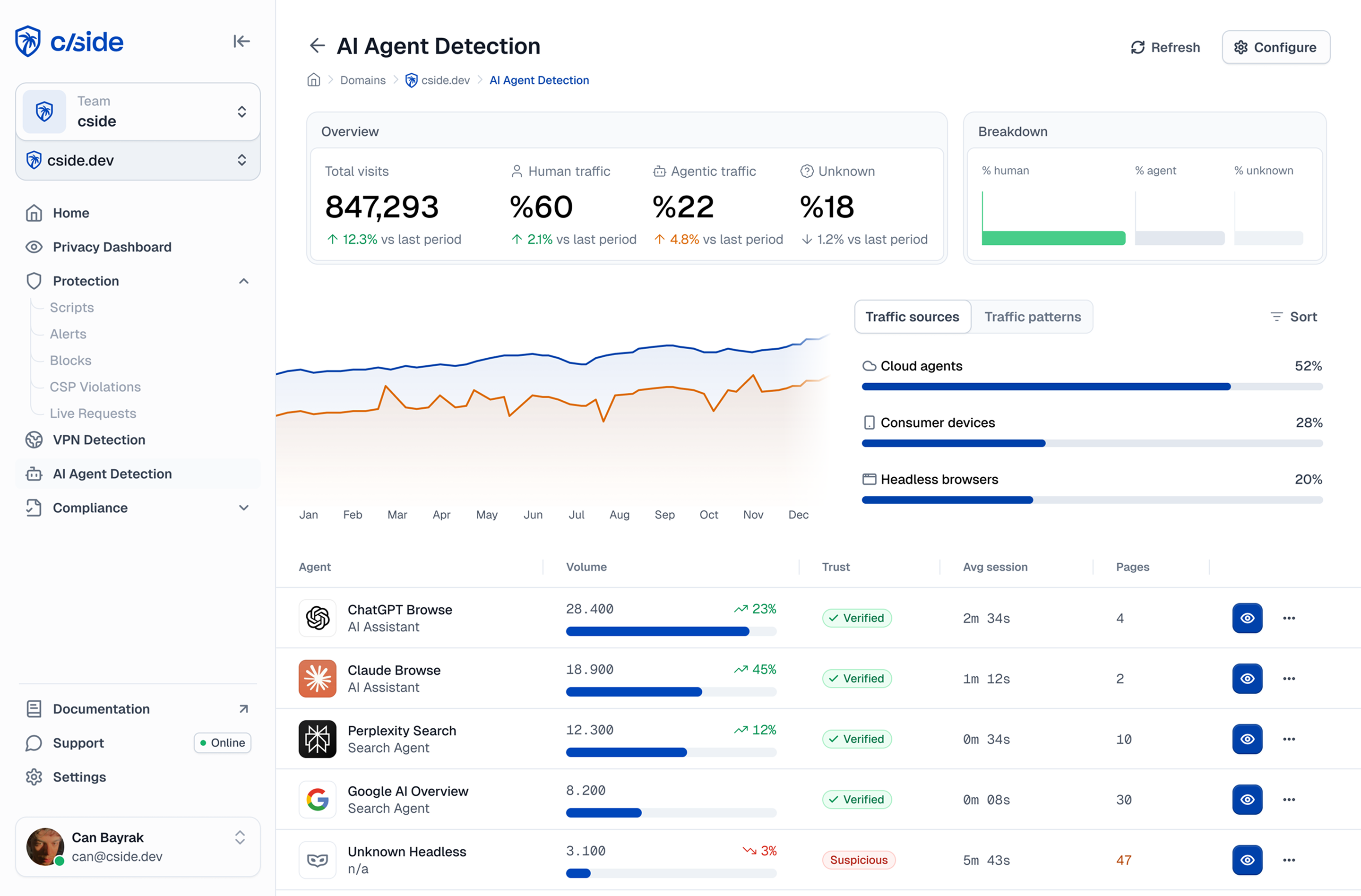
- Dashboard showing which agents are accessing your site and what actions they are taking per page
- Risk scores derived from behavioral signals and browser environment analysis to flag malicious AI agents
- Detection signal output that feeds into your existing enforcement and workflow tooling
- Fraud prevention coverage for promo code abuse, content piracy, credit card testing, vulnerability discovery, and advanced scraping
Our team detailed some of the specific signals we use to catch AI agents in this blog: How we detect AI agents on your website
Detection approach
Monitors for signals across four layers: Identity (user-agent strings and cryptographic hashes), Network, Browser, and Behavioral signals. Deep visibility into browser and behavior signals that other tools lack.
Pricing
- Free tier and free trial available
- Small business (starting at $99/mo) and enterprise packages available
Implementation
Self-service deployment. Add a JavaScript snippet to your site and monitoring begins. Guided setup in a PoC environment is available upon request.
Pros
- Raw data available through API and webhook
- Purpose built for fraud detection, not just traffic analytics
- Flexibility for custom enforcement (Allow / Block / Tailored Experience)
- Best for organizations trying to stop fraud: competitive scraping, content piracy, and payment fraud
HUMAN Security (AgenticTrust)
HUMAN Security runs one of the biggest bot detection networks in the world. AgenticTrust is their product specifically for AI agent detection, built on top of that existing network.
Features
- Verifies agent identity using cryptographic signatures, not just user-agent strings
- Identifies specific named agents like AWS AgentCore, OpenAI Atlas, and Claude for Chrome
- Tracks what agents do across your site at the session level, not just per-request
- Single dashboard view across all your protected applications
Detection approach
Primarily network-layer with deep threat intelligence. HUMAN deploys some client-side JavaScript, but detection decisions are made server-side against their threat intelligence network.
Pricing
Enterprise-only pricing. Not published. You will need to talk to their sales team. There is no free tier or self-service option.
Implementation
Enterprise deployment with vendor support. Integrates through CDN partnerships, cloud platforms, or server-side modules. Onboarding takes multiple weeks and includes configuring detection rules for your specific traffic.
Pros
- The largest threat intelligence dataset in the market, built from over one quadrillion analyzed interactions
- Cryptographic agent identity verification adds a trust layer beyond behavioral detection
- Great fit to protect against advertising fraud related activity
DataDome (Agent Trust)
DataDome analyzes every request to your site and makes a bot decision in under 2 milliseconds. Agent Trust is their AI agent product, which classifies agents by type and evaluates whether they should be allowed to do what they are trying to do.
Features
- Sorts agents into four types: AI Crawler, AI Assistant, Agentic Browser, and Autonomous Agent
- Evaluates intent per request, asking whether this agent should be allowed to perform this action
- Supports cryptographic agent identity verification through Web Bot Auth
- Processes every request with no sampling, so nothing gets a free pass
Detection approach
Network and CDN-layer architecture. DataDome evaluates every request server-side in under 2 milliseconds. Some client-side signals feed back into server-side decision engines, but the detection logic lives outside the browser session.
Pricing
Enterprise-only. You need a demo and sales conversation to get pricing. No free tier or self-service option available.
Implementation
Deploys through CDN partners like Cloudflare, AWS CloudFront, Fastly, and Akamai, or through server-side modules. Vendor-assisted setup. Expect days to weeks before you are fully running.
Pros
- Trust-based approach that goes beyond "bot or not" to evaluate what agents should be allowed to do
- No sampling means every request gets evaluated, not just a percentage
- Processed nearly 8 billion AI agent requests in early 2026, giving their models a large signal base to learn from
Cloudflare Bot Management
Cloudflare's bot management runs on ML models trained through traffic patterns across millions of websites to classify requests at the edge, supplemented by JavaScript challenges via Turnstile and behavioral heuristics.
Features
- AI Crawl Control for managing known AI crawlers and agents with per-crawler policies
- Per-customer bot defense models using 50+ heuristics, built since mid-2025
- Turnstile for frictionless challenge-based verification without traditional CAPTCHAs
- AI Labyrinth: traps misbehaving bots in generated content rather than blocking outright
Detection approach
CDN-edge detection. ML models classify requests as they arrive at Cloudflare's network. Turnstile adds a client-side challenge layer, but the core detection architecture operates at the edge.
Pricing
Free plan includes basic bot protection (Super Bot Fight Mode). Business plan at $200/month adds more bot management features. Full Bot Management requires an Enterprise plan with custom pricing. The gap between the free tier and the full product is significant.
Implementation
If your site already runs on Cloudflare, enabling bot management is a configuration toggle. If not, deployment requires a DNS migration (pointing nameservers to Cloudflare), which is a meaningful infrastructure decision. Enterprise features require a sales conversation.
Pros
- Global IP reputation and pattern matching at CDN scale
- Machine learning scoring per request
- Bot Fight Mode for low-friction deployment
Why AI agent detection helps reduce fraud
Existing fraud vectors will get amplified by AI agent driven bots
The Merchant Risk Council's 2026 Global Payments and Fraud Report surveyed members including Airbnb, Blizzard, and other major commerce platforms. The most common payment fraud types: first-party misuse (83% of members affected), card testing (71%), and refund abuse (60%).
Each of these becomes more dangerous when an AI agent executes it instead of a traditional bot:
- Card testing. An AI agent runs hundreds of validation attempts in parallel browser sessions, each producing behavioral patterns that pass network-layer checks.
- First-party misuse and refund abuse. Agents can file disputes, request refunds, and exploit return policies across multiple merchant accounts simultaneously.
- Account creation at scale. Agents fill registration forms, route CAPTCHAs to solving services, and build synthetic identities for referral abuse.
- Promo code abuse. Agents systematically test promotional codes across product categories and stockpile valid ones faster than any human operator could.
- Content and pricing scraping. Agents operating in browser sessions bypass crawl rate limiters designed for traditional HTTP scrapers.
The different AI agent bots on your website
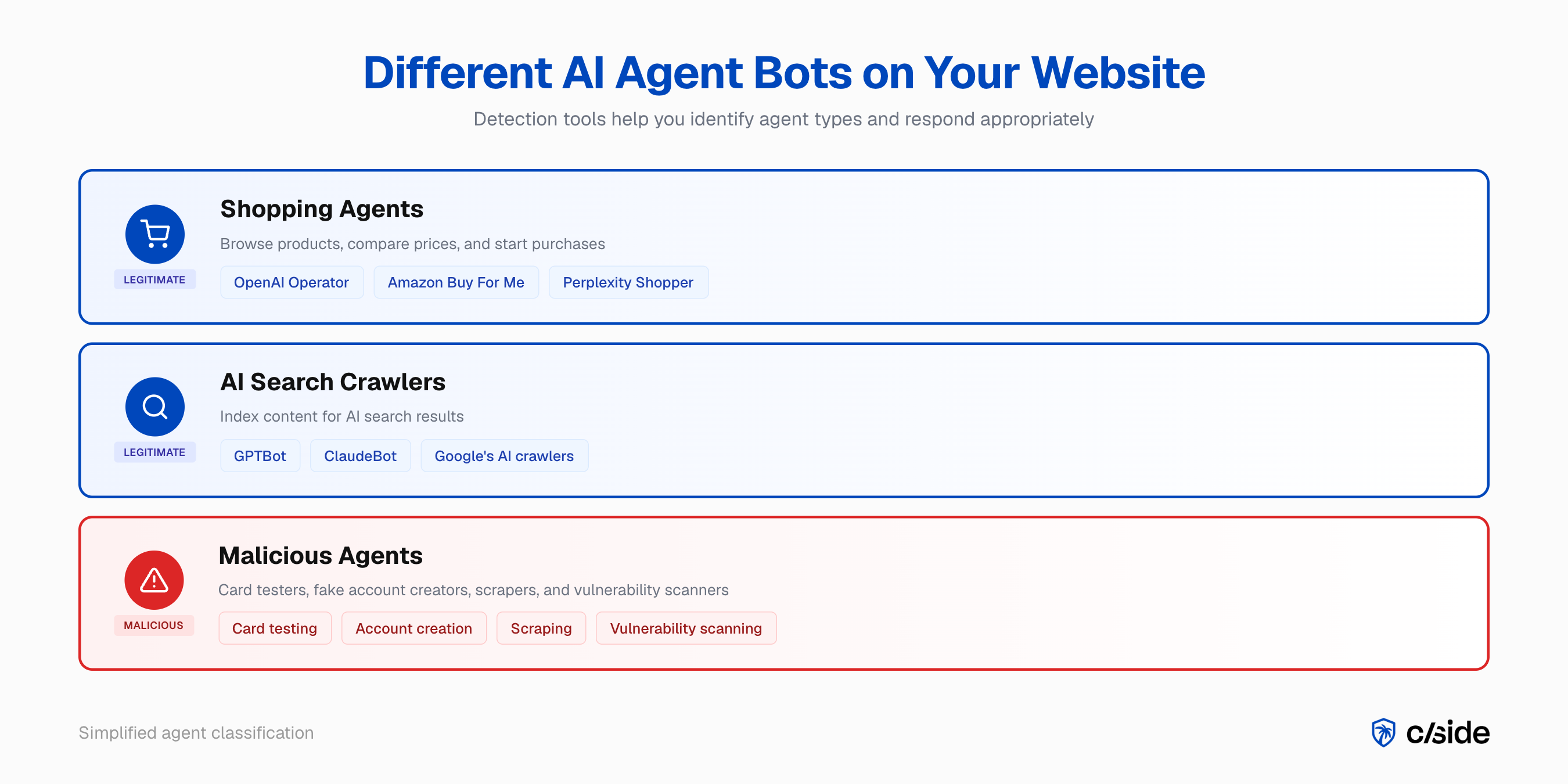
Not every AI agent on your site is a problem. Some are bringing you customers.
- Shopping agents (OpenAI Operator, Amazon Buy For Me, Perplexity Shopper) browse your products, compare prices, and start purchases. Visa and Mastercard launched payment infrastructure for agent-initiated transactions in 2025. This is legitimate business.
- AI search crawlers (GPTBot, ClaudeBot, Google's AI crawlers) index your content for AI search results. Most identify themselves through their user-agent string.
- Malicious agents are card testers, fake account creators, scrapers, and vulnerability scanners. They use stealth browsers and residential proxies, and they never identify themselves.
What to look for in an AI agent detection tool for your website
The capabilities that matter for AI agent detection are different from what you would evaluate in a traditional bot management tool. If you want to weigh more vendors than the four above, including Kasada and Arkose Labs, see our broader comparison of bot and agent trust management platforms.
- AI agents run inside real browsers. If the tool only reads network signals, it cannot see what the agent is doing inside the session.
- Knowing whether traffic is OpenAI Operator or an unknown scraper changes the response entirely. The tool should identify specific agents, not just flag "bot or human."
- Product pages, cart, and checkout carry different risk. A site-wide rule cannot account for that. Look for page-level policy support.
- Blanket blocking kills legitimate agentic commerce. The tool should support allow, block, and guide actions based on classification.