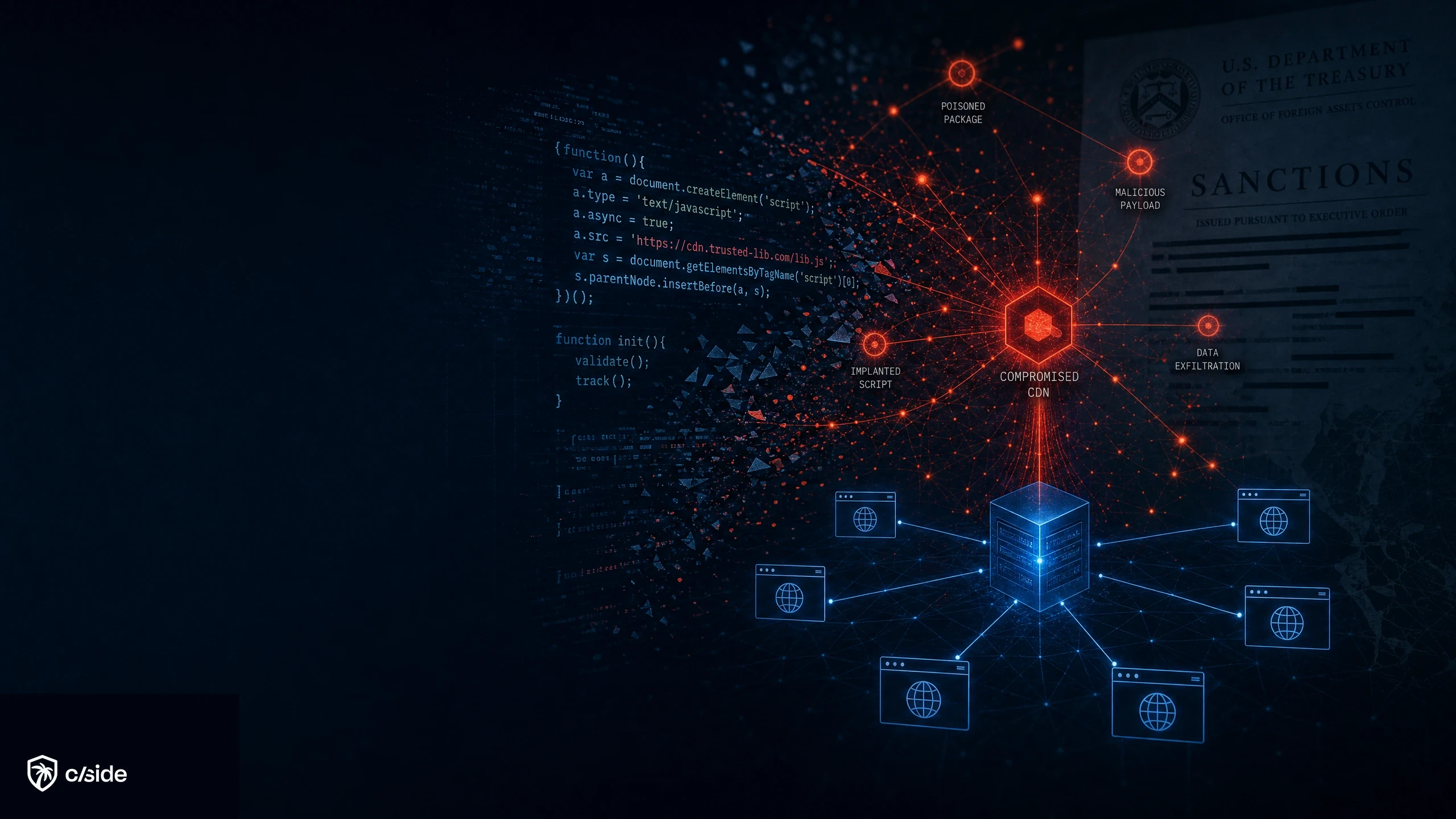
Quick answer: OFAC sanctioned Funnull Technology Inc. on 2025-05-29, along with administrator Liu Lizhi. That action reframes the Polyfill[.]io incident: what looked like a redirect campaign against websites that still loaded an old JavaScript utility was in fact a browser supply-chain failure connected to a larger infrastructure laundering operation.
The lesson for security teams is direct: third-party scripts cannot be treated as trusted forever because they were trusted once. Ownership changes, CDN routing changes, and second-stage payloads can turn a normal browser dependency into an attack path.
TL;DR: Funnull sanctions and Polyfill laundering
- OFAC sanctions: OFAC sanctioned Funnull Technology Inc. and administrator Liu Lizhi on 2025-05-29
- $200M in losses: Treasury linked Funnull to more than $200 million in U.S. victim-reported losses
- 548 CNAMEs mapped: The FBI identified 548 Funnull CNAMEs linked to more than 332,000 unique domains
- Repo bought and altered: Treasury said Funnull bought and altered a web developer code repository in 2024 to redirect visitors
- Runtime checks needed: The Polyfill[.]io case shows why browser-side defenses need runtime script behavior checks, not only vendor trust
Short on time? See cside's in-browser Magecart and skimmer blocking. It covers everything below in one deployment.
What changed: Funnull is now a sanctioned infrastructure provider
The U.S. Department of the Treasury sanctioned Funnull as a Philippines-based company that provided computer infrastructure for hundreds of thousands of websites involved in virtual currency investment scams. Treasury described these scams as pig butchering and said Funnull directly facilitated schemes tied to more than $200 million in U.S. victim-reported losses.
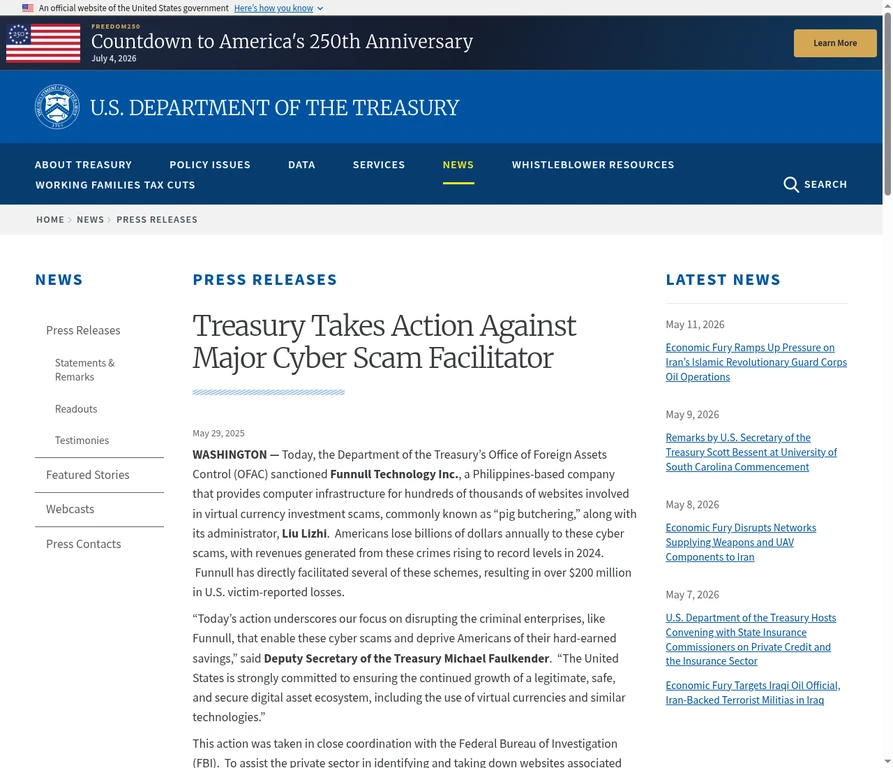
The same action sanctioned Liu Lizhi, described by Treasury as an administrator of Funnull. Treasury said Liu was involved in operational documents and tasking that included assigning domains to cybercriminals for investment fraud, phishing scams, and online gambling sites.
The scale matters. The FBI advisory published the same day said investigators had identified 548 unique Funnull CNAMEs linked to more than 332,000 unique domains since January 2025. That is not a single bad domain. It is an infrastructure layer.
How Polyfill[.]io fits into the larger Funnull pattern
In 2024, Polyfill[.]io was already a clear browser supply-chain warning. A widely embedded JavaScript service changed hands, then served malicious redirects to a percentage of users based on runtime conditions. Security firm Sansec documented the payload. (The related CVE-2024-38526 was assigned to pdoc, the Python documentation tool that loaded polyfill.io, not to the incident as a whole.) cside covered it in The Polyfill[.]io attack explained, reported the real scale in our complete Polyfill.io timeline, and explained why it was more than just a redirect attack.
Treasury's Funnull action makes the connection sharper. Treasury said that in 2024 Funnull purchased a repository of code used by web developers and maliciously altered the code to redirect visitors of legitimate websites to scam websites and online gambling sites.
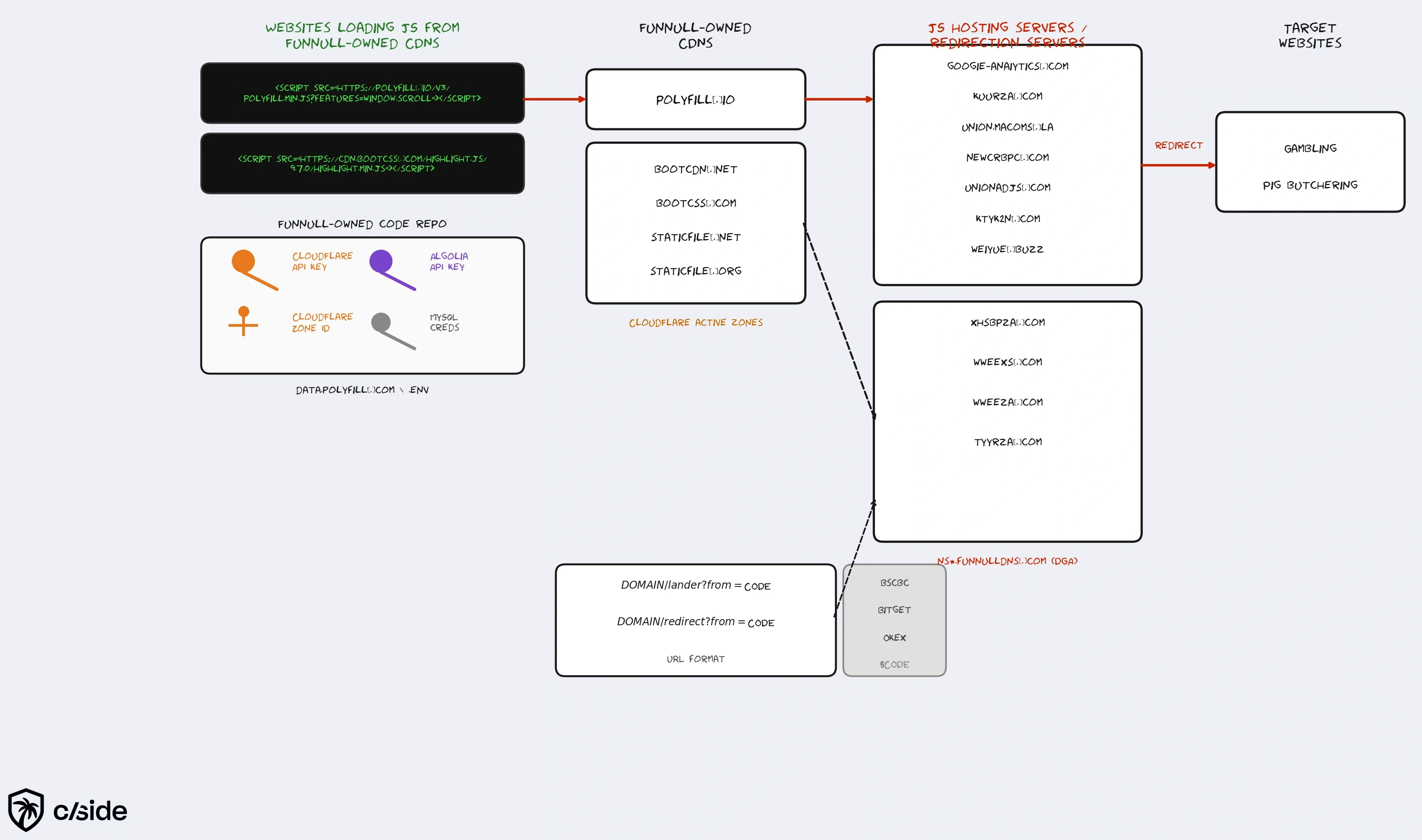
As of 2026-05-18, PublicWWW still listed 61,593 web pages containing "polyfill.io", even though Namecheap had taken action against the malicious domain after the 2024 supply-chain attack. That residue is the operational problem: browser dependencies can remain embedded long after a domain has been suspended, blocked, or publicly identified as unsafe.
That is the operating pattern security teams need to recognize. A script can be harmless when approved, risky when ownership changes, and malicious when the code path changes. The website owner may not change a line of code. The user's browser still executes the new payload.
What infrastructure laundering means for security teams
Infrastructure laundering is the use of credible infrastructure to hide or legitimize malicious activity. Instead of hosting every scam site on obvious low-reputation servers, an operator can route through cloud providers, CDNs, DNS chains, and front brands that look normal from a distance.
For browser security, the most important part is not the label. It is the control gap. A site may trust a CDN URL because it worked yesterday. A vendor review may approve a domain because the vendor was legitimate at the time. A tag manager may show the same top-level script while that script loads a different second-stage resource at runtime.
That is why source-based trust fails. The browser does not execute a vendor questionnaire. It executes JavaScript.
| Control | What it helps with | Where it falls short |
|---|---|---|
| Script inventory | Shows which scripts are supposed to be present | Misses runtime behavior and fast vendor-side changes |
| Vendor review | Captures business ownership and approval | Goes stale after acquisitions, rebrands, and subprocessor changes |
| Subresource Integrity | Blocks changed static files when hashes are pinned | Breaks on dynamic scripts and does not cover runtime sub-scripts |
| Content Security Policy | Limits where scripts and resources can load from | Requires precise allowlists and can miss behavior inside allowed domains |
| Runtime behavior monitoring | Watches what scripts actually load, change, and do | Needs browser-layer instrumentation and operational review |
Why sanctions do not end the browser-side risk
Sanctions can disrupt a named company, freeze assets under U.S. jurisdiction, and make business with the sanctioned party legally risky for U.S. persons. They do not automatically remove every related domain, script, CDN route, or cloned front company from the internet.
The post-sanction risk is already visible in threat research. Silent Push reported that infrastructure associated with the broader Triad Nexus and Funnull ecosystem continued to evolve after the 2025 sanctions, including geographic blocking, CNAME rotation, and clean-looking front companies.
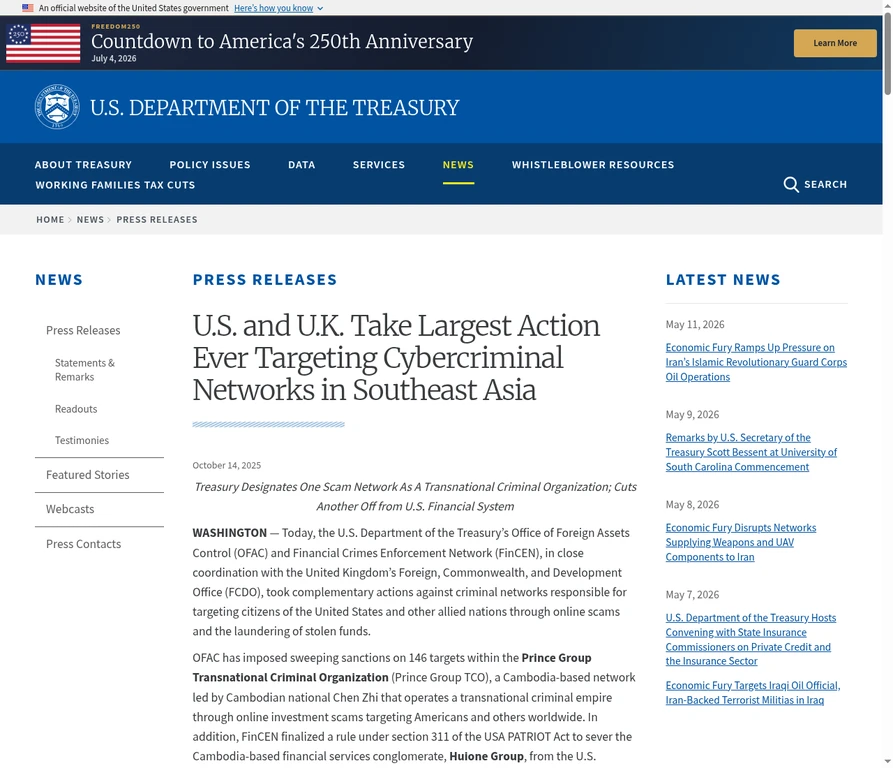
Treasury's later U.S. and U.K. action against Southeast Asian cybercriminal networks also shows the wider enforcement context. OFAC sanctioned 146 targets within the Prince Group Transnational Criminal Organization, while FinCEN finalized a rule severing Huione Group from the U.S. financial system. These are large, adaptive networks. Removing one brand does not remove the business model.
What to do this week
Start with the scripts that can touch login, checkout, account creation, payment, and personal data flows.
- Search for
polyfill[.]io,bootcdn[.]net,bootcss[.]com,staticfile[.]net,staticfile[.]org, andunionadjs[.]comin source code, tag managers, CMS templates, and legacy snippets - Remove dead compatibility scripts that modern browsers no longer need
- Map every third-party script to an owner, purpose, page scope, and data access level
- Identify scripts that load additional scripts, build URLs dynamically, or execute different code by user agent, geography, referrer, or session state
- Use SRI only where the script is static and the provider supports stable hashes
- Tighten CSP on sensitive flows, then monitor violations before moving from report-only to enforcement
- Add runtime monitoring so script changes, redirects, data access, and unexpected network calls are visible when users load the page
Treat this as an exercise in third-party script governance, not a one-time Polyfill cleanup.
How cside helps monitor third-party script risk
cside works at the browser layer, where third-party scripts actually execute. That matters because server logs, vendor reviews, and static inventories miss important runtime behavior.
With cside, teams can see which scripts load on real pages, what those scripts call, how they change, and whether they attempt suspicious behavior such as unexpected redirects or data access. That visibility helps security and compliance teams move from "we approved this vendor once" to "we know what this code is doing now."
The Funnull sanctions are a useful forcing function. They show that client-side supply-chain risk is not theoretical, and it is not limited to obviously malicious domains. The risk sits in the gap between trusted inclusion and runtime execution.
As of 2026-05-18, sanctions designations, infrastructure indicators, and active fronts can change. Treat the named domains and CNAMEs as investigation leads, not a complete blocklist.
Further reading
- Polyfill.io supply chain attack: complete timeline and analysis
- Treasury Takes Action Against Major Cyber Scam Facilitator
- FBI advisory on Funnull infrastructure
- Sansec forensic analysis of the Polyfill.io payload
- Silent Push research on post-sanction Funnull infrastructure
- The Polyfill[.]io attack explained
- The Polyfill[.]io attack: more than just a redirect attack
- Script integrity management for ecommerce brands