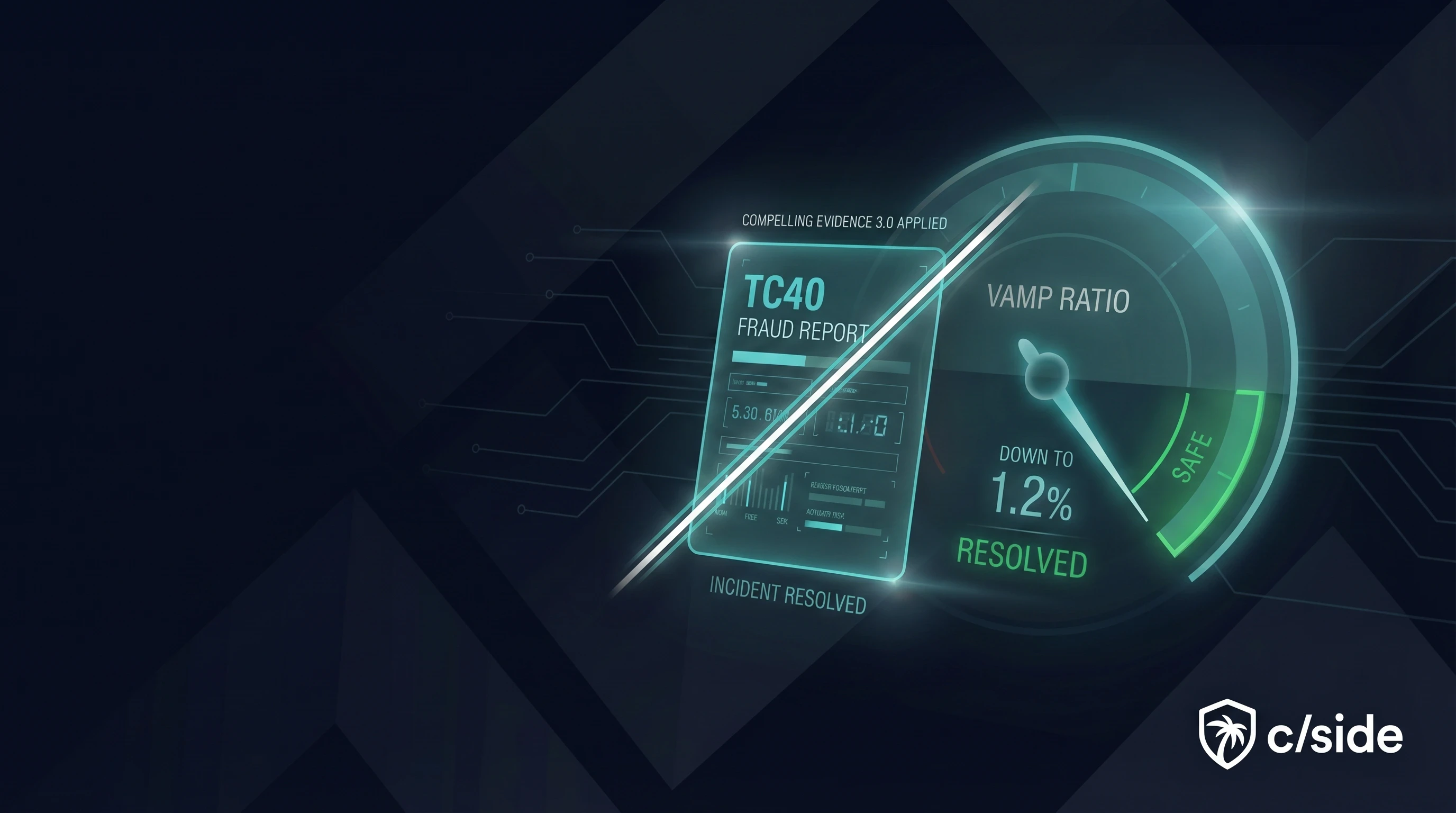
Quick answer: A TC40 is a Visa issuer-submitted fraud report that counts toward the VAMP ratio regardless of whether a chargeback is processed. The only way to remove a TC40 from the VAMP numerator is to win a Compelling Evidence 3.0 (CE 3.0) representment on the linked Visa reason code 10.4 chargeback. c/side, the browser-layer security platform, captures the deterministic device ID and real client IP that are the rate-limiting fields in any CE 3.0 case. A successful representment removes both the chargeback and the TC40 from the fraud count.
A TC40 is Visa's issuer-submitted fraud report. When a cardholder calls their bank and claims a transaction was unauthorised, the issuer files a TC40 whether or not they subsequently process a chargeback. Under the legacy VFMP, those TC40s sat in a separate fraud ratio. Under VAMP, which replaced VDMP and VFMP on 1 April 2025 and tightened again on 1 April 2026, a TC40 counts the same as a chargeback. It contributes directly to the single ratio Visa uses to enforce against acquirers and their merchants.
That matters because a significant share of TC40s never become chargebacks. Issuers often write off low-value disputes rather than process them. Those write-offs still generate the TC40 message. The merchant has no chargeback to fight, no direct dispute workflow to respond through, and no immediate mechanism to scrub the fraud report from their ratio.
Except one. A successful Compelling Evidence 3.0 representment on a linked chargeback removes the associated TC40 from the fraud count. It is the only sanctioned way to take a TC40 off your VAMP numerator after the fact. This piece explains the mechanic.
Why TC40 matters in a VAMP world
Quick Answer: Under VAMP, a TC40 fraud report and a TC15 chargeback both count toward the same monthly ratio. A merchant with a clean chargeback record can still breach the 1.5% Excessive threshold on TC40 volume alone. Because TC40s are often filed without a matching chargeback, merchants frequently do not see them until the ratio reading arrives from the acquirer.
The operational reality is that the VAMP numerator has two tributaries and one of them is partly invisible to the merchant. Visa's public VAMP overview defines the ratio as the count of fraud reports (TC40) plus disputes (TC15), divided by settled transactions (TC05). Merchants that need the underlying TC40 records usually have to request that data from their acquirer or processor.
See the VAMP 2026 merchant playbook for the full threshold context and how VAMP is calculated month-by-month.
What a TC40 actually is
Quick Answer: A TC40 is a Visa record containing issuer-reported fraud claim data. It includes the merchant ID, merchant category code, acquirer, transaction amount and date, partial cardholder information, and a fraud type indicator. It is generated when a cardholder reports a transaction as fraudulent to their issuer. It does not by itself reverse the transaction.
A TC40 carries the fraud signal without the dispute process. Issuers use TC40 volume to prioritise fraud reviews, Visa uses it to monitor acquirers, and acquirers use it to score merchants. Merchants who get no visibility on TC40 traffic can be downgraded or terminated without ever seeing a chargeback.
The core mechanic: CE 3.0 reversal removes the TC40
Quick Answer: When a merchant wins a Compelling Evidence 3.0 representment on a Visa reason code 10.4 dispute, two things happen. The chargeback is reversed, and the TC40 associated with that transaction is removed from the fraud count that feeds the VAMP ratio. The transaction still counts against the dispute count until the CE 3.0 reversal processes, then it is scrubbed from both.
This is the rule that makes CE 3.0 materially more valuable than CE 2.0 was. Previous rounds of Compelling Evidence could overturn a chargeback but did not formally remove the fraud report. CE 3.0 changes that linkage.
The practical effect is that CE 3.0 gives merchants a retrospective lever on their VAMP ratio. Every reason code 10.4 dispute that wins under CE 3.0 takes one unit off the fraud numerator. On a merchant running 200,000 transactions monthly with a 1.8% ratio, each won representment is a unit less in the numerator; the aggregate impact depends on the volume of qualifying disputes and the representment win rate.
From c/side data: c/side tracks TC40 scrub rates across its merchant base by comparing VAMP numerator readings before and after CE 3.0 representment campaigns. The key variable is the share of reason code 10.4 disputes that have complete browser-layer evidence (device ID and real client IP) for both prior and disputed transactions. This determines the maximum addressable scrub potential for any given merchant.
What it does not do
Quick Answer: CE 3.0 does not remove TC40s from reason codes other than 10.4. It does not remove TC40s on disputes the merchant loses or does not represent. It does not apply retroactively to CE 2.0 cases that were lost. It does not remove TC40s from Mastercard SAFE reports, which feed the equivalent Mastercard programmes separately.
Three boundary conditions merchants commonly get wrong:
- CE 3.0 only applies to Visa reason code 10.4 ("Other Fraud: Card-Absent Environment"). A reason code 10.5 ("Visa Fraud Monitoring Program") dispute does not qualify, nor does a service or processing dispute.
- The merchant must actually represent: a TC40 attached to a dispute the merchant declines to fight stays on the fraud count.
- The representment must win. A qualified packet that loses on the merits does not remove the TC40.
The four-step workflow to scrub a TC40
Quick Answer: Identify the Visa reason code 10.4 dispute linked to the TC40. Assemble CE 3.0 qualifying evidence (two prior undisputed transactions, 120 to 365 days old, with matching device ID or IP plus one of shipping address or User ID). Submit representment with browser-layer evidence. Confirm with the acquirer that the TC40 has been removed from the fraud count after the reversal processes.
Each step has a common failure mode.
Step 1. Link the TC40 to the chargeback. TC40s and chargebacks are separate messages in Visa's settlement data. Most acquirers can match them on transaction reference, but merchants often need to request the link explicitly.
Step 2. Build the CE 3.0 packet. The qualification rules are covered in the CE 3.0 requirements guide. The two prior transactions must be undisputed, on the same payment credentials, 120 to 365 days old. At least two of four data elements must match. One of those must be IP or device ID.
Step 3. Submit the representment with browser-layer evidence. Server-side records alone typically do not produce IP or device ID at CE 3.0 standard. Browser-layer evidence captured at checkout, via a tool like c/side's Chargeback Evidence or with device fingerprinting for compelling evidence, provides the deterministic match the issuer needs.
Step 4. Verify the scrub. After the reversal processes, confirm with the acquirer that the TC40 has been removed from the next VAMP reading. Ask for a before-and-after ratio snapshot.
Why browser-layer evidence is the unlock
Quick Answer: The rate-limiting step in TC40 removal is CE 3.0 win rate. Win rate depends on evidence quality, particularly device ID and IP match across prior and disputed transactions. Browser-layer evidence captured at checkout is the only source that produces those matches deterministically.
c/side's Chargeback Evidence product instruments this at checkout. Every session on the same merchant produces a stable device identity, which means a prior transaction from ten months ago matches the disputed one today without ambiguity.
For a Head of Risk with an elevated TC40 load, the key question to answer is: how many of your current reason code 10.4 disputes have full browser-layer evidence (device ID and real client IP) for both the prior and disputed transactions? That number determines your maximum addressable TC40 scrub rate. Merchants who have not yet instrumented browser-layer capture are leaving that scrub potential on the table.
For iGaming operators, where TC40 volumes in the gaming MCC are routinely high, this calculation is especially material.
What to do this week
Quick Answer: Request the TC40 data feed from your acquirer if you do not already have it. Segment it by reason code and measure the share attributable to 10.4. Run a CE 3.0 representment test on the top quartile by value and measure the win rate. If the win rate is below 70%, the evidence chain is the gap.
- Day 1: ask the acquirer for TC40 volume by reason code for the last 60 days. Insist on reason code 10.4 as a separate cut.
- Day 2: pull the corresponding chargebacks, if any, for the top 100 TC40s by transaction value.
- Days 3-5: run CE 3.0 representments on the cases that qualify, using existing evidence. Record the win rate.
- Day 6: on losing cases, identify which of the ten CE 3.0 evidence points (see CE 3.0 requirements) were missing or weak. Typically device ID, IP, and descriptor first-6 are the failure points.
- Day 7: scope the remediation. Browser-layer evidence instrumentation typically takes a few days to integrate; confirm the timeline with your implementation team.
Further reading on c/side
- c/side Chargeback Evidence product page
- VAMP 2026 Merchant Playbook
- Compelling Evidence 3.0 Requirements
- Browser-Layer vs Server-Layer Chargeback Evidence
This article reflects c/side's analysis of VAMP and friendly-fraud regulations as of 2026-04-28. Threshold values, deadlines, and programme rules are subject to change by Visa, Mastercard, and acquirer-specific contracts. Verify with primary sources before operational decisions.