Google recently proposed Device Bound Session Credentials (DBSC), a browser-native mechanism that ties session cookies to the physical hardware of the device that created them. It is a direct response to one of the most effective attacks in the modern threat landscape: malware steals your session cookie, and the attacker logs in as you. No password required. No MFA prompt. No second chance to catch them.
That a browser vendor is building hardware-backed session binding into the platform is significant. It is not just a new security feature. It is an acknowledgment that the browser session itself has become a first-class security boundary, one that attackers exploited for years while most platforms kept treating authentication as a one-time event at login.
The uncomfortable reality is that banking portals, government services, and healthcare systems remain exposed to this attack class. They verify identity at the moment of login. They often do little to verify the device holding the session afterward.
What DBSC actually does
The core problem with today's session model is that a cookie is a portable secret. Whoever holds it can use it. There is no mechanism in the standard bearer-token model to verify that the session is being used by the same device that created it.
DBSC changes that by introducing a hardware-backed keypair into the session lifecycle. When a browser establishes a session under DBSC, it generates a private key stored in hardware, such as a TPM on Windows or the Secure Enclave on macOS. The server registers the session against the corresponding public key. From that point, the browser must periodically prove it still holds the private key. The server only issues refreshed, short-lived cookies if that cryptographic proof checks out.
The result is that the stolen cookie becomes useless off-device. An attacker who exfiltrates the cookie cannot extract the underlying private key from the hardware. The session expires quickly and cannot be renewed from a different machine.
This is not a marginal improvement. It closes the specific replay window that infostealers and adversary-in-the-middle phishing kits exploit at scale.
Why Google is building this now
Session theft is not a new attack. What changed is the industrialization of it.
Infostealers, malware designed to silently harvest browser cookies, saved credentials, and session data, have become a commodity. These records are packaged, indexed, and sold in underground markets. Buyers get access to active, authenticated sessions across banking, enterprise SaaS, government portals, and healthcare systems.
The adversary-in-the-middle (AiTM) phishing variant is equally effective and requires no malware on the victim's machine. The attacker proxies a legitimate login page. The user enters their credentials and completes the MFA challenge against the real application. The phishing infrastructure captures the resulting session token and hands it to the attacker. The victim's MFA controls work exactly as designed. The attacker still wins.
The attack chain is often quiet at the detection stage. It relies on valid credentials and valid sessions, which means endpoint detection and network monitoring can miss the compromise. The attacker is authenticated, so the system treats them as legitimate.
The strategic signal in DBSC
Google's proposal carries a message that matters beyond the technical specification.
By building session binding into the browser platform itself, Google is effectively stating that the browser session is now a security control plane worth protecting directly. That is a significant shift in how the industry thinks about where authentication ends and session security begins.
For too long, the dominant model has been: authenticate the user at login, then trust the token. Backend systems log authentication events. SIEM platforms alert on anomalous login patterns. But once the session is established, the server has no native mechanism to verify that the same device is still on the other end.
Attackers understood this asymmetry years ago. The infostealer ecosystem is built on it. The entire AiTM phishing industry is built on it. DBSC is the browser vendor's answer, and it also validates a broader thesis: browser and runtime context matters, backend logs alone miss too much, and fraud, account takeover, and abuse are increasingly decided in the client session.
What DBSC does not solve
DBSC is a strong anti-session-theft control. It is not a full browser-side abuse defense platform, and precision matters here.
It does not stop malware from running on the victim's machine. If an attacker has code execution on the device, they can abuse the session from that same device before it expires. DBSC specifically addresses the replay problem: stolen sessions used on a different machine. It does not address fraud committed through the original device, account sharing, bot-driven abuse, or the broader class of client-side attacks that manipulate the browser environment itself.
The table below maps what DBSC covers against what it leaves open.
| Threat | DBSC coverage |
|---|---|
| Infostealer cookie theft replayed off-device | Mitigated: stolen cookie cannot be renewed without the hardware key |
| AiTM phishing session capture | Mitigated: captured token expires and cannot be refreshed off-device |
| Malware running on the victim's device | Not covered: attacker can use the session from the compromised machine |
| Credential stuffing and bot-driven login abuse | Not covered: operates at the login layer, not the session layer |
| Client-side script injection and web skimming | Not covered: a separate browser runtime threat |
| Account sharing and multi-session fraud | Not covered: requires behavioral and device-level analysis |
This is not a criticism of DBSC. It is a precise scoping of what any single control can do. The browser session becoming a hardware-bound security boundary is a meaningful advance. It does not eliminate the need for continuous, behavioral session monitoring.
The gap that exists right now
DBSC is a proposal. Broad adoption requires browser vendors, identity providers, and web applications to implement the standard across their infrastructure. That will take years.
In the meantime, the attack is happening today. Banking portals, government services, and healthcare systems are issuing bearer tokens with no device binding and no continuous validation. A session token generated on a user's iPhone in New York can be replayed on a desktop browser routing through a residential proxy in Eastern Europe, and the application will see nothing unusual. It holds a valid token.
This is the gap that high-risk platforms cannot afford to leave open while waiting for a browser standard to mature. The question is what they can deploy now.
Browser fingerprinting as continuous session context
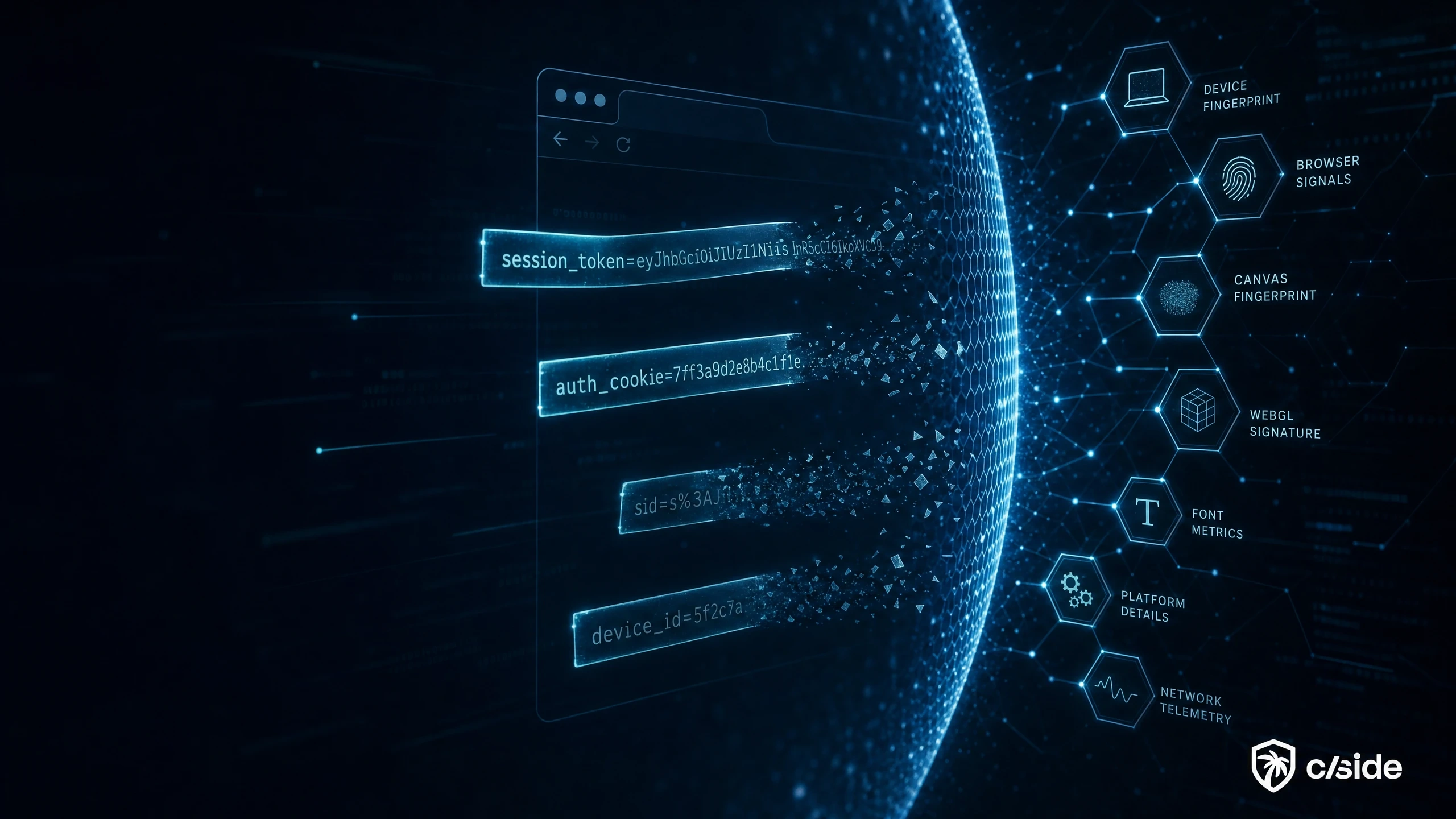
Browser fingerprinting does not require hardware-backed cryptography to provide meaningful session validation. It works by collecting observable signals from the device and browser environment, including screen resolution, installed fonts, WebGL rendering patterns, canvas fingerprint, IP context, proxy indicators, and VPN indicators. Those signals build a persistent identifier for each visitor.
When a user logs in, the fingerprint establishes a baseline for that session. If the session token is later used from a different device, the fingerprint will not match. The environment shift is detectable without changing the authentication infrastructure.
This is not a replacement for DBSC. It is a different layer of the same defense. DBSC prevents the stolen cookie from being renewed off-device. Fingerprinting detects when the session environment has changed mid-session, even before the cookie expires. Together, they represent the continuous, device-aware session validation that the current bearer-token model lacks.
The practical deployment path is straightforward. Fingerprinting signals feed into an existing rules engine or identity provider. A device mismatch mid-session triggers a step-up MFA challenge or invalidates the token outright. The attacker who replayed a stolen cookie from their own machine hits a wall before reaching sensitive data.
What this means for high-risk platforms
The DBSC proposal should prompt a direct question for any security team running a banking portal, government service, or healthcare system: what do you have in place to detect when a valid session token is being used by the wrong device?
If the answer is nothing beyond token expiry, the exposure is real and the attack is well understood. Infostealers harvest and monetize session cookies. AiTM phishing kits are commercially available. The sessions being targeted are not hypothetical. They are the authenticated sessions of your users, right now.
DBSC tells us where the industry is heading. Browser fingerprinting and device-level session validation tell us what is available today.
Continuous session context with cside
cside's advanced device fingerprinting collects over 100 browser, device, and network signals to build a persistent identifier for every visitor. By feeding these signals into your existing rules engine or identity provider, you can detect when a valid session token is being used by an unrecognized device: the exact attack class that DBSC is designed to address at the platform level.
cside also monitors your site's client-side environment for the malicious scripts and session-hijacking payloads that operate below the authentication layer entirely. It is the browser-layer visibility that backend logs cannot provide.
Book a demo to see how cside detects compromised sessions before the damage is done.