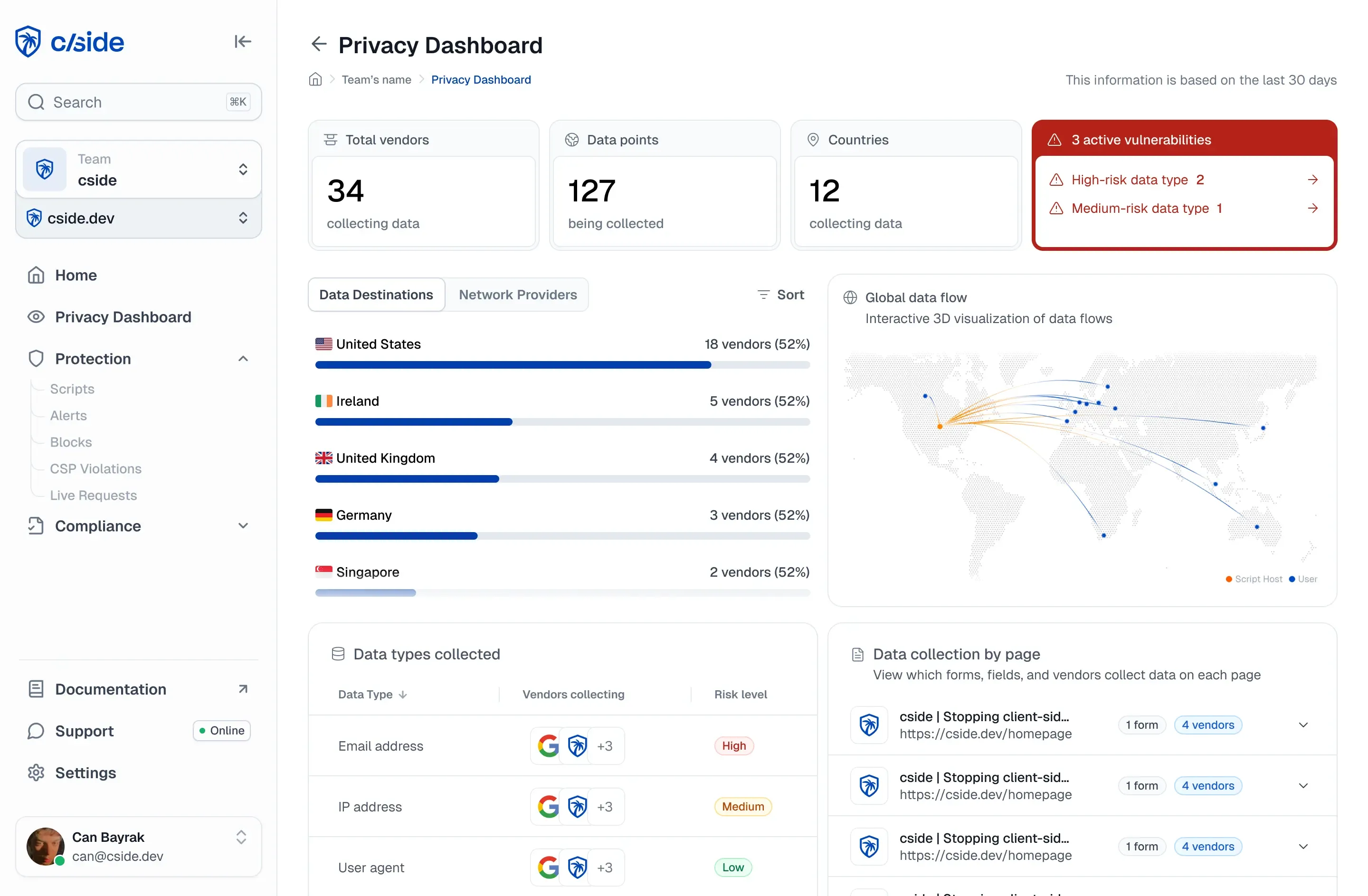

TL;DR: undeclared-agent behavioral resolution stack
- The wrong window: Network-layer bot tools are looking at the wrong window. Ahrefs found that 63% of websites already saw AI-chatbot-interface traffic in early 2025, and cside's controlled tests showed traditional tools missed AI agents in 81 out of 100 scenarios.
- What cside sees: cside identifies named agents like OpenAI Operator, Amazon Buy For Me and Perplexity Shopper by browser-layer signatures, adds behavioral resolution for undeclared agents that arrive with no AI user-agent, and classifies intent so a shopper is treated differently from a card tester.
- The decision: If your checkout policy has to make a decision inside the session, use a browser-layer platform. If you only need to log AI crawler visits after the fact, a bot list from AWS WAF Bot Control's 650+ named catalog will suffice.
Short on time? See cside's AI-agent detection. It covers everything below in one deployment.
Autonomous AI activity on the web is not the same as traditional automation. A script that fills a form on a schedule is a known quantity. An AI agent that browses, evaluates, makes decisions, and transacts without per-interaction human instruction is a different class of problem.
Detection platforms built for scripted bots are not equipped to handle agents that adapt their behaviour, use real browser environments, and leave interaction signatures nearly indistinguishable from a human user. The hardest cases are undeclared agents: sessions that arrive with no AI user-agent, no platform IP, and no header that connects them to an AI vendor at all. This article covers what autonomous AI activity looks like, why it is hard to detect, and which platforms are currently best positioned to identify it.
If you want a step-by-step operational walkthrough rather than a platform comparison, see our guide to detect AI agent traffic on your website.
What is autonomous AI activity on the web?
Quick answer: Autonomous AI activity refers to AI agents that act on web properties without requiring a human to direct each individual action. These agents browse, interact, and transact on behalf of users or systems. They differ from traditional bots in that they reason about context, adapt to page content, and exhibit goal-directed behaviour across multiple steps of a session.
Named agents and categories
The most visible autonomous agents are commercial shopping and assistant tools:
- OpenAI Operator: a general-purpose browser agent that can complete web tasks on a user's behalf, including filling forms, navigating multi-step flows, and initiating purchases.
- Amazon Buy For Me: a shopping agent integrated into the Amazon app that identifies and purchases products from third-party sites.
- Perplexity Shopper: an agent that searches and completes purchases as part of a conversational query response.
- LLM crawlers: agents that index web content for use in AI training or retrieval-augmented generation, including crawlers operated by OpenAI, Anthropic, Google, and others.
- MCP-connected agents: agents that use the Model Context Protocol to interact with web services through structured API calls alongside or instead of browser sessions.
- Custom agentic pipelines: internally built or third-party automation that uses LLM reasoning to navigate web interfaces, typically for data extraction or process automation.
Why "autonomous" changes the detection problem
Traditional bots follow a fixed script. They make predictable requests in predictable sequences. Autonomous agents do not. They receive a goal, reason about how to achieve it given the current page state, take action, observe the result, and adjust.
That reasoning loop produces interaction patterns that vary between sessions, between agents, and even within a single session as the agent adapts to unexpected content. The variability that makes autonomous agents powerful is exactly what defeats the rule-based detection methods that work against scripted bots.
Behaviour comparison table
| Dimension | Traditional Bot | Autonomous AI Agent |
|---|---|---|
| Request pattern | Fixed, repeating | Goal-directed, variable |
| JavaScript execution | Often minimal or absent | Full execution, including dynamic content |
| UI interaction | Programmatic, no mouse movement | Simulated human-like interaction |
| Session length | Short, single-purpose | Multi-step, context-aware |
| Adaptation | None (script is static) | Adapts to page content and errors |
| Identity signal | Often spoofed user-agent | Real or near-real browser fingerprint |
| Detection by IP block | Effective for known ranges | Limited (uses residential proxies or LLM platform IPs) |
| Detection by rate limiting | Effective | Often operates within rate limits deliberately |
The detection challenge: what makes autonomous AI activity hard to identify
Quick answer: Autonomous AI agents are hard to detect because they deliberately or structurally resemble human users. They execute JavaScript, render pages, interact with UI elements, and often operate at a pace that does not trigger rate-based alerts. Detection failure rates run high. Ahrefs found that 63% of websites were already seeing traffic arrive via AI chatbot interfaces as of early 2025, and cside's controlled testing found that traditional tools missed AI agents in 81 out of 100 controlled test scenarios.
Human-like interaction patterns
Autonomous agents that use real browser environments (Chromium, Chrome, or headless equivalents with full JavaScript execution) produce request sequences, timing patterns, and DOM interaction signals that are close to human behaviour. OpenAI Operator, for example, uses a real browser. The fingerprint it presents is not obviously distinguishable from a standard Chrome installation without deeper analysis.
The gap between "looks like a user" and "is a user" is only visible when you examine the full behavioural signature: the entropy of mouse movements, the consistency of scroll velocity, the timing between keystrokes, the sequence of events that led to a particular page, and the characteristics of the browser environment at a level below what the agent itself controls.
Adaptive behaviour that defeats rule-based detection
Rule-based detection relies on known patterns: block this user-agent, flag this request rate, challenge this IP range. Autonomous agents break these rules in two ways. First, they often operate within normal-looking parameters by design. A shopping agent does not need to scrape 10,000 product pages per minute when it can extract what it needs in a session that looks like a single human browsing session. Second, when a rule fires, a reasoning agent may route around it by changing approach, slowing down, or abandoning and restarting from a different context.
Forrester renamed its coverage category to "Bot and Agent Trust Management Software" in Q4 2025. The threat model has moved faster than legacy network controls were designed to handle. That gap is partly a tooling problem and partly an architecture problem.
MCP and API access alongside browser sessions
The Model Context Protocol has changed how detection works. An agent that uses MCP can interact with a web service through structured API calls rather than browser sessions, or combine both in a single workflow. An agent might use a browser session to authenticate and gather context, then switch to API calls for bulk data extraction. Detection systems that only monitor one channel will miss activity on the other, and a single compromised script in that browser session can prompt-inject the AI agent reading the page.
The scale of the detection failure
As of early 2025, Ahrefs found that 63% of websites were already seeing traffic arrive via AI chatbot interfaces. cside's controlled testing found that traditional tools missed AI agents in 81 out of 100 controlled test scenarios. The gap is architectural: network-layer tools cannot see inside the browser session where agents operate. These figures pre-date the widespread deployment of the most capable autonomous agents, so the current detection failure rate is likely higher.
What this looks like in practice: An Amazon Buy For Me agent is tasked with purchasing a specific skincare product on a mid-sized beauty retailer's site. It loads the homepage via a clean residential IP, navigates through category pages to the product, reads ingredient details across multiple tabs, selects the correct variant, and advances to checkout. Every network-layer checkpoint passes: legitimate IP, standard browser user-agent, session velocity within normal bounds, no rate-limit triggers. The platform's CDN logs a single unremarkable browser session. Inside the browser, cside's instrumentation captures a different story: the precise, non-entropic element targeting pattern of an LLM-directed session, the fixed latency between page load completion and first interaction that matches known Amazon agent infrastructure, and a navigator property inconsistency that appears when a real browser is driven programmatically. The agent is identified as Amazon Buy For Me, classified against the site's checkout policy, and routed through a configured agentic commerce guardrail. Network tools saw nothing to challenge. The browser layer resolved the session in real time.
Top platforms for detecting autonomous AI activity
Quick answer: Eight platforms are currently active in autonomous AI detection: cside, DataDome Agent Trust, HUMAN AgenticTrust, Imperva Advanced Bot Protection, Akamai Bot and Abuse Protection, AWS WAF Bot Control, Cloudflare Bot Management, and Darwinium. They differ substantially in detection layer, named-agent coverage, intent classification capability, and suitability for different deployment contexts. For a parallel breakdown of the broader category, see our roundup of the best bot and agent trust management platforms compared.
cside
Approach: Browser-layer detection and agent trust management.
Key capabilities: cside operates inside the page rather than at the network edge. It detects named autonomous agents including OpenAI Operator, Amazon Buy For Me, and Perplexity Shopper, as well as unknown agents and standard crawlers such as Googlebot. Detection signals include IP signatures from LLM platforms, timing patterns, fingerprint mismatches, suspicious network requests, VPN and proxy detection, and UI interaction analysis.
Technical architecture: A browser-layer script instruments the client environment, capturing interaction signals that are not visible to network-layer tools. This includes DOM event sequences, timing between interactions, browser environment characteristics, and the specific signature of agent-generated versus human-generated inputs.
Intent classification: cside classifies agent intent and provides deanonymisation of AI sessions, identifying which agent is present and what it is trying to do. Per-page guardrails allow different policies at different points in the user journey, with allow, block, and guide controls and escalation to human approval.
Best for: Web properties where behaviour inside the page is the primary signal source. E-commerce checkout flows, content-rich applications, and any environment where agent intent matters as much as agent identity.
Notable limitation: Requires a client-side script deployment. Not applicable to pure API traffic that does not involve a browser session.
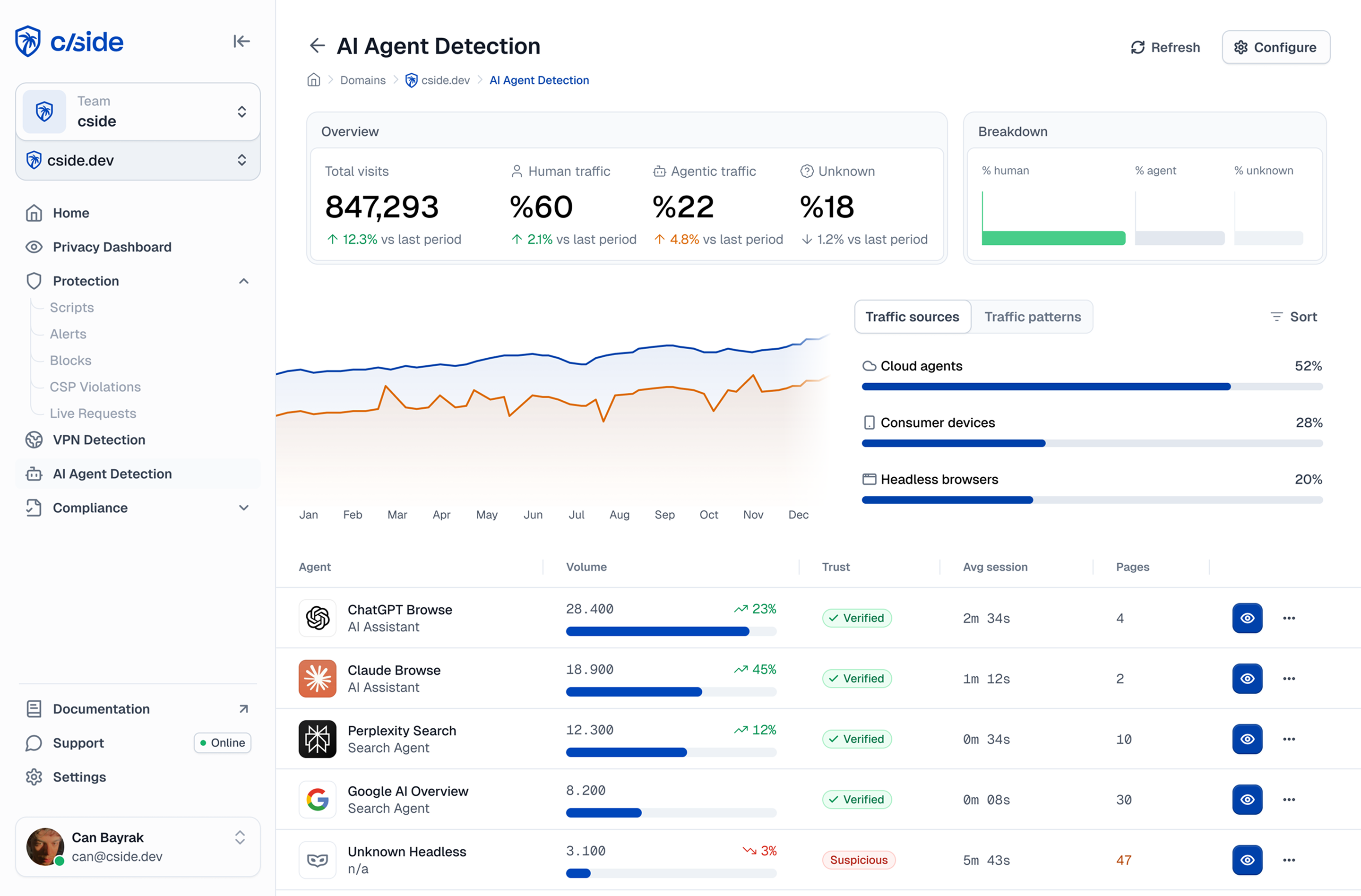
See how cside compares directly with DataDome, HUMAN Security, Cloudflare, Imperva, and Akamai. The live product page is at cside AI agent detection.
DataDome Agent Trust
Approach: Network and CDN-layer detection.
Key capabilities: DataDome's Agent Trust product classifies agents into four categories: AI Crawler, AI Assistant, Agentic Browser, and Autonomous Agent. Every session receives a dynamic 100-point Agent Trust score. Identity verification uses Web Bot Auth cryptographic signatures and Know Your Agent (KYA) frameworks. DataDome's Galileo research team monitors agent behaviour patterns and identity verification challenges across the traffic it processes. Agent Trust is included in all Bot Protect plans at no additional cost.
Technical architecture: CDN-layer interception with server-side analysis. Detection is based on request headers, IP signatures, timing analysis at the connection level, known agent fingerprints, and cryptographic verification frameworks.
Intent classification: Limited to network-layer signals. In-page behavioural intent is not available from the CDN layer.
Best for: High-volume deployments where network-layer coverage is the primary requirement, and teams already using DataDome for traditional bot protection.
Notable limitation: Cannot observe in-page behaviour. Agent activity that occurs within a normal-looking browser session is less visible.
HUMAN AgenticTrust
Approach: Network-layer detection with threat intelligence enrichment.
Key capabilities: HUMAN Security's AgenticTrust combines network-layer detection with the SATORI threat intelligence network. HUMAN AgenticTrust provides cryptographic agent verification using digital signatures and session-level visibility from product discovery to checkout, underpinned by SATORI threat intelligence.
Technical architecture: Network interception with cryptographic verification layer and threat intelligence overlay. SATORI provides cross-customer signal aggregation across HUMAN's global network.
Intent classification: Network-layer and cryptographic verification signals. In-page behaviour is not observable from the network layer.
Best for: Security-first deployments where threat intelligence context and cryptographic agent verification matter. Strong fit for financial services and platforms with existing HUMAN deployments.
Notable limitation: Browser-layer signals are unavailable. Agent sessions that pass network checks are not further analysed for in-page behaviour.
Imperva Advanced Bot Protection
Approach: WAF and network-layer.
Key capabilities: Imperva's bot protection integrates with its broader WAF and application security platform. Detection relies on request analysis, IP reputation, and known bot signatures. Enterprise licensing includes SLAs, data residency options, and SIEM integration.
Technical architecture: WAF-integrated detection with network-layer analysis. Integrates with Imperva's cloud security platform.
Intent classification: Not available at the browser layer. WAF-level signals inform risk scoring.
Best for: Enterprises with existing Imperva deployments who want to extend bot management to cover AI agent traffic within the same management console.
Notable limitation: Agent behaviour inside the browser session is not visible. Integration complexity can be significant for non-Imperva environments.
Akamai Bot and Abuse Protection
Approach: CDN-layer.
Key capabilities: Akamai's bot protection runs on its global CDN infrastructure. Akamai published guidance on agentic AI content in October 2025, responding to the emerging agent traffic category. Network-layer detection covers known agents and volumetric patterns.
Technical architecture: CDN-integrated with global reach. Detection at the edge before traffic reaches origin.
Intent classification: Network-layer only.
Best for: Enterprises already using Akamai for content delivery who want bot and agent coverage without adding a separate vendor. Global reach is a genuine advantage for multinational deployments.
Notable limitation: Browser-layer signals are not accessible from the CDN. Named-agent identification is less granular than browser-layer alternatives.
AWS WAF Bot Control
Approach: WAF-layer with AI Activity Dashboard.
Key capabilities: AWS launched its AI Activity Dashboard in February 2026, tracking more than 650 bots and agents. For AWS-hosted workloads, WAF Bot Control integrates natively with IAM, CloudWatch, Security Hub, and the broader AWS security toolchain. The 650+ entity library provides coverage for the major named agents.
Technical architecture: WAF-layer detection with native AWS service integration. Detection data flows into CloudWatch for alerting and Security Hub for aggregated findings.
Intent classification: Not available. The AI Activity Dashboard identifies which agents are active; it does not classify what they are attempting to do.
Best for: Engineering teams running on AWS who want agent visibility without adding an external vendor. Particularly useful for API-layer monitoring on AWS-hosted endpoints.
Notable limitation: Limited to WAF-layer visibility. Browser-session behaviour is not observed. Most effective for origin and API traffic rather than client-side sessions.
Cloudflare Bot Management
Approach: Network-layer via DNS and CDN.
Key capabilities: Cloudflare's Bot Management provides detection at the network edge for sites using Cloudflare for DNS or CDN. The platform maintains a bot signature library and applies behavioural heuristics at the network layer.
Technical architecture: CDN-integrated. Detection occurs at the Cloudflare edge before requests reach the origin server.
Intent classification: Not available at the browser layer.
Best for: Sites already on the Cloudflare network where adding bot management is operationally simple. Cost-effective for mid-market deployments with moderate requirements.
Notable limitation: Browser-session signals are unavailable. Agent coverage is less granular than dedicated agent trust platforms. Not designed specifically for autonomous agent detection.
Darwinium
Approach: Fraud signal focus with agent trust dimension.
Key capabilities: Darwinium focuses on distinguishing trusted AI agents from malicious ones, with a particular emphasis on fraud signals. The platform provides risk scoring at the session level, incorporating device signals, behavioural patterns, and fraud intelligence.
Technical architecture: Client-side instrumentation combined with server-side analysis. Closer to the browser layer than pure network-layer tools, though the primary use case is fraud prevention rather than full agent detection.
Intent classification: Risk-focused scoring. Strong for fraud-adjacent use cases including payment fraud and account takeover via agents.
Best for: E-commerce and financial services teams where the primary concern is fraud perpetrated by or through AI agents, rather than broader agent traffic governance.
Notable limitation: Agent trust and fraud prevention is the frame. Broad agent monitoring, content scraping detection, and governance use cases are less central.
Platform comparison summary
| Platform | Detection Layer | Autonomous Agent Detection | Intent Classification | Named Agent ID |
|---|---|---|---|---|
| cside | Browser | High | Yes | Yes (Operator, Buy For Me, Perplexity Shopper, Googlebot) |
| DataDome Agent Trust | Network / CDN | Medium-High | Limited | Partial |
| HUMAN AgenticTrust | Network | Medium | Limited | Partial |
| Imperva Advanced Bot Protection | WAF / Network | Medium | No | Partial |
| Akamai Bot and Abuse Protection | CDN | Medium | No | Partial |
| AWS WAF Bot Control | WAF | Medium | No | Yes (650+ library) |
| Cloudflare Bot Management | CDN / Network | Low-Medium | No | Partial |
| Darwinium | Client + Server | Medium | Risk-focused | Partial |
Browser-layer vs network-layer detection for autonomous agents
Quick answer: The detection layer determines what signals are available. Network-layer tools see headers, IP addresses, and request timing at the connection level. Browser-layer tools see what happens after the page loads: UI interaction sequences, JavaScript execution patterns, timing between events, and fingerprint characteristics of the browser environment. For autonomous agents that use real browsers, the browser layer is where the most discriminating signals live.
Why the layer matters for autonomous agents specifically
Autonomous agents that use real browser environments (and the most capable commercial agents do) look like users at the network layer. The IP address may come from an LLM platform's known range, which provides one signal. But many agents route through residential proxies or use IP infrastructure that overlaps with legitimate users.
The signals that distinguish an autonomous agent from a human are behavioural. They live in the timing between UI events, the absence of natural mouse movement entropy, the pattern of JavaScript calls the agent makes to understand page state, and the characteristics of the browser environment at a level below what the agent itself can easily spoof. A CDN sees none of them.
The role of interaction pattern analysis in autonomous agent detection
Interaction pattern analysis examines the sequence, timing, and character of UI events across a session. Human users produce input with natural variation: mouse trajectories curve, typing speed fluctuates, scroll velocity reflects reading behaviour. Autonomous agents produce inputs that are either too regular or too precisely timed to match the statistical distribution of human interaction, and these are among the signals that give agents and stealth browsers away.
More telling is the relationship between page content and interaction. A human reading a product description will pause, scroll back, and interact in ways that reflect comprehension. An agent extracting a price or SKU targets specific elements, extracts values, and moves on without the surrounding behaviour that human attention produces. Platforms that model these patterns against a human baseline see far more than those limited to network-layer signals.
Session fingerprinting for agent identification
Session fingerprinting for autonomous agents extends beyond the standard browser fingerprint (Canvas hash, WebGL renderer, screen resolution, installed fonts). Agents introduce additional fingerprint dimensions:
- Automation framework signals: traces left by Playwright, Puppeteer, Selenium, or equivalent frameworks, even when configured to suppress them.
- Browser environment anomalies: missing or unusual values in navigator properties, inconsistencies between reported and observed screen characteristics, or the absence of expected browser features.
- Timing signature: the latency between receiving a page and beginning to interact with it, which reflects LLM reasoning time rather than human reading time.
- Network request patterns: the specific requests an agent makes to understand page state, including calls to APIs, analytics endpoints, or resources that a human browser session would not typically trigger in isolation.
Named-agent identification combines these signals into a signature matched against known agent profiles. cside's controlled testing found that traditional tools missed AI agents in 81 out of 100 controlled test scenarios. Current agents have grown more sophisticated, and detection systems that rely on network-layer signals alone can only see so much. For a deeper toolkit-level view, see our roundup of the best tools for AI agent detection to prevent website fraud.
Key capabilities to prioritise for autonomous AI detection
Quick answer: When evaluating platforms for autonomous AI detection, prioritise: agent deanonymisation (knowing which agent it is, not just that one is present), intent scoring (what is the agent trying to do), session-level behavioural analysis (not just request-level), MCP and API correlation (covering non-browser interaction channels), and real-time policy application (taking action during the session, not after).
The capabilities that matter most for autonomous agent detection are distinct from those that matter for traditional bot management:
- Agent deanonymisation: the ability to identify which specific agent is active (OpenAI Operator, Amazon Buy For Me, Perplexity Shopper, or an unknown agent) rather than simply flagging that non-human traffic is present. Named-agent identification enables policy decisions proportionate to the actual agent and its typical behaviour.
- Intent scoring: classifying what the agent is attempting to do. A shopping agent browsing product pages has different intent from one attempting to complete a checkout, and different again from a scraper extracting bulk pricing data. Intent scoring enables graduated policy responses.
- Session-level behavioural analysis: examining the full arc of a session rather than individual requests. Autonomous agents pursue goals across multiple steps; their identity and intent are most clearly expressed in the relationship between those steps.
- MCP and API correlation: the ability to correlate browser-session activity with API calls and MCP interactions from the same agent. Agents that use multiple channels need to be tracked across those channels to prevent detection evasion through channel switching.
- Real-time policy application: applying allow, guide, or block decisions during the active session, not after the fact. Post-session analysis is useful for intelligence gathering, but preventing harm at checkout requires real-time intervention capability.
The future of autonomous AI detection
Quick answer: Autonomous AI detection is a rapidly evolving discipline. The Forrester category formalisation in Q4 2025, the deployment of agentic payment infrastructure by Visa and Mastercard, and McKinsey's projection of $3 to $5 trillion in agentic commerce by 2030 all indicate that this is a growing, not a stabilising, problem. Detection architectures need to be built for adaptability, not just for the current generation of agents.
The Forrester category and what it signals
Forrester's creation of the "Bot and Agent Trust Management Software" category in Q4 2025 is significant for two reasons. First, it validates that AI agent traffic is a problem distinct from traditional bot abuse and that the market for solutions addressing it is real and growing. Second, it gives engineering and security teams a framework for structured vendor evaluation.
The category name reflects the shift from pure prevention to trust management: the goal is not to block all agent traffic, but to classify it, govern it, and enable the legitimate use cases (including agentic commerce) while preventing the harmful ones.
Agentic commerce and what it means for detection
Forrester reports that 36% of US consumers have expressed interest in using AI agents for specific transaction categories, and Visa and Mastercard launched agentic payment infrastructure in 2025 to support exactly this use case. McKinsey's projection of $3 to $5 trillion in agentic commerce by 2030 puts scale context on what is currently a small but fast-growing category.
For detection platforms, this creates a more complex mandate. Blocking all AI agent traffic is no longer a viable policy, because some of that traffic represents legitimate customers transacting through agents of their own choosing. The detection challenge shifts from identification to differentiation: telling humans, good bots, and malicious agents apart so you can separate the agent transactions your business wants to enable from the scraping, fraud, and policy violations you want to prevent.
Detection as enabling infrastructure
Platforms that support this differentiation at transaction time, with real-time intent classification and per-step policy controls, will be essential infrastructure for commerce properties as agentic transactions grow.
Why detection architecture needs to evolve alongside agent capabilities
The agents available in 2026 are more capable than those of 2025, and the agents of 2027 will be more capable still. Detection approaches that rely on static signatures or fixed rule sets will lose ground steadily as agent developers adapt to avoid them.
The most durable detection architecture operates at the layer where agent behaviour is most expressive (the browser) and combines behavioural analysis, fingerprinting, and named-agent identification in a model that can be updated as new agent types emerge. Platforms with a dedicated focus on autonomous agent detection, rather than those extending traditional bot management to cover agents as a secondary use case, are better positioned to keep pace.
The Ahrefs finding that 63% of websites were already seeing AI chatbot-referred traffic as of early 2025 is a baseline, not a ceiling. Engineering and security teams not investing in autonomous agent detection now will be doing so under significantly more difficult conditions in twelve to eighteen months.