

Blog
Blog

How web extensions can hurt your site (INFIRC[.]com and INFIRD[.]com)

The domain infirc[.]com and infird[.]com have caused quite the stir recently, and highlighted the dangers of infected or malicious web extensions.

Oct 18, 2024 5 min read
web-extensions-image-cover
Table of Contents

TL;DR: infirc.com and infird.com extension-injected referer with rotating user agents

  • Referer spike, real cause: Every analytics dashboard reads a spike in referer traffic as either affiliate luck or an attack on your site, but 145 requests in a single day from infirc.com, each with a distinct user agent, means something else: an extension injecting itself into your visitors' sessions.
  • How cside mapped it: cside's public domain directory indexed infirc.com and infird.com as they appeared, the internal engine flagged both as malicious against the same script that also called AliExpress, rano.info, zurano.info, and google-analytics.com Measurement Protocol, and we tracked traffic from the Czech Republic, China, London VPNs, and Japan.
  • Still in PCI scope: The script explicitly skips Google, Bing, and other high-defense environments. CSP would not have caught it, and visitor-side extension injection still falls inside your PCI DSS 6.4.3 and 11.6.1 scope, even though the code was never in your repo.

Short on time? See cside's in-browser Magecart and skimmer blocking. It covers everything below in one deployment.

The domain infirc[.]com and infird[.]com have caused quite the stir recently, and highlighted the dangers of infected or malicious web extensions.

Infirc[.]com was first observed coming into our backend appearing as the referer header, even though it is not hosted or referenced by our site.

Our public domains directory indexed the domain right after, and our internal detection engine flagged it as potentially malicious.
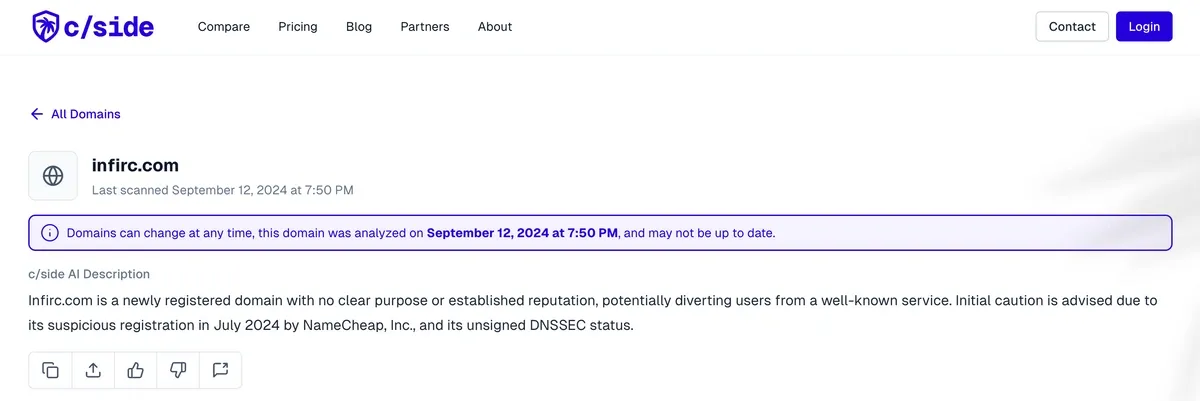
cside directory entry analyzing the newly registered infirc.com domain

Infirc[.]com is a newly registered domain with no clear purpose or established reputation.

A few weeks after, we noticed a significant increase in search impressions and clicks on this page, indicating that people were researching this domain. This prompted us to dive deeper.
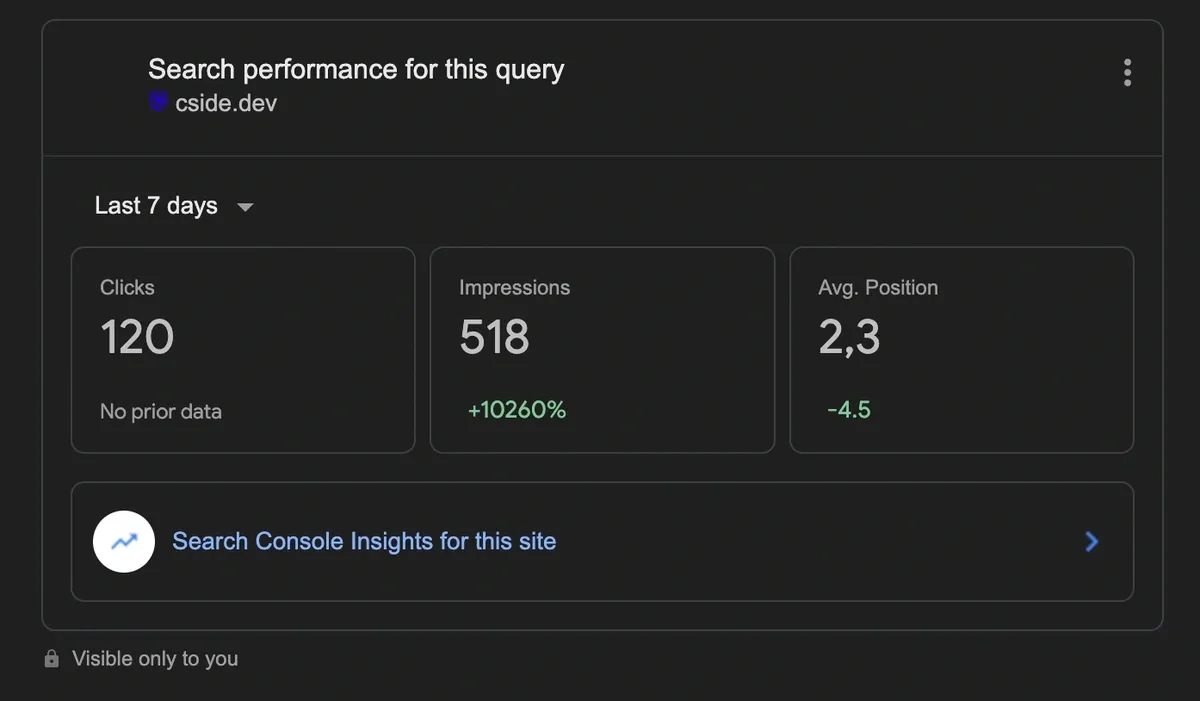
Search Console graph showing growing impressions for infirc.com queries

A malicious domain inside a web extension (plugin)

As per the source, it suggests that script was found on cside, but we are not infected. The only other possibility is visits from a browser with a web extension that tries to inject code.

In some cases, extension IDs are leaked. In this case, we weren't able to find one.

If someone's web extension is infected, or an attacker creates one, they can be used to attack websites. For example, you have an ecommerce website that allows visitors to create accounts and perform transactions. A visitor with an infected web extension buys a product. In that process, their PII and financial details are captured by the malicious 3rd party script inside the infected extension.

Alternatively, a malicious extension use bot-traffic to capture any kind of information it's not supposed to access.

We noticed an influx of proxy requests originating from different IP addresses across the globe, including:

  • Czech Republic
  • China
  • London (via VPN)
  • Japan

The logs from September 17, 2024, show the earliest trace of infirc[.]com making requests to our backend. As time progressed, especially around October 13, 2024, we observed 145 proxy requests directed toward this domain in a single day.

Each request presented a different user agent, making it difficult to pinpoint a single source of activity. Likely bot-driven traffic or a coordinated attack through a range of user agents and VPNs.

On October 15th, we caught and indexed infird[.]com, which showed similarity.
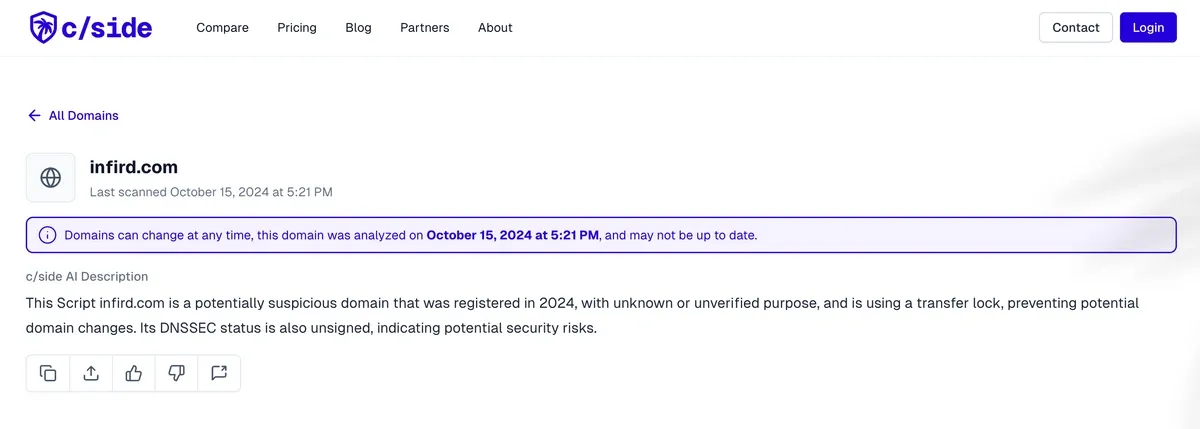
cside directory entry analyzing the newly registered infird.com domain

The malicious scripts loaded by the domains

Digging deeper revealed a complex network of scripts, extensions, and external domains. Both infirc[.com] and infird[.com] host the same script, as can be seen from both these pages:

Both scripts referenced AliExpress and another domain, rano[.]info. The latter could be an ingest domain used to collect, process, or receive data from external sources.

The analysis of the scripts revealed attempts to bypass common detection mechanisms. Both domains load external scripts from untrusted sources like:

  • zurano[.]info/zimblat?i=7OB7CVF5V7&atr=477978779The domain zurano[.]info was flagged as neither legitimate nor associated with any trusted services.

The script was also seen transmitting data to other external servers, including:

This behavior shows that infirc[.]com loads unauthorized scripts and sends data to various external servers, possibly to track users or manipulate analytics.

Two functions, _0xfc929c() and _0x1238ee(), were identified in the code, suggesting that the script might be trying to:

  1. Redirect users to different URLs.
  2. Modify links or interactions on the page without user consent.

This type of behavior shows of a possible attempt to alter the browsing experience of users or to phish sensitive information by redirecting them to malicious sites.

The script includes specific checks to avoid running in particular environments, such as platforms like Google, Bing, and other social media networks, to avoid detection in high-profile, well-defended environments.

CSPs are widely used as a first layer of protection against client-side attacks, including these. Attackers know about them, and can easily circumvent it. We don't rely on CSPs and were able to detect it.

How to protect your site

Please check your code for any reference to these domains and remove them. However, this is almost certainly a malicious 3rd party script that's trying to be injected from outside.

We can block these attempts, though attackers who know about cside's presence can also circumvent us. This is an attack coming from a visitor's browser, not malicious 3rd party code already present on your own site. We can still detect it and share information with you, including IPs and time of the attempts.

Any 3rd party scripts present on your site that are compromised, we can detect and block before they execute in the browser of your visitors. Protecting them, and you, from malicious actors.

By using our free tier, you are safe from this and other similar attacks.
Simon Wijckmans
Founder & CEO

Founder and CEO of cside. Previously a product manager on Cloudflare Page Shield (now Cloudflare Client-Side Security). Co-chair of the W3C Anti-Fraud Community Group and a Forbes 30 Under 30 honoree. Building accessible security against client-side attacks, web security is not an enterprise-only problem.

FAQ

Frequently Asked Questions

Extensions inject scripts into every page the user visits. Two domains we tracked, infirc.com and infird.com, were loaded by a browser extension and showed up in our analytics as fake referer traffic that looked like an attack on our own site.

Compare the referer header pattern against a single source. Extension traffic appears across many user agents and IPs with no consistent origin. Domain-directory tools like cside.com/domains help correlate the suspicious source quickly.

No single tool catches everything, but real-session client-side monitoring is the most reliable layer. Web application firewalls and content security policies watch the server and the page manifest, so they miss code a browser extension injects after the page loads. A tool that observes what actually executes in your visitors' sessions, like cside, sees the injected script even when it never touched your code, as happened with infirc[.]com.

No. A content security policy is a useful first layer, but attackers know it and design around it, and the infirc[.]com script was built to bypass common detection mechanisms. A malicious extension also injects code directly into the running page from the visitor's browser, outside the scope a CSP can enforce. cside does not rely on CSPs and detected the injection by watching the real script behaviour in the session instead.

A web application firewall inspects traffic reaching your server, so it never sees a script an extension injects inside the visitor's browser. That is why the infirc[.]com activity showed up only as odd referer traffic, not as a blocked request. Client-side tools like cside watch what runs in the actual browser session and hash the script payloads there, catching injected or compromised code that a WAF structurally cannot observe.

Look for a tool that observes scripts as they execute in real visitor sessions, not just a static scanner or a policy check. Extension-injected skimmers capture PII and card data during checkout without ever appearing in your repository, so payload-level monitoring that flags unauthorised external calls matters most. Confirm it maps to PCI DSS 6.4.3 and 11.6.1, gives you attacker IPs and timestamps, and blocks scripts before they run.

Both are serious, and a good defence covers them together. A compromised third-party script lives in your own supply chain, while a malicious extension like the one loading infirc[.]com rides in from the visitor's browser and never touches your code. The extension case is harder for traditional tooling because you cannot audit or remove code you do not host. cside detects both by monitoring what executes client-side.

cside monitors the scripts that actually execute in your visitors' browser sessions and hashes their payloads, so it flags code that appears at runtime even though it was never in your repository. With infirc[.]com the injected script came from an extension, yet cside still saw its behaviour, its calls to untrusted domains, and its data exfiltration attempts. It then shares the attacker IPs and timestamps so you can act.

Yes. The infirc[.]com script included checks to stay dormant on Google, Bing, and major social platforms so it would only run in less-defended environments. Because cside observes behaviour inside your own visitors' real sessions rather than relying on a crawler the script can recognise and evade, those environment checks do not hide it. cside flagged the domain as malicious and traced the external calls it made.

Yes. For the infirc[.]com and infird[.]com activity cside recorded the earliest request, the 145 requests seen in a single day, the rotating user agents, and source locations including the Czech Republic, China, London VPNs, and Japan. Because the attack comes from a visitor's browser rather than your own code, this evidence, attacker IPs and exact timestamps, is what lets you investigate and confirm the source quickly.

cside deploys as a single first-party JavaScript snippet, or agentlessly through the Scan Method, with no DNS change and nothing routed through cside. Once the script is on your pages it watches what executes in each real visitor session and blocks unauthorised or compromised scripts before they run, including code injected by a malicious extension. Setup takes minutes, and you keep full visibility with attacker IPs and timestamps for anything it catches.

Yes. cside offers a free tier you can sign up for and deploy on your site, which already protects against injection attempts like infirc[.]com and infird[.]com. Paid plans are metered by session or pageview volume with tiered pricing, and you can talk to the team for higher-volume or PCI-specific needs. The free plan is enough to start monitoring what executes in your visitors' browsers and blocking malicious injected scripts.

Monitor and Secure Your Third-Party Scripts

Gain full visibility and control over every script delivered to your users to enhance site security and performance.

Start free, or try Business with a 14-day trial.

cside dashboard interface showing script monitoring and security analytics
Related Articles
Book a demo

Want to walk through this with an engineer?

Thirty minutes, on your own site. Not a slide deck.

We'll show you:

Which third-party scripts are running on your site right now
Where you stand on PCI DSS 6.4.3 and 11.6.1
How much of your traffic is bots and AI agents

Rather just send a question?

Finding open slots…

Real humans only. We'd know.

Having trouble booking? Open scheduler in a new tab

What are you trying to solve?

Tell us in a line and we'll come back with something useful, not a generic pitch.

We usually help with:

Seeing which third-party scripts run on your site
PCI DSS 6.4.3 and 11.6.1 evidence
Bots, AI agents and account takeover

Prefer to just book a time? Pick a slot instead