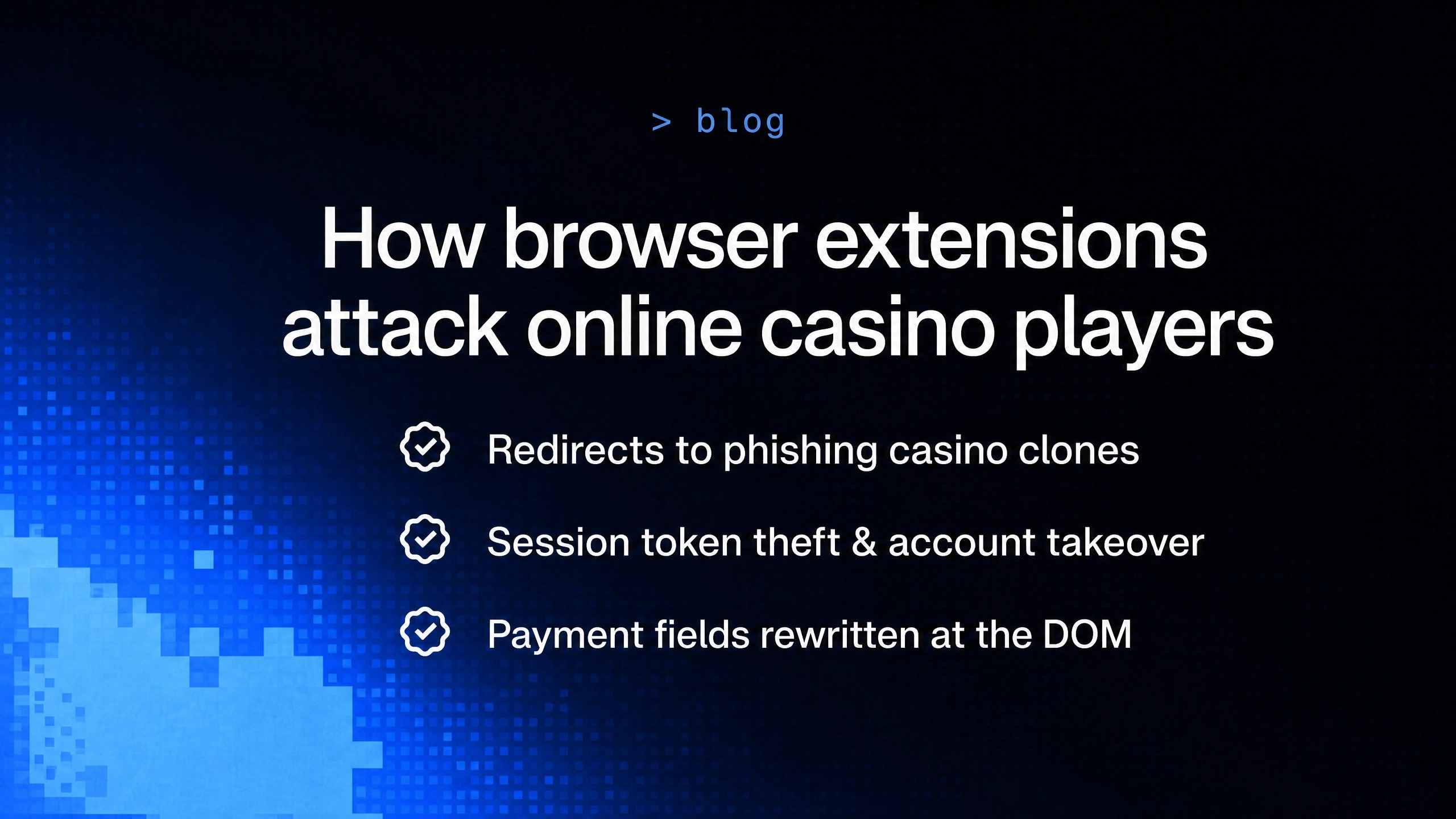
TL;DR: extension-level document.cookie read and DOM payment-field rewrite on withdrawal
- Extensions read cookies from memory: Every operator says their session cookies are secure, but a browser extension with read-and-change-all-data permission reads document.cookie directly out of memory and the first login you see is from a fresh IP the player never used.
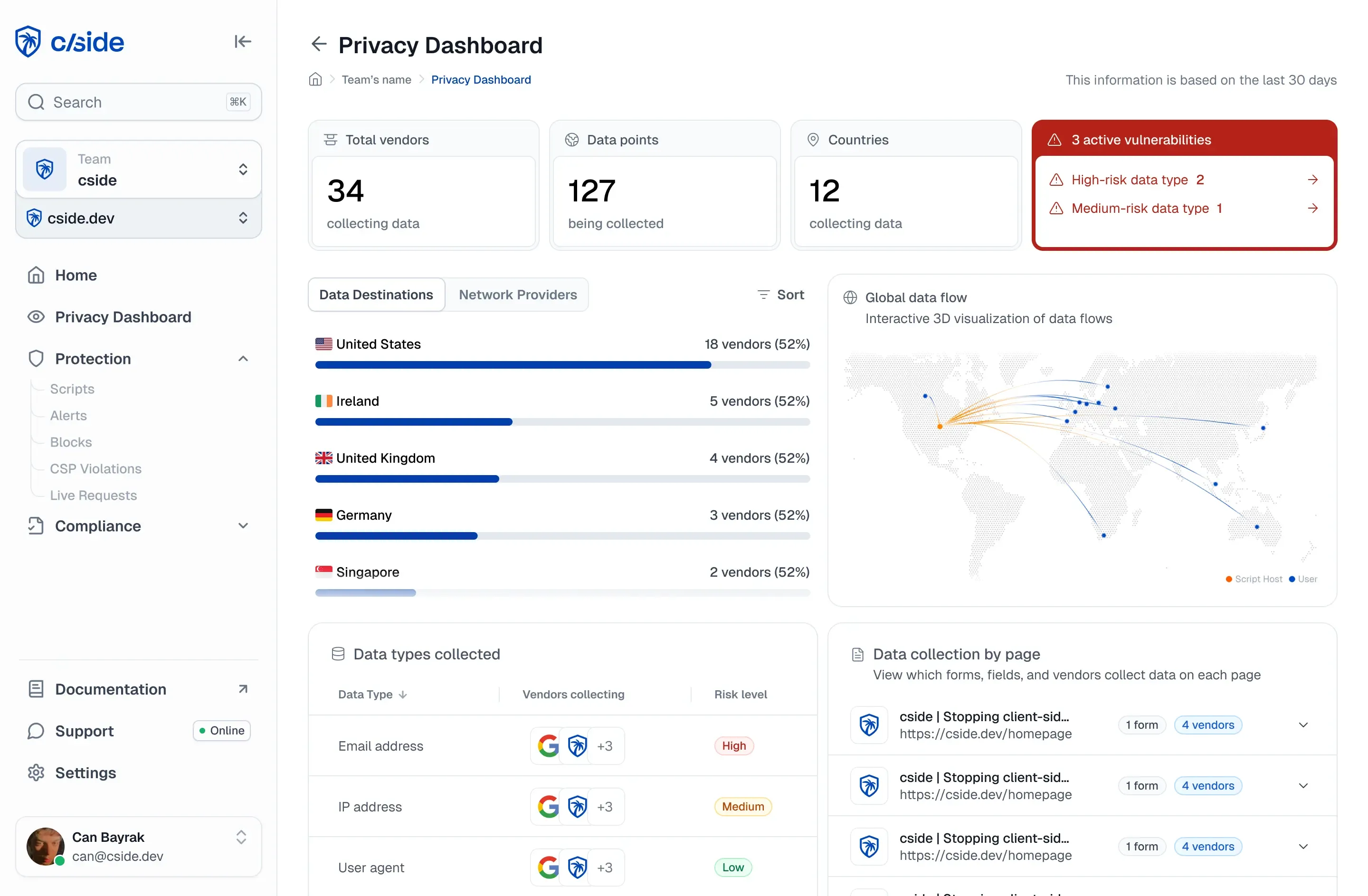
- Full-session DOM monitoring: cside instruments 100% of real user sessions and watches DOM mutations on payment and authentication fields regardless of which extension is responsible, and Q1 2025 telemetry surfaced over 300,000 attack signals across monitored sites, most of them from script execution the server never logged.
- Prove which script did it: PCI DSS 6.4.3 requires monitoring of scripts on payment pages and GDPR Article 32 requires technical measures for session data, so the question is not whether extensions can be blocked, it is whether you can prove which script rewrote a payout wallet address in a specific session.
Short on time? See cside's in-browser Magecart and skimmer blocking. It covers everything below in one deployment.
Your servers are clean. Your WAF logs are quiet. Your third-party scripts passed last month's audit. Yet somewhere right now, a player on your platform is having their session token extracted, their payment redirected, or their browser silently handed to a phishing clone of your casino. The attacker never touched your infrastructure. They touched your player's browser instead. According to cside's own telemetry from Q1 2025, over 300,000 attack signals were detected across monitored sites in a single quarter, most of them originating from script execution that server-side tools never logged.
How browser extensions can inject code into any page
Quick Answer: Browser extensions operate at the highest privilege level available in the browser, above any script the website itself loads. A compromised or malicious extension can read, modify, and inject JavaScript into any page the user visits (including your casino) without the operator's server ever receiving a request or log entry indicating that anything unusual occurred.
Browser extensions are installed by users voluntarily, often for entirely legitimate purposes: ad blocking, price comparison, spell checking, or bonus-tracking tools marketed specifically to casino players. Once installed, extensions are granted permissions that no webpage script can match. A "read and change all your data on websites you visit" permission is commonplace and is accepted without scrutiny by most users.
When a player navigates to your casino domain, the extension's content scripts execute in the same browser context as your own JavaScript. They share access to:
- The live DOM, including form fields, button values, and displayed account balances
- Session cookies and local storage (where session tokens are often held)
- Network requests made by the page, before responses are processed
- Any data the player types, including credentials and payment details
The extension does not need to exploit a vulnerability in your code. It is operating with the browser's permission, granted by the player. Understanding the privilege model is the first step; the next is knowing how attackers exploit it.
Specific attack patterns targeting casino sessions
Quick Answer: Malicious extensions targeting casino players commonly execute four attack patterns: redirecting the player to a phishing clone of the casino site, intercepting bonus codes before they reach the operator's server, stealing session tokens to enable account takeover from a separate device, and modifying payment destination fields to redirect withdrawals.
The attack surface is well-defined once you understand the casino session lifecycle. Here are the patterns cside observes most frequently in iGaming environments:
Redirect to phishing clone. At login or after a deposit flow initiates, the extension intercepts a navigation event and replaces the destination URL with a near-identical phishing domain. The player sees what looks like a brief loading screen and arrives at a site they assume is still yours. Credentials entered on the phishing clone are captured.
Bonus code interception. Promotional campaigns distribute high-value bonus codes. An extension monitoring for specific DOM elements (deposit forms, promo code fields) can read entered codes, suppress the network request, and replay the same code on a competing platform. The operator sees a failed or abandoned session rather than a compromise.
Session token theft. Extensions with storage permissions can read document.cookie values and localStorage directly. A stolen session token allows the attacker to authenticate as the player from a different device entirely, with no login event triggering on the operator's side.
Payment redirect. During a withdrawal, an extension modifies the account number or wallet address field value at the DOM level, after the player has entered their legitimate details and before the form submits. The player's display shows their own details; the submitted value belongs to the attacker.
These four patterns share a common property: they all execute inside the browser, before any network request reaches your server. That is why the conventional security stack does not see them.
Why server-side and network-layer tools are blind to this class of attack
Quick Answer: Server-side monitoring, WAFs, and network-layer security tools see only the requests that reach the server. Browser extension attacks execute entirely within the player's browser process before any network request is made, or they modify data that the server receives as legitimate input. There is no malicious request to intercept because the attack is the browser's own activity.
This is the structural problem that makes extension-injected attacks so dangerous for operators. Your security stack is oriented around requests: what arrives at your origin, what your CDN sees, what your WAF filters. Browser extension attacks bypass all of these controls at the architectural level, not by evading them.
Consider session token theft specifically. The extension reads document.cookie directly from the browser's memory. No network request is made to your server. No WAF rule fires. No log entry is written. The first signal you see as an operator is an account login from an unexpected IP address, which might look like a VPN, a travelling player, or a shared household. By then the session has already been used.
Tools like Cloudflare Page Shield operate at the network layer and monitor which scripts make outbound requests. They do not instrument what those scripts (or injected extension code) actually do inside the browser. There is no proxy, no network tap, and no server-side hook that can see DOM manipulation happening on a player's local machine.
The attack happens where your visibility ends: inside the browser itself. Detecting it requires instrumentation that operates at the same layer.
How cside detects extension-injected script execution
Quick Answer: cside instruments every real user session in the browser itself, monitoring script execution behaviour in real time. It identifies anomalous patterns consistent with extension-injected code by detecting unexpected script origins, DOM mutation patterns outside the operator's own codebase, and network calls to domains not present in the site's known script inventory, without needing to identify the specific extension responsible.
cside operates at the same layer as the attack. Rather than monitoring network requests from the outside or sampling a subset of sessions, cside's instrumentation runs inside the browser alongside every script that executes on the page. It monitors every first, third, and fourth-party script in the player's session, including scripts loaded dynamically or injected by extensions. An AI-powered behavioural engine watches what each script actually does in real time: what data it accesses, where it sends data, and whether its behaviour matches known breach or exfiltration patterns. This gives cside observability over:
- Scripts that execute but were not loaded from the operator's own origin or approved CDNs
- DOM mutations to fields that should not be touched by third-party code (payment forms, promo inputs, session storage)
- Network calls initiated from within the page to domains that do not appear in the site's known script inventory
- Behavioural changes in existing scripts that may indicate a supply chain compromise upstream
Critically, cside does not need to identify which browser extension is responsible. It observes the behaviour: an unexpected script writing to a payment form field, or an unauthorised network request being initiated mid-session. The behaviour is the indicator, regardless of its source.
This is the same principle applied to the Polyfill.js supply chain compromise in June 2024, which affected over 490,000 sites. The specific payload was unknown until disclosure, but the behaviour, unexpected redirects being initiated by a commonly trusted script, was detectable at the execution layer.
What operators should monitor for
Quick Answer: Operators should monitor for script execution from origins not in their approved inventory, unexpected DOM mutations on payment and authentication fields, outbound network requests to unrecognised domains initiated during deposit or withdrawal flows, and session behaviour anomalies such as rapid re-authentication from a new IP immediately after a deposit event.
Effective client-side monitoring for extension-based attacks requires instrumentation across 100% of sessions, not a sampled subset. Attacks targeting VIP players, specific geographies, or specific deposit thresholds will not appear in a 10% sample with any statistical regularity. The ENISA Threat Landscape for Supply Chain Attacks specifically identifies targeted, low-volume attacks as the class most likely to evade conventional detection.
Operators should establish baselines for:
- The complete inventory of scripts that execute on each page type (lobby, deposit, withdrawal, login)
- Which domains each script is permitted to contact at runtime
- Which DOM elements each script is permitted to modify
- Normal session duration and authentication patterns by player segment
Any deviation from those baselines is a candidate signal worth investigating: a new script origin appearing on the deposit page, a network call to an unknown domain during a withdrawal, or a payment field mutation that did not originate from the operator's own code.
The Verizon 2024 Data Breach Investigations Report identifies web applications as the most common attack vector in externally-attributed breaches. For iGaming operators, the attack surface has extended into the browser itself, and the monitoring posture needs to match.
What this means for your security programme
Browser extension attacks are a structural gap in the conventional security stack. Tuning an existing WAF rule or tightening a CSP policy will not close it. The attack executes inside the browser, where your server-side tools have no visibility. Closing that gap requires instrumentation that operates at the same layer as the attack itself.
If your current client-side monitoring covers less than 100% of sessions, geo-targeted or VIP-targeted extension attacks can run in the unmonitored portion indefinitely. If your monitoring operates at the network layer rather than the execution layer, DOM manipulations and cookie reads will not appear in its logs at all.
The monitoring questions worth asking your current vendor are straightforward: Does your tool observe every session? Does it instrument what scripts do inside the browser, or only which scripts make outbound network requests? Can it provide session-level evidence of a specific script execution event in a specific user session?
If you would like to see how cside instruments 100% of sessions and surfaces extension-injected behaviour in iGaming environments, request a demo via the cside website.