TL;DR: compromised casino affiliate script detection with full vendor load chain baselining across brands
- CSP trusts the domain: A CSP allowlist happily loads a compromised affiliate script from its approved domain: Polyfill.js used exactly that trust to hit 490,000 sites in June 2024 after the project changed hands.
- Invisible to server logs: Compromised affiliate code steals commissions by overwriting UTM cookies, redirects players just before deposit, and fetches second-stage payloads from a child script, none of which shows up in server logs or WAF traces.
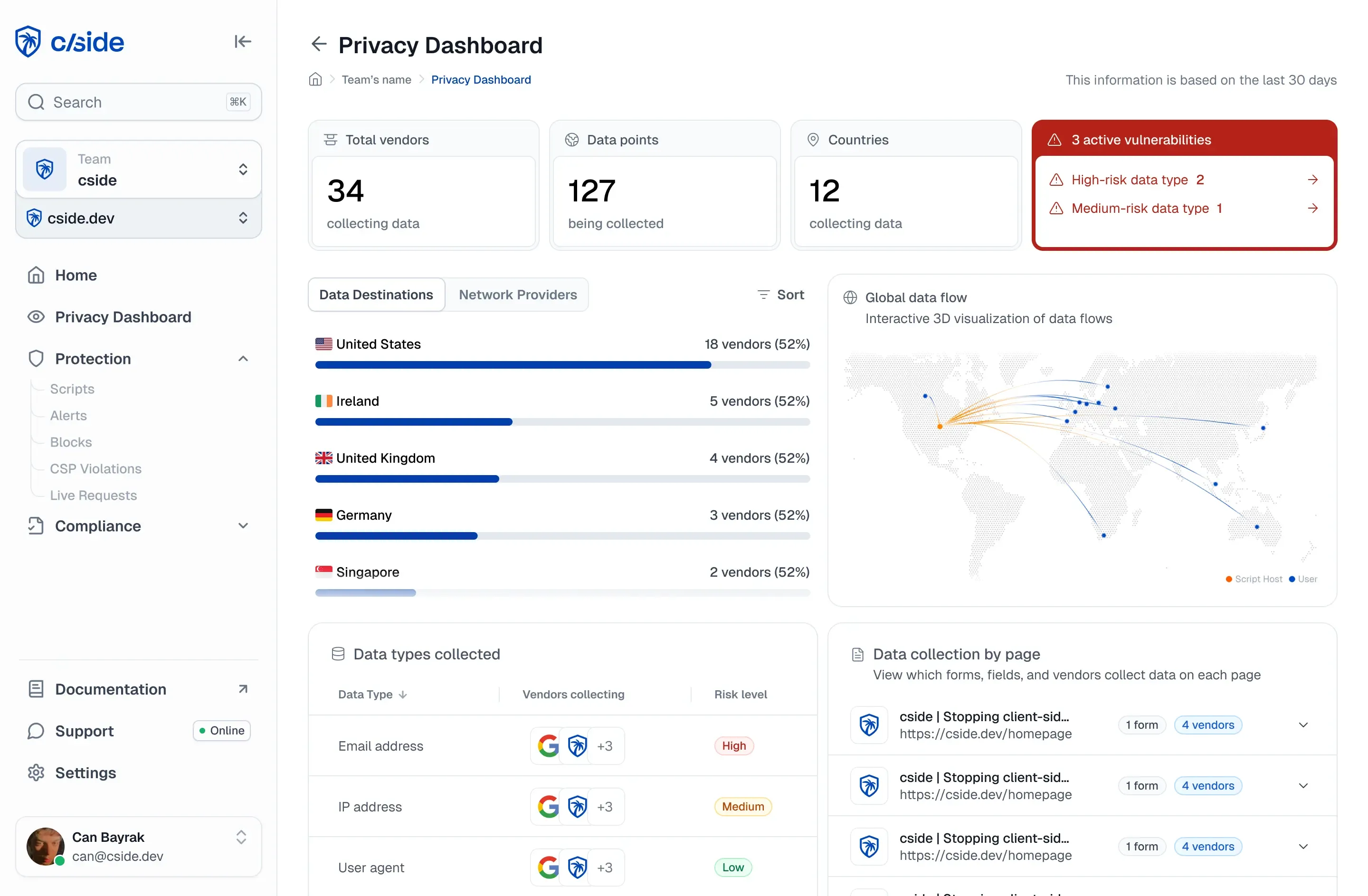
- Baseline the full chain: cside maps the full first, third, and fourth-party load chain, baselines each affiliate script in real sessions, and flags the first request to a new domain, keeping the affiliate live while the payload change gets caught.
Short on time? See cside's in-browser Magecart and skimmer blocking. It covers everything below in one deployment.
The casino affiliate model is one of the most efficient customer acquisition channels in iGaming, and one of the largest untrusted third-party attack surfaces in any industry. Affiliate partners embed tracking pixels and JavaScript on traffic sources across the web, and those same scripts routinely end up loaded on the casino's own pages through tag managers and referral tracking parameters. When an affiliate script is compromised, the operator has effectively granted a hostile actor direct script execution access to their platform. The ENISA Threat Landscape for Supply Chain Attacks identifies third-party code as the primary vector in supply chain compromises, and the casino affiliate stack is a textbook example of why.
How affiliate scripts enter the casino tech stack
Quick Answer: Affiliate scripts enter the casino tech stack through three primary routes: tag managers that load affiliate pixels site-wide, referral tracking parameters that trigger script execution on landing pages, and deep-link mechanisms that embed affiliate identifiers into the player journey. Each route gives the affiliate's code execution access to the operator's own page environment.
The affiliate relationship requires measurement, and measurement requires code. To track that a player arrived from a specific partner, converted, and generated revenue, the affiliate's tracking script must execute somewhere in the player's journey on the operator's site. This is the intended architecture, not a technical mistake.
The problem is what that architecture permits. An affiliate script loaded via Google Tag Manager on the casino's lobby page has the same DOM access, cookie-read ability, and network permissions as the operator's own JavaScript. The operator has intentionally loaded it, so it runs without a CSP rule blocking it or a WAF rule firing.
Common entry points include:
- Tag manager containers that load affiliate pixels on every page or on specific conversion events (first deposit, registration)
- Referral landing pages that read UTM parameters and fire affiliate tracking calls before the player reaches the main lobby
- Deep-link redirect pages that resolve affiliate IDs and set tracking cookies before forwarding the player into the site
Each entry point is a place where a compromised affiliate script can execute with the operator's implicit trust. The entry mechanism is by design; it is the abuse of that mechanism that matters.
The attack patterns: what compromised affiliate scripts actually do
Quick Answer: Compromised affiliate scripts execute four primary attacks against casino operators: silently redirecting players to competing platforms during high-intent moments, stealing referral commissions by overwriting UTM parameters and cookie values, abusing deep-link mechanisms to inject fraudulent affiliate IDs, and loading additional malicious payloads that persist across the player session.
The Polyfill.js compromise in June 2024 demonstrated at scale how a single trusted script, used by over 490,000 sites, could be turned into a delivery mechanism for malicious redirects after the original project changed hands. Affiliate scripts face the same risk: the operator trusts the partner, the partner's infrastructure gets compromised, and the attacker inherits that trust relationship.
Player redirect. During a high-intent moment (typically at the login page, the deposit flow, or after a bonus is applied) the compromised script detects the player's behavioural state and initiates a navigation event to a competing casino or phishing clone. The redirect is fast enough that many players assume it is a legitimate redirect. The operator's analytics show an abandoned session rather than a redirect.
Commission theft via UTM manipulation. Affiliate commissions are calculated based on UTM parameters and tracking cookies that identify the referring partner. A compromised script can overwrite document.cookie values or modify URL parameters in real time, replacing a legitimate affiliate ID with the attacker's own. The operator pays commission to the wrong party. This is particularly difficult to detect because the revenue event still occurs, but only the attribution is wrong.
Deep-link abuse. Affiliate deep links resolve an ID parameter and set a tracking cookie before forwarding the player. A script that intercepts this flow can inject a fraudulent affiliate ID into the cookie before forwarding completes, hijacking the revenue attribution for the entire player relationship.
Further payload delivery. The compromised script's most dangerous capability is loading additional JavaScript from attacker-controlled infrastructure. A small stub script, trusted because it carries the affiliate's identity, fetches a full payload that can execute any of the above attacks and more, including keylogging during registration or credential harvesting. This is the vendor load chain in action: the affiliate script is the parent, it loads child scripts, and those children can load grandchildren. cside maps the full chain, not just the first-degree dependency, which is where the actual malicious payload usually sits.
Why compromised affiliate scripts differ from other supply chain attacks
Quick Answer: Unlike third-party scripts that enter the stack without explicit intent, affiliate scripts are deliberately loaded with broad page access because measurement requires it. The trust relationship is intentional, which means the script bypasses the controls that would normally catch untrusted code. A compromised affiliate script is a trusted vector turned hostile, harder to detect and harder to block without breaking the affiliate relationship.
The Verizon 2024 DBIR consistently identifies web application attacks as the most common external attack vector. What makes affiliate compromise distinct within that category is the trust differential.
Most supply chain attacks exploit third-party scripts that operators load without reviewing them. Affiliate script compromise is different: the operator has actively reviewed and approved the relationship. The script has an account, a contract, and an agreed-upon scope. When the script is compromised, the attacker exploits the approval that already exists, not a gap in approval processes.
This creates several detection challenges:
- Blocking the script breaks a revenue-generating affiliate relationship
- The script's network calls to its own domain look legitimate, because the domain is the affiliate's real domain
- Payload delivery from a second domain is the first behavioural indicator that something has changed, and it requires runtime monitoring to catch
- UTM manipulation and cookie writes do not generate any network error or server log entry
White-label casino platforms that serve multiple brands face a compounding version of this problem. A single compromised affiliate script loaded across 20 brands via shared tag manager configuration affects all 20 simultaneously. The IBM 2024 Cost of a Data Breach report puts the global average breach cost at $4.88M, but for multi-brand operators the blast radius multiplies that exposure. Detecting these behavioural changes before they propagate requires instrumentation at the execution layer.
How cside detects behavioural changes in affiliate scripts
Quick Answer: cside monitors affiliate scripts at the execution layer in 100% of real user sessions. It baselines what each affiliate script normally does (which domains it contacts, which DOM elements it reads or writes, what network requests it initiates) and alerts when runtime behaviour deviates from that baseline, without needing to block the script or break the affiliate relationship.
The key insight is that a compromised script behaves differently. Before compromise, the affiliate's script fires a tracking pixel to its own domain and sets a cookie. After compromise, it contacts a second domain, modifies a cookie it did not previously touch, or initiates a redirect that was not in its previous execution pattern. Those behavioural changes are detectable without knowing in advance that a compromise has occurred.
cside's approach to affiliate script monitoring includes:
- cside maps the complete vendor load chain for every affiliate script, including child and grandchild scripts loaded dynamically. If an affiliate script is clean but the child it loads is malicious, cside sees the full dependency tree and attributes the behaviour to the correct origin
- cside identifies every first, third, and fourth-party script that executes on each page (lobby, deposit, withdrawal, registration) and flags new scripts that appear without a corresponding change in the operator's own deployment
- When an affiliate script begins contacting a domain it did not previously contact, cside surfaces that as a change event requiring review
- Writes to cookie values or UTM-related storage that are inconsistent with the script's previous behaviour are flagged as anomalous
- Calls to
window.locationor navigation API mutations that are not initiated by the operator's own code are surfaced with full context about which script initiated them
cside observed over 300,000 attack signals across monitored sites in Q1 2025, many of which involved third-party script behaviour changes consistent with supply chain compromise.
The business impact: revenue loss, disputes, and regulatory exposure
Quick Answer: The business impact of compromised affiliate scripts includes direct revenue loss from player redirects, commission disputes with legitimate affiliates whose IDs have been overwritten, chargeback exposure from players who were redirected to phishing sites, and potential regulatory action under PCI DSS and GDPR for failure to control third-party script access to payment flows.
The financial exposure is rarely visible in a single transaction. Redirect attacks remove players at the moment of highest intent, typically just before deposit. The operator sees increased abandonment rates and lower conversion, which may be attributed to UX issues or campaign quality before a script compromise is considered.
Commission fraud via UTM manipulation is often discovered only when a legitimate affiliate reports lower-than-expected earnings and initiates a dispute. By that point, the manipulation may have been running for weeks.
Regulatory exposure is a separate layer of risk. The PCI Security Standards Council requires that all scripts executing on payment pages be authorised and monitored under PCI DSS requirement 6.4.3. A compromised affiliate script executing on a deposit page is a direct compliance failure. GDPR obligations under Article 32 apply where player data is exposed through the compromised script's payload.
For operators licensed under the UK Gambling Commission or Malta Gaming Authority, client-side security posture is increasingly part of technical compliance assessments. Demonstrating that all third-party scripts, including affiliate pixels, are monitored at the execution layer is becoming a baseline expectation, not a differentiator.
What operators should do now
The affiliate channel is not going away, and monitoring it should not require disrupting existing affiliate relationships or renegotiating contracts. The operational question is whether your current security tooling gives you visibility into what affiliate scripts do at runtime, not just which domains they load from.
Network-layer tools such as Cloudflare Page Shield track which script URLs appear on a page. They do not track what those scripts do once they execute: whether they overwrite a cookie, modify a UTM parameter, read session storage, or initiate a redirect. Tools built for compliance audit purposes typically sample a percentage of sessions and produce periodic reports; they are not designed to surface a script behaviour change in the first affected session it occurs.
cside instruments every session at the execution layer, baselines affiliate script behaviour on deployment, and alerts on deviations in real time. This means that a compromised affiliate script (even one that fetches its payload from a second domain only on specific player conditions) is detected in the session where it first executes that behaviour, rather than when an audit report runs next month.
If you operate a multi-brand or white-label casino platform with affiliate tracking active across brands, contact cside to understand how execution-layer monitoring can be deployed without changes to your affiliate stack.