
TL;DR: ad marketplace client-side script risk management
- Two teams, both right: Ad ops teams treat third-party rotation as a revenue feature. Security teams treat it as a supply chain nightmare. Both are right, and pretending you can pick one is how ad networks become your worst breach vector.
- The visibility gap: Forrester found 25% of enterprises attribute heightened security risk to their expanding third-party networks, yet less than half of companies assess even 50% of those relationships. cside's first-party JavaScript agent observes ad scripts as they run in the browser and blocks malicious injections in real time.
- Keep rotation, add monitoring: If ad revenue depends on frequent script rotation, keep the rotation but instrument every payload with a first-party browser agent that watches behavior live. If you cannot deploy runtime monitoring yet, at minimum inventory every ad-tech partner and segment their credentials before the next zero-day comes through the tag manager.
Short on time? See cside's in-browser Magecart and skimmer blocking. It covers everything below in one deployment.
For businesses monetizing through ad marketplace models, the less traditional 3rd-party advertising networks, analytics platforms, and marketing scripts are indispensable. They're needed to drive revenue by boosting engagement and tracking user behavior.
But, they also come with client-side risks.
We're talking about malicious ad injections, phishing schemes, and vulnerabilities in 3rd party scripts that are increasingly exploited by attackers.
Studies like the Verizon 2024 Data Breach Investigations Report (DBIR) and Forrester's Business Risk Survey show that vulnerabilities in the digital supply chain, including 3rd-party dependencies, are a leading cause of modern data breaches.
That's because these scripts have full reign in the browser of your users. They can essentially load anything they want and completely change the visitor's experience.
Our goal is to cover best practices for protecting end-user data and maintaining continuous compliance. Even under pressure to maximize ad revenue. One shouldn't rule out the other.
What are these threats exactly
- Malicious scripts: Ad marketplace models depend on frequent script rotation for analytics and ad rendering. Bad actors use these dynamic environments to embed malware or intercept data. As the DBIR indicates, malicious injection via ad servers or direct script manipulation remains a top infiltration vector.
- Credential theft and exploits: The DBIR shows that phishing, stolen credentials, and exploit vulnerabilities increasingly rank as leading breach causes. Attackers latch onto marketing platforms and unsupervised scripts to execute quick pivots into more sensitive areas of the website.
- Explosion of 3rd-party ecosystems: Forrester's 3rd-party risk research shows that overreliance on vendors has complicated risk oversight: 25% of enterprises attribute heightened security risk to their expanding 3rd-party networks, yet less than half of companies assess even 50% of those relationships, often due to resource constraints and competing priorities.
- Usage of modern tech: As Forrester notes, many businesses do not see 3rd-party risk management (TPRM) as a high-level priority, even though zero-day exploits like MOVEit have exposed supply chain weaknesses. Manual oversight fails to keep up with the dynamic nature of modern digital ecosystems, allowing client-side vulnerabilities to remain unnoticed.
How this applies in the ad marketplace realm
The reliance on outside ad networks and marketing tech providers makes ad marketplace platforms, and those who integrate them, prime targets for attackers. Forrester mentions specifically that finance, manufacturing, and large multinational corporations have an elevated risk, yet do not consistently prioritize 3rd-party security.
Companies operating internationally encounter variation in regulatory frameworks. EMEA businesses, for instance, experience more rigorous mandates via the EU's Digital Operational Resilience Act (DORA) and GDPR.
Meanwhile, North American and APAC organizations witnessed steep declines in TPRM concern, despite ongoing increasing of cross-border ad scripts and infrastructure. This regulatory gap often results in inconsistent vendor vetting.
And of course, overlooking 3rd-party relationships can lead to all kinds of trouble. Your revenue, compliance fines, or even class-action lawsuits following data breaches. Once attackers embed themselves client-side, they can siphon consumer data or hijack campaigns with relative ease, and likely unnoticed.
How to solve this
To strengthen client-side and 3rd-party risk management, organizations must adopt a structured and proactive approach.
First, maintain a comprehensive and regularly updated registry of all analytics and ad-tech partners. Each vendor should be assessed based on their access to sensitive user data and the organization's revenue dependency on their services.
Automation can play an important role in vendor assessments. Any organization managing extensive networks of 3rd-party scripts should implement robust TPRM or governance, risk, and compliance platforms. These tools provide continuous evaluation and streamline oversight, moving beyond static, annual checklists to dynamic, real-time monitoring. And it saves a ton of time, which saves a ton of money.
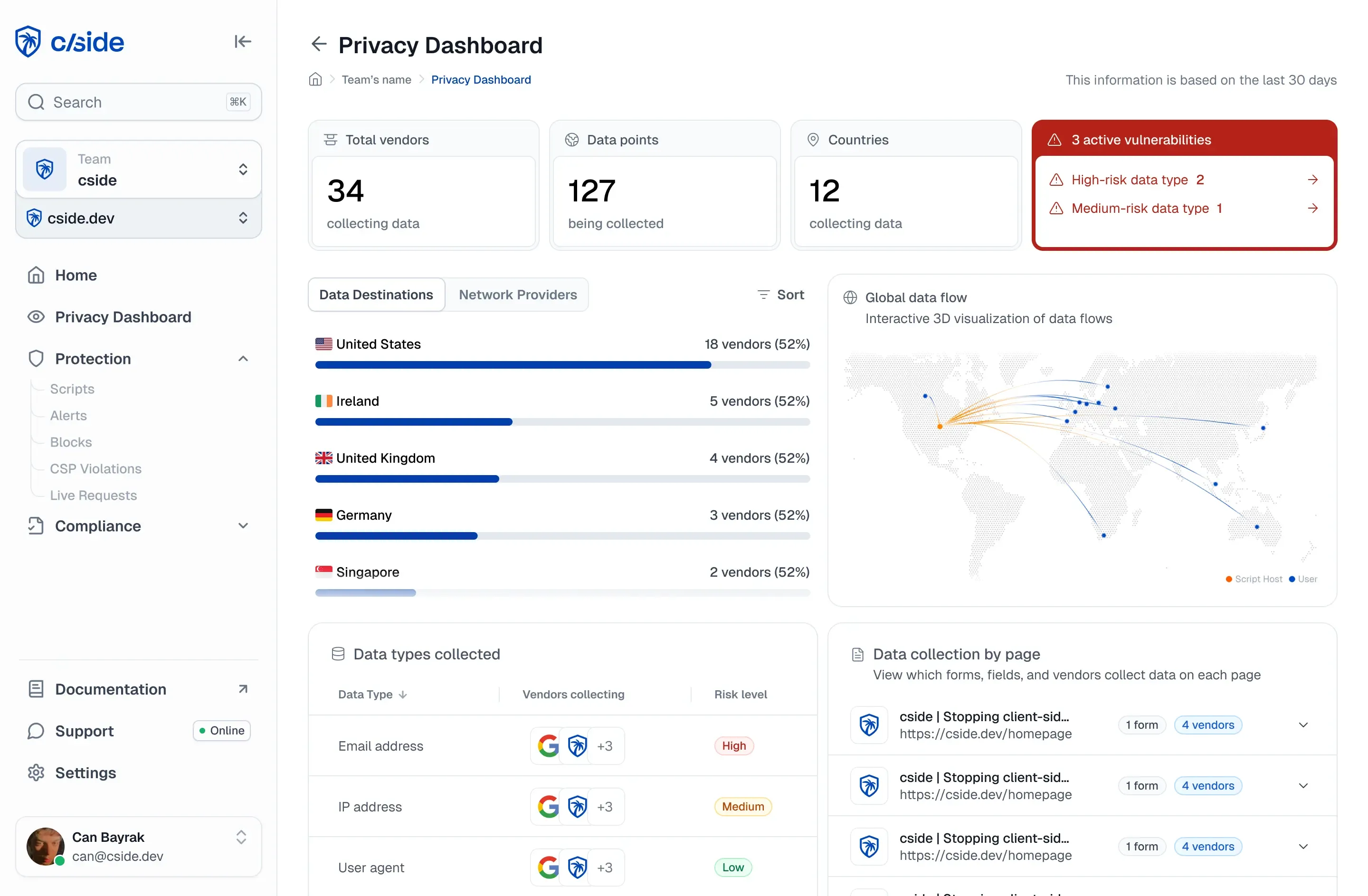
On the client side, various options are in the market. We developed a first-party script solution that ensures visibility into ad scripts as they run. This enables the detection and blocking of malicious injections in real-time, which not all tools can provide.
As standard, multifactor authentication (MFA) should be mandated for all administrative logins, and credentials for 3rd-party platforms should be segmented. Deploying phishing detection tools across teams also bolsters resilience.
Matching security investments to recognized risks is equally important. Organizations acknowledging 3rd-party exposure are more likely to secure higher budgets for risk management. Use this momentum to fund TPRM platforms and code inspection tools.
Closing notes
Your ad marketplace monetization is likely at risk due to the very nature of its implementation on your site. It's not a bug, it's a feature: that's simply how the client-side environment works.
Prioritize client-side security in protecting these scripts, and thus your users and yourself. Use a tool like cside, to continuously monitor the behavior of these 3rd-party scripts to catch any malicious attempts.
Meanwhile, set up an inventory of these 3rd-party scripts (which cside does for you), and make sure you vet your partners well.
Pay attention to every section of the web supply chain, and assure your visitors and users are safe to navigate your pages.