
Account takeover in 2026 is an automation problem before it is a credentials problem. Attackers now run AI agents inside real browsers that solve challenges, rotate stealth-browser fingerprints, and change tactics based on how your defenses react. A single rule at the login endpoint cannot keep up with that. This playbook gives you one operating model that spans login, recovery, session, and post-auth, and points to the deeper guides for each piece.
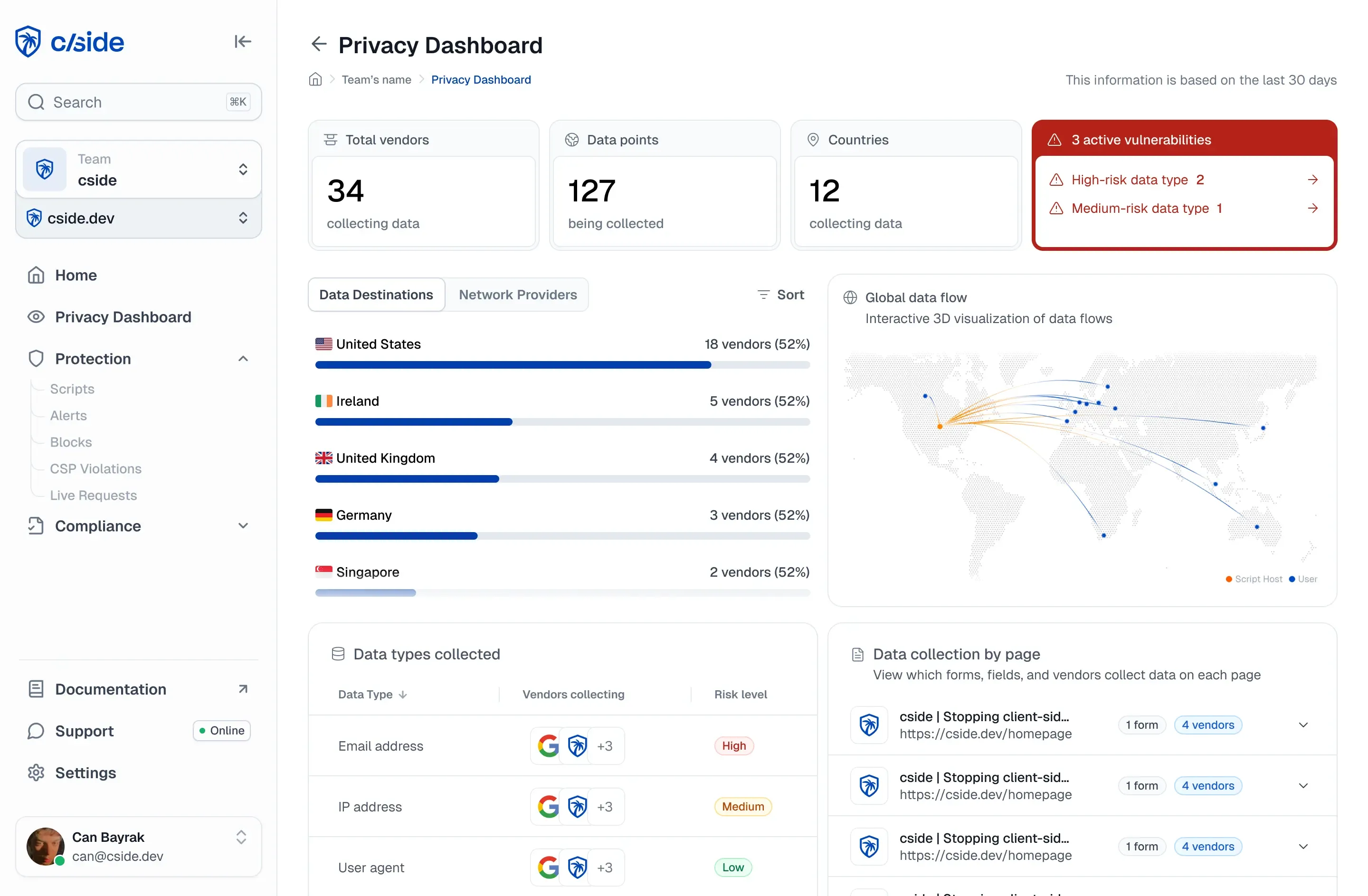
The useful frame: stop defending the password check and start scoring the session. The password is often correct. What is wrong is the browser environment, the network path, the recovery event, or the post-auth action that follows. cside instruments the browser layer to capture device and real-IP signals, AI-agent and stealth-browser behavior, VPN/proxy patterns, and any third-party script tampering with your login page — the evidence a server log alone will not show.
The four-stage ATO operating model
Treat ATO as a lifecycle, not an event. Each stage gets an owner, its own risk signals, a response action, and a retained evidence trail. A weak signal at one stage should raise the bar at the next, not vanish once the login succeeds.
| Stage | Primary risk | Signals to capture | Response | Evidence to keep |
|---|---|---|---|---|
| Login | Credential stuffing, AI-agent bots | Attempt velocity, device fingerprint, navigator.webdriver, MFA result | Throttle, challenge, block | Attempt logs, fingerprint, MFA outcome |
| Recovery | Reset abuse, support social engineering | Reset-token age, new-device reset, email/phone change | Step-up verify, cool-down | Reset events, device delta, channel changes |
| Session | Token replay, adversary-in-the-middle | Session-device continuity, IP/ASN drift, fingerprint drift | Re-authenticate, revoke session | Session origin, continuity breaks |
| Post-auth | Payout/address change, order velocity | Payment-method change, gift-card buys, order bursts | Hold action, manual review | Change history, analyst decision |
Why the attacker profile shifted
The cheap part of ATO got cheaper and smarter. cside research found that installs of playwright-stealth — one of many stealth-browser kits used to defeat fingerprinting — were about ten times higher by the end of 2025 (cside research report). That class of tooling lets an agent present as a normal Chrome session while automating logins at scale.
These agents do not look like the curl-and-proxy bots of a few years ago. They drive a real rendering engine, so naive checks pass. The tells move into the runtime: inconsistencies between declared and observed environment, automation-control surfaces like Chrome DevTools Protocol (CDP) Runtime leaks, residential-proxy behavior, and fingerprint drift across sessions that should be stable. OWASP still frames credential stuffing as automated login attempts using known username-password pairs and recommends layered controls — MFA, breached-password checks, throttling, and bot detection (OWASP cheat sheet). The layering still holds; the bot-detection layer is what has to be rebuilt for agents.
Where programs leak
A login defense can be flawless while the account still gets taken. The leaks cluster in three places:
- Recovery flows — password reset and remembered-device removal are often weaker than login, and they hand the attacker durable access.
- Session continuity — a replayed cookie or an adversary-in-the-middle proxy gives an authenticated session with no password and no fresh MFA step.
- High-value post-auth actions — payout changes, saved-card edits, and gift-card purchases are where a quiet takeover turns into loss.
Score these as their own surfaces. NIST SP 800-63B treats automated-attack resistance as part of authenticator and session design, which puts bot mitigation, phishing-resistant MFA, and session-risk signals in the same control stack (NIST SP 800-63B).
The 90-day rollout plan
You do not need to ship all four stages at once. Sequence by where loss lands first.
- Instrument before you enforce. Deploy browser-layer signal capture in observe-only mode across login, recovery, and checkout so you have a baseline of normal devices and networks per account.
- Harden login. Require phishing-resistant MFA for high-value accounts, block known-breached passwords at sign-up and reset, and add AI-agent and stealth-browser detection to the login endpoint.
- Lock down recovery. Treat resets as fraud surfaces: step-up verification on new-device resets, cool-downs after email or phone changes, and analyst review for support-driven recovery.
- Carry risk into the session. Re-authenticate when session-device continuity breaks or fingerprint drift appears mid-session, and revoke rather than warn on confirmed replay.
- Gate post-auth actions. Hold payout, address, and payment-method changes behind the session-risk score, and require a fresh challenge for the riskiest ones.
- Close the loop with support. Review false positives with the support team weekly, because their queue is where over-blocking shows up first.
How the cluster fits together
This post is the hub. Each stage has a deeper guide, and the right move is to read the one that matches the leak you are fixing.
| If you need to… | Read |
|---|---|
| Stand up a business-level ATO program from scratch | How to prevent account takeover fraud |
| Catch takeover before checkout using session drift | Detect account takeover before it happens |
| Stop the automation feeding stuffing campaigns | Credential stuffing: how to detect and stop it |
Where cside sits in the model
cside is the browser-layer signal source the model runs on. It captures device and real-IP context, AI-agent and stealth-browser behavior, VPN/proxy patterns, and runtime script tampering, then delivers those signals via API so your fraud logic can score sessions across all four stages. Because it watches the runtime, it sees a tampered third-party script skimming credentials on your login page — an attack a WAF and server log miss entirely. Pipe one shared session-risk score through login, recovery, session, and post-auth instead of bolting separate rules onto each.
Further reading on cside
- How to prevent account takeover fraud
- Detect account takeover before it happens
- Credential stuffing: how to detect and stop it
- cside AI Agent Detection