
Fake account creation has always been a fraud vector. What has changed is the quality of the fakes. Traditional automated account creation used scripts that filled forms at machine speed, recycled fingerprints across sessions, and failed basic behavioural checks. AI-powered account creation uses real browser sessions, varied timing, realistic-looking behavioural patterns, and generated personal details that pass basic validation.
The result is a population of fake accounts that look legitimate by every metric traditional fraud systems use to classify them, becoming a resource for abuse, promo fraud, credential stuffing, or resale to other fraudsters. The same browser-layer visibility gap that lets AI card-testing agents go undetected applies here too, as covered in How to Block AI Card-Testing Agents.
Why Fake Accounts Are Created
Quick answer: Fake accounts enable a range of fraud schemes: promotional abuse (claiming new-user discounts multiple times), inventory manipulation (holding stock to resell), credential resale (selling verified accounts on dark web markets), review fraud, and platform-specific abuse. The cost of creating accounts has dropped significantly as AI-powered automation has made bulk creation cheaper and more evasion-capable.
Common use cases for fake account infrastructure:
- Promo fraud: New-user discounts, referral bonuses, and sign-up credits are valuable. A single fraudster with AI-powered account creation can claim them at scale across hundreds or thousands of accounts.
- Inventory manipulation: Bulk account creation can be used to hold limited-release inventory, ticket allocations, or constrained supply, then resell access or the items themselves.
- Review and rating manipulation: Fake accounts are the infrastructure for rating fraud: boosting products, downgrading competitors, and manufacturing social proof.
- Credential resale: Verified accounts on popular platforms have market value. Accounts created and verified through real-looking registration flows sell in criminal markets.
- Platform abuse escalation: Fake accounts are often the first step in more complex fraud chains: account takeover preparation, social engineering infrastructure, or layered identity fraud.
Why CAPTCHA Fails Against AI Account Creation
Quick answer: CAPTCHA was designed to distinguish humans from rule-based bots. AI-powered account creation defeats it through AI vision models that solve visual challenges, CAPTCHA-solving services that use human solvers at low cost, and behavioural patterns that satisfy CAPTCHA's underlying heuristics without being human.
The failure modes are well-documented:
AI vision models: Modern vision models can solve standard image-based CAPTCHA challenges with high accuracy. The cognitive gap between humans and machines that CAPTCHA relies on has effectively closed for most common challenge types.
Human-powered solving services: A large market of CAPTCHA-solving services uses real humans in low-cost labour markets to solve challenges for automated systems. The turnaround time is typically under 30 seconds. From your CAPTCHA system's perspective, the challenge was solved by a human.
Behavioural CAPTCHA evasion: Behavioural CAPTCHA systems that track mouse movement, click patterns, and interaction dynamics are increasingly circumvented by AI browser automation that generates plausible human-like behavioural signals. The generation quality varies, but sophisticated systems can produce behavioural patterns that pass standard behavioural CAPTCHA.
In cside's controlled testing, traditional tools missed AI agents operating inside real browser sessions in 81 out of 100 scenarios, and AI account creation agents fall squarely into that gap.
The fundamental limitation of CAPTCHA is that it is a single checkpoint rather than a session-level continuous evaluation. Even if it catches some automated sessions at the moment of the challenge, it provides no protection against sessions that passed the challenge through any of the above mechanisms.
The Session Signals That Reveal AI Account Creation
Quick answer: AI account creation sessions have behavioural signatures at the browser layer that persist throughout the registration flow, not just at the CAPTCHA checkpoint. Interaction timing, form fill patterns, fingerprint state, and post-registration behaviour collectively reveal automated account creation that CAPTCHA missed.
Registration form fill behaviour Human users filling a registration form take variable time per field. They pause on email fields (to check or type their address), take longer on password fields (to construct and remember), and occasionally make and correct errors. AI account creation systems fill forms with consistent, precise timing: each field takes approximately the same amount of time, there are no correction events, and the form is completed without hesitation.
Generated personal data patterns AI-generated personal details often have statistical patterns that differ from real user registrations: unrealistic name combinations, email addresses that follow algorithmic generation patterns, phone numbers that cluster around specific prefixes or follow structural patterns, and address data that does not correspond to plausible residential addresses.
Fingerprint state Account creation sessions from AI systems typically present clean, default-state fingerprints without the accumulated context of real consumer devices. A fresh fingerprint appearing at scale (many registrations from similarly profiled sessions) is a signal.
Post-registration behaviour Fake accounts often exhibit characteristic post-registration behaviour: immediately engaging with promo codes, immediately attempting to exploit referral systems, or remaining completely inactive after creation (parked for later use). These behavioural profiles in the first minutes and hours after account creation are observable signals.
Session correlation AI account creation at scale produces correlated session patterns: similar timing between sessions, similar fingerprint clusters, similar navigation paths through the registration flow. Individual sessions may look plausible; the pattern across sessions reveals the automation.
Controls That Work
Quick answer: Effective fake account prevention requires continuous session evaluation rather than a single checkpoint. Behavioural signals throughout the registration flow, email and phone verification, and post-registration monitoring together provide the coverage that CAPTCHA alone cannot achieve.
Behavioural evaluation throughout registration Rather than a single CAPTCHA checkpoint, continuous behavioural monitoring of the registration session provides signals that AI account creation cannot consistently suppress. Form fill patterns, interaction timing, and fingerprint characteristics accumulate into a behavioural score across the full registration session.
Email and phone verification Requiring verification of a working email address or phone number adds a barrier to bulk account creation. It does not stop determined fraudsters who use temporary email or phone services, but it adds cost and friction that limits scale. Combined with behavioural signals, verification catches accounts that behavioural analysis flagged but did not definitively block.
Post-registration behavioural monitoring Accounts that immediately claim promotional offers, immediately use referral systems, or immediately exhibit high-volume activity have behavioural profiles that differ from normal new-user onboarding. Flagging and reviewing accounts with these post-registration patterns before activating benefits catches promo fraud and abuse.
Correlation analysis Looking across registration sessions rather than at individual sessions reveals coordinated account creation. Clusters of sessions with similar fingerprints, similar timing, similar form fill patterns, or similar post-registration behaviour indicate systematic fake account creation even when individual sessions pass point-in-time checks.
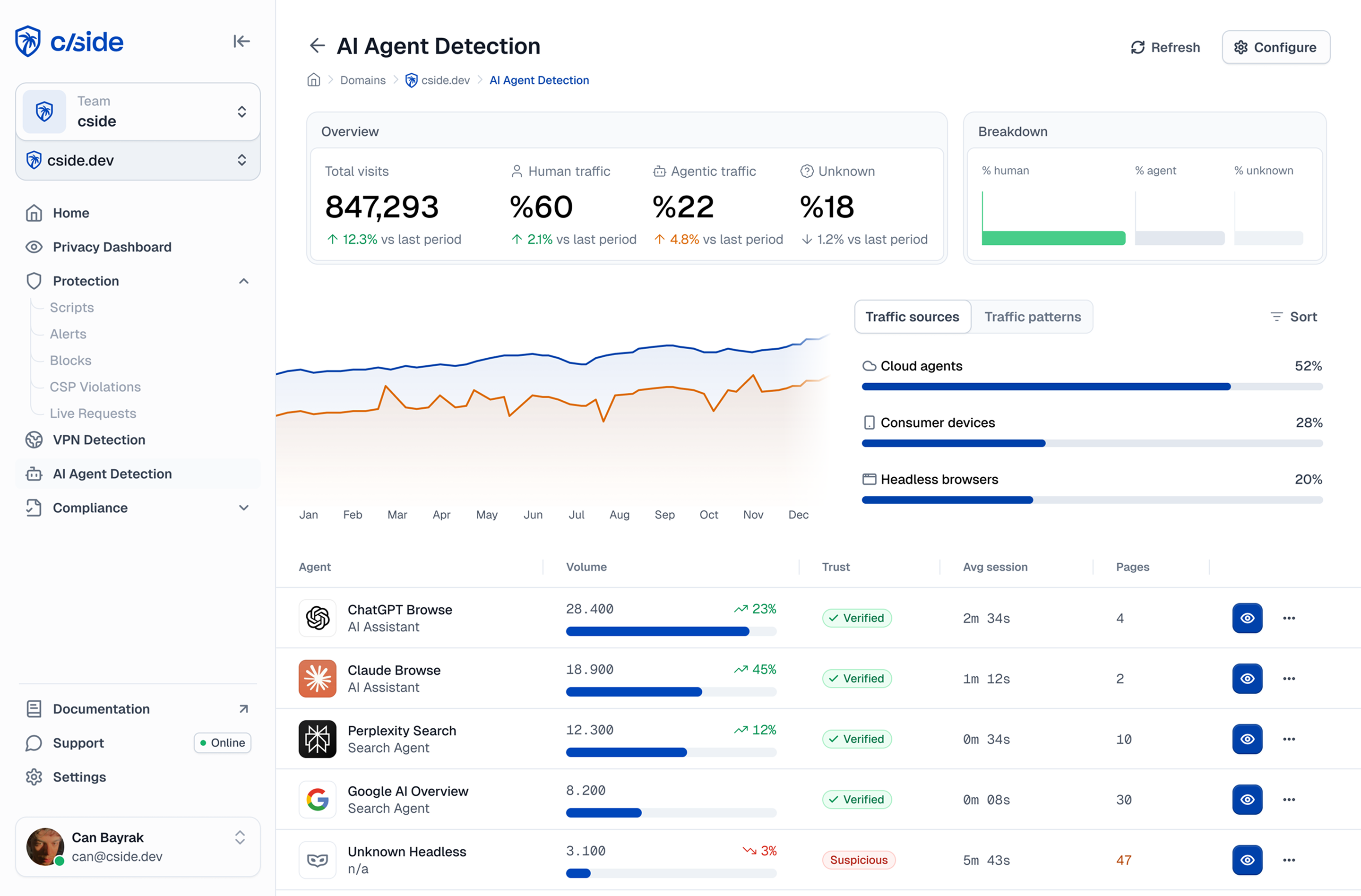
cside surfaces these session-level and cross-session signals in real-time, giving fraud teams the visibility to act on registration abuse before fake accounts are activated and used. If you are evaluating tools for this, see the best bot and agent trust management platforms compared.
What cside Catches That CAPTCHA Misses: A Concrete Scenario
Quick answer: A promo fraud operation targets a SaaS platform's 30-day free trial. Each account gets a distinct email address, a plausible name, and passes CAPTCHA via a human-solving service. Traditional fraud tools see nothing. Here is what the browser session reveals.
The agent navigates to the signup page and waits 18 seconds before touching the form, a scripted delay to simulate reading. The first name field is filled in 0.6 seconds flat. The email field takes exactly 1.1 seconds for every registration in the batch. Password entry time is 1.8 seconds, identical across 200 consecutive sessions. There are zero correction events on any field across the entire batch. The form is submitted within 0.5 seconds of the last field completing.
cside observes: field-level timing variance of less than 40 milliseconds across all 200 sessions, fingerprint profiles clustering around the same framework defaults, and post-registration behaviour showing immediate promo code claims within 90 seconds of account confirmation. Individual sessions pass every point-in-time check. The cross-session pattern shows systematic automated registration at scale. cside flags the batch as coordinated fake account creation and pauses benefit activation pending manual review.