This article takes an honest look at the features of Source Defense.
Since you’re on the cside website, we acknowledge our bias. That said, we’ve built our case honestly and based our analysis on publicly available information, industry information, and our own or our customers' experiences.
If you want to verify their claims yourself, please go to their product pages.
| Criteria | cside | Source Defense | Why It Matters | What the Consequences Are |
|---|---|---|---|---|
| Approaches used | Script-based monitoring + server-side analysis, but also offers crawler and a free CSP reporting endpoint | Crawler + JS-Based Detection | ||
| Real-time Protection | Full support |
Full support |
Attacks can occur between scans or in the excluded data when sampled | Delayed detection = active data breaches |
| Full Payload Analysis | Full support |
No support |
Ensures deep visibility into malicious behaviors within script code itself | Threats go unnoticed unless the source is known on a threat feed |
| Dynamic Threat Detection | Full support |
No support |
Identifies attacks that change based on user, time, or location | Missed detection of targeted attacks |
| DOM-Level Threat Detection | Full support |
Full support |
Tracks changes to the DOM and observes how scripts behave during runtime | Unable to identify sophisticated DOM-based attacks |
| 100% Historical Tracking & Forensics | Full support |
No support |
Needed for incident response, auditing, and compliance | Needed for incident response, auditing, and compliance |
| Bypass Protection | Full support |
No support |
Stops attackers from circumventing controls via DOM obfuscation or evasion | Stealthy threats continue undetected |
| Certainty the Script Seen by User is Monitored | Full support |
No support |
Aligns analysis with what actually executes in the browser | Gaps between what’s reviewed and what’s actually executed |
| AI-driven Script Analysis | Full support |
No support |
Detects novel or evolving threats through behavior modeling | Reliance on manual updates, threat feeds or rules = slow and error-prone detection |
| QSA validated PCI dash | Full support |
Full support |
The most reliable way to ensure a solution is PCI compliant is to conduct a thorough audit by an independent QSA | Without QSA validation, you rely entirely on marketing claims, which could result in failing an audit |
| SOC 2 Type II | Full support |
No support |
Shows consistent operational security controls over time | Lacks verified security control validation, making it a risky vendor |
| PCI specific UI | Full support |
No support |
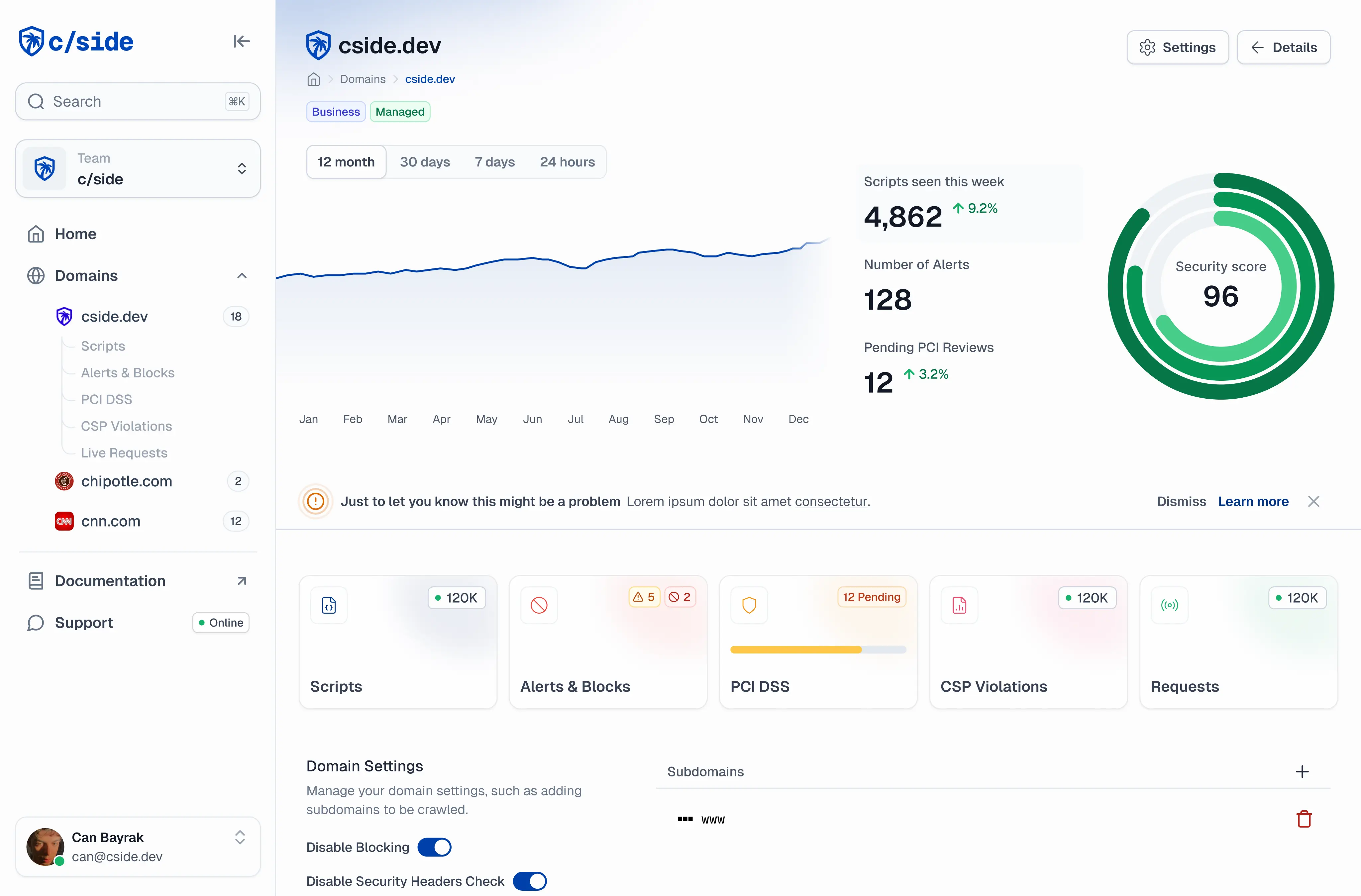
An easy interface for quick script review and justification via one click or AI automation | Mundane tasks and manual research on what all the scripts do, which takes hours or days |
| Ticketing Integrations (Linear, Jira) | Full support (Both Linear and Jira) |
No support |
Native integrations with developer ticketing tools allow security alerts to flow directly into existing workflows | Without native ticketing integrations, teams must manually create tickets for security findings, slowing response times |
What is Source DefenseSource Defense specializes in client-side website security. They were founded in 2014 and, in their own words, built Source Defense with simplicity in mind.
How Source Defense Page Protect works
Source defense offers 2 methods:
“Source Defense Detect” - Crawler basedSource Defense Detect is a crawler that mimics a user visiting the same page, fetching the 3rd-party scripts that load.** **Crawlers can simulate user sessions, but they’re not actual users. And that difference matters, because they don’t capture the precise payload a real visitor receives during their browser session.
Most 3rd-party scripts use logic that adapts the response based on context. Location, device, time, and more. Crawlers are only one specific combination of this, so are unable to capture this correctly. They have some capabilities of mimicking different types of users, but not to the furthest degree.
Additionally, attackers can reasonably easily spot these crawlers and simply serve the non-altered script. The simple logic being: “if the request comes from a cloud provider, serve a clean script.”
Vendors that rely solely on crawlers typically need to buy extra intelligence from 3rd-parties. At cside, we also offer a crawler for situations where our script-based monitoring is not possible (niche cases), but with a major advantage: it's powered by threat data we continuously gather from every site using our on-site monitoring.
This doesn’t guarantee prevention, but it dramatically increases the chances of catching real-world threats compared to a crawler that depends on outside feeds.
Additionally, A crawler on its own cannot make you PCI DSS 4.0.1 (requirements 6.4.3 and 11.6.1) compliant. Read more on that here. We provide a combination with our other solutions where we can help you achieve PCI DSS compliance.
“Source Defense Protect” - JS Agent basedSource Defense also offers a JavaScript agent. Agent based approaches can make for a helpful dashboard with interesting information about scripts but they are not unbreakable and have a few issues by design.
JS agents are trigger based. Anything that doesn’t trigger, is considered good. This has the dangerous effect of “they do not know what they didn’t catch”.
These triggers are defined in the browser, where a bad actor can easily find out what behavior they are tracking. A bit like playing minesweeper but the bombs are exposed.
Source Defense uses their script to create a client-side sandbox, but the problem with that approach is up-to 100ms latency.
Another issue is that agent scripts rely on the same browser environment as the attacker. If a malicious script is already running, it can override core functions like the fetch). When the JS agent tries to send an alert, the attacker can intercept or redirect that request.
From the outside, it looks like everything’s working. But the alert never reaches its destination. The detection was triggered, but the signal was cut off before it left the browser.
This bypass method can be prevented and connections can be protected, but we haven’t seen any client-side security solution that is agent based adopt it.
We detailed that concept here.
Agents can show interesting information but any bad actor can work their way around them. There is also the common perception that they can make sites slower. This can be true but depends on how the script functions. We have decided not to rely on purely on the agent method as attempting to perform detections at the same rank as the bad actor performing threats does not work reliably.
Most importantly: Source Defense can not show you the script contents, which makes it hard for forensics and or have the ability to improve detections.
How cside goes further
Source Defense takes a sandboxing approach, isolating third-party scripts to limit what they can access on the page. The idea is sound, but sandboxing alone has limits. Attackers who find a way around the sandbox constraints still have access to the user's session. cside analyzes scripts before they reach the browser, so malicious code is blocked entirely.
Source Defense's per-script permission model requires ongoing configuration as your site evolves. New scripts, updated dependencies, and changing third-party integrations all need policy updates. With cside, protection is automatic. Our engine learns what scripts are supposed to do and flags deviations. No manual rule writing.
For forensics, Source Defense provides behavioral alerts when sandbox boundaries are crossed. cside captures the actual malicious payload: the full script code that triggered the detection, preserved in an immutable archive. When your incident response team needs to understand how an attack worked, or when a QSA auditor asks for evidence, you have the source code.
cside offers two deployment options:
- Script Method: Add one script to your site. We monitor behaviors client-side and analyze scripts server-side. Takes seconds to deploy.
- Scan Method: If you can't add a script, cside scans your site using threat intelligence gathered from thousands of websites with billions of combined visitors.
cside actively contributes to the W3C to improve browser-native security specifications, and integrates natively with Linear and Jira so security findings flow directly into your development workflows.
Sign up or book a demo to get started.