Key Points
- DataDome monitors bots. cside monitors the browser runtime to produce signals that feed multiple fraud use cases.
- Both products overlap on specialized AI agent detection. They take a similar overall approach to distinguishing consumer agents from malicious agents by looking at identity, network, browser, and behavioral layers.
- The products differ greatly in pricing and accessibility. cside starts at $99/month with a fully self service sign up available. DataDome starts at $3,830 per month and requires an enterprise sales process to access the product.
- Both products tackle AI agent abuse and ATO fraud, but cside also helps with account sharing and multi-accounting. DataDome offers API & MCP protection that cside does not.
Introduction
Bots have always been instrumental to carrying out fraud schemes. AI-agent powered bots are now amplifying fraud vectors like account takeover, multi-accounting, and credit card testing. Legacy bot detection tools are failing to catch those threats. Our own internal tests were able to bypass traditional measures (CAPTCHAs, JS challenges) 81% of the time.
cside and DataDome both aim to solve this new agentic attack vector. The core overlap between the two tools is that they have specialized monitoring against AI agents at the network, browser, and behavioral level. DataDome asks "is this request from a bot?" and decides to allow/block/challenge. cside asks "what is happening in this visitor's browser session?" and produces identity signals, behavioral signals, and security signals that feed multiple use cases.
Disclosure from the author: cside is a competitor of DataDome. This comparison aims to be factually accurate about both products and help you understand when each vendor is the right choice. It's based on publicly available information as well as user reports and we update it periodically to keep it current.
DataDome vs cside: Pricing & Accessibility
| cside | DataDome | |
|---|---|---|
| Pricing (entry) | $99/mo | $3,830/mo for Bot Protect. Account Protect sold separately. |
| Free tier | Yes | No |
| Self-serve Onboarding | Yes. Dashboard can be accessed in minutes. | No. Sales process required to access product. |
| G2 rating | 4.8/5 | 4.7/5 |
| Mobile SDKs | No | Yes |
| Implementation | Script tag added to your website | Requires server-side or CDN integration |
Free plan
cside: Free forever. Basic AI agent detection signals. Free trial for the Business plan if you want to test advanced signals.
DataDome: No free tier. DataDome offers a free trial for evaluation.
Pricing
cside: $99/month for 50,000 API calls. Visitor identity signals include AI agent detection as well as other fraud signals like multi-accounting and account takeover.
- $2 per 1,000 additional calls.
- Enterprise: custom quote.
DataDome: Bot Protect Essentials starts at $3,830 per month. Includes website protection against bots. Account fraud products sold separately.
Reviews
- cside: 4.8/5 on G2. 4.9/5 on Sourceforge.
- DataDome: 4.7/5 on G2.
Implementation
- cside: Self-serve onboarding available with dashboard access in minutes. Add a script tag to your website (similar to analytics tools). Can be live in under a day. Guided onboarding available for enterprise use cases.
- DataDome: Enterprise sales process required for the full product. Deploy a CDN module or server side integration, and then a client-side JavaScript.
DataDome vs cside: Fraud Use Cases
| cside | DataDome | |
|---|---|---|
| Client-side script monitoring | Yes. Browser-runtime product designed for PCI DSS Requirements 6.4.3 & 11.6.1 | Yes, via DataDome Page Protect / Source Defense |
| Account Takeover (ATO) | Yes (credential stuffing, suspicious access detection) | Partial (credential stuffing) |
| Multi-accounting | Yes | Partial |
| Account Sharing Detection | Yes | Partial |
| Friendly Fraud Chargeback Evidence | Yes (through partnership with Chargebacks911) | No |
| Anti-Scraping | Yes | Yes (core focus) |
| Ad Fraud | No | Yes |
| DDoS Protection | No | Yes |
This is where the coverage difference becomes clear. DataDome monitors bots. cside monitors the browser runtime. cside asks "who is this visitor?" and "what is executing in their browser runtime" when they visit your page. This produces an array of security and anti-fraud signals.
cside Fraud Use Cases:
- Account takeover: Detect when a new device, location, or browser environment appears on an existing account. Correlate device fingerprints against known session patterns.
- Account sharing: Identify when a single account is accessed from more devices than your policy allows. Trigger enforcement actions like MFA challenges or upgrade prompts.
- Multi-accounting: Catch users who create multiple accounts from the same device or browser. Useful for bonus abuse, referral fraud, or policy circumvention.
cside also has a separate award winning client-side security product that protects your website from payment page skimming, formjacking, and malicious code injections for phishing attacks.
DataDome Fraud Use Cases:
- Account takeover: Account Protect detects credential stuffing, fake signups, and account farms by analyzing behavioral patterns and flagging anomalies. Most of DataDome's coverage on ATO is based on stopping bots which is only one part of the ATO attack chain.
- Ad fraud: Ad Protect monitors paid and organic traffic across ad campaigns, analyzing both client-side and server-side signals to identify fraudulent clicks.
- Scraping: Core focus. Detection engine scores every request in real time to block scraping bots at the edge.
When cside is the best fit
- You want to solve account sharing, multi-accounting, or account takeover beyond bot blocking: DataDome catches bots. cside catches bots and also looks at signals like impossible travel or the same device tied to dozens of signups to give you visibility into fraud that bot detection alone does not surface.
- You are a mid-market or small business that wants an accessible tool, not an enterprise platform: cside has usage based pricing, self-serve signup, and a dashboard in minutes. A head of fraud at a 50-person eCommerce company can pilot test cside to reduce chargebacks within a few weeks before asking for permanent implementation budget.
- Your team wants raw signals for flexibility and customization: For example - one of our recent implementations was with a developer-led team at a fintech SaaS that wanted to ingest fingerprinting and behavioral signals to build their own scoring logic. cside is developer friendly so you can customize what to do with our data.
When DataDome is the best fit
If your security (and budget) prioritizes bot management, DataDome is purpose-built for it:
- Your biggest problems are scraping, DDoS, and high-volume credential stuffing. For example an ecommerce platform getting hit with millions of bot-driven login attempts or a media company watching its content get scraped by hundreds of rotating proxies.
- You need bot protection across APIs and MCP infrastructure. If you have significant traffic through public-facing APIs and MCP servers, DataDome ships dedicated protection features. cside is focused on your website.
DataDome vs cside: Detection Features
| cside | DataDome | |
|---|---|---|
| Coverage | Website | Website, APIs |
| Device + browser fingerprinting | Yes (102+ signals) | Yes |
| AI agent detection | Yes (behavioral signals) | Yes (behavioral signals) |
| Stealth browser detection | Yes | Yes |
| Custom Rules | Yes | Yes |
| Raw data available | Yes (webhook, API) | Yes (API, access depends on pricing plan) |
AI Agent Detection
Both cside and DataDome identify AI agents visiting your website. AI agent traffic is growing rapidly and there are different categories that should be addressed differently:
- Consumer agents like Perplexity Comet, Claude Computer Use, and OpenAI Operator. They represent legitimate demand through a new channel.
- LLM crawlers and model trainers from major AI platforms.
- Malicious agents running automated fraud.
Both vendors analyze signals across four layers (identity, network, browser environment, behavior) to classify what an agent is and determine its intent. The shared goal is to block bad actors without cutting off the consumer agents that drive agentic commerce.
We broke down some of the exact signals our team looks at in our guide How to Detect AI Agent Traffic On Your Website.
Persistent Visitor ID
cside's fingerprinting produces a persistent visitor ID that follows a visitor across sessions. You can access that ID through an API or no-code rules builder. This is the foundation for use cases like account sharing detection, multi-accounting, and chargeback evidence. It gives you flexibility for enforcement or custom tuning your own models for fraud detection.
DataDome uses device fingerprinting internally to power its bot detection models. Its public positioning emphasizes bot, API, MCP, and account-fraud protection rather than a standalone persistent visitor ID output for custom identity workflows.
What is cside?
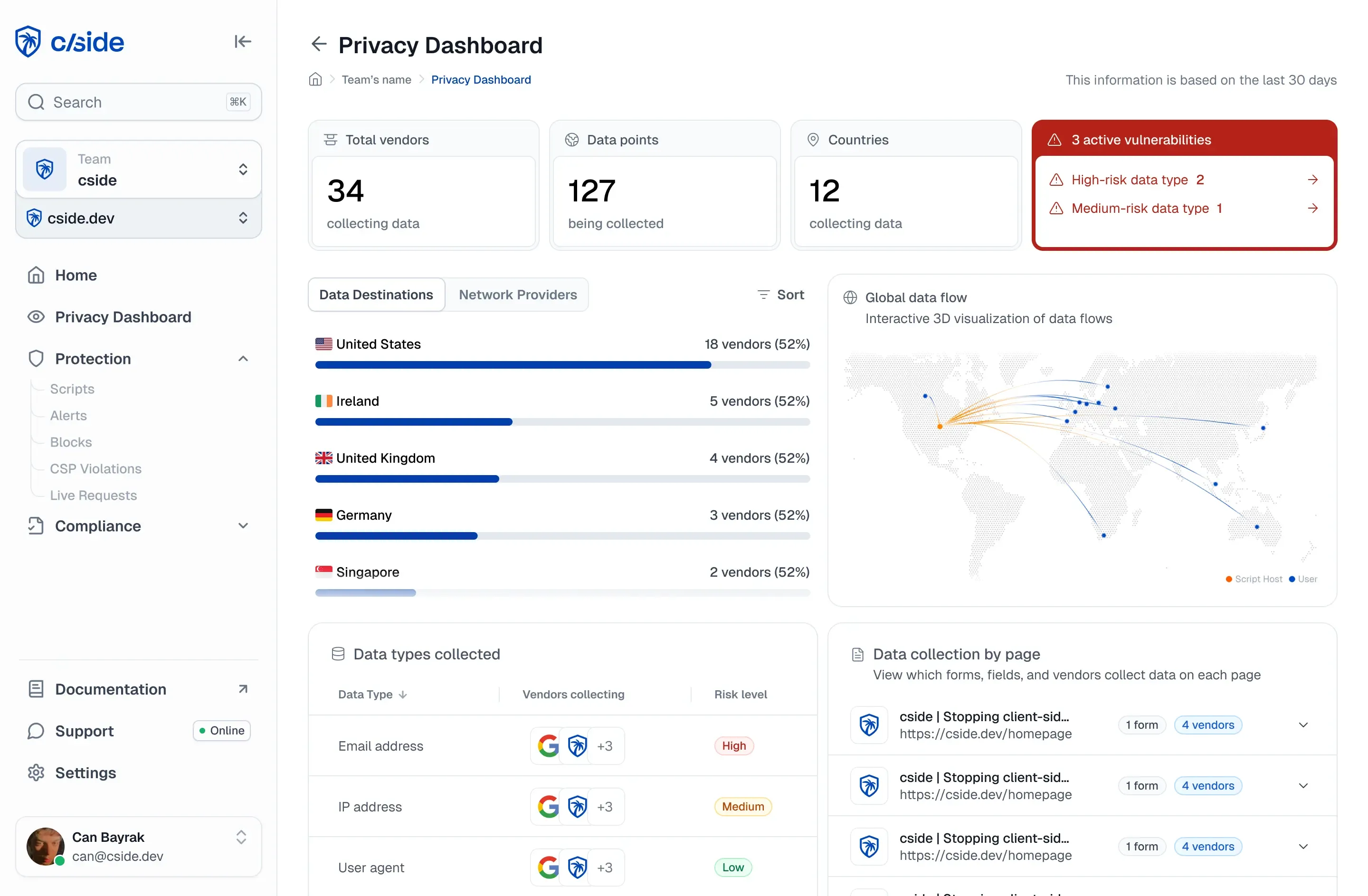
cside is a web security platform that prevents fraud on your website by monitoring the browser runtime. The fingerprinting product collects 102+ signals and focuses on four use cases: account takeover, account sharing, chargeback evidence (CE 3.0 through Chargebacks911), and AI agent detection. The script monitoring product watches every script executing on a page, catching injections, tampering, and skimming attacks that fingerprinting alone does not see.
What is DataDome?
DataDome is a bot management and AI agent trust platform that detects and blocks automated threats across websites, mobile apps, and APIs in real time.
What cside covers that DataDome does not
- Account sharing and multi-accounting detection: cside explicitly exposes a persistent visitor ID that tracks how many distinct devices access a single account and flags when the same device creates multiple accounts. DataDome offers fingerprinting and account-fraud signals, but its public positioning centers on bot, agent, API, and account-protection workflows.
- Third-party script monitoring: cside monitors every script running on your pages through its own browser-runtime platform. This catches credential skimming attacks, compromised third-party scripts, and unauthorized data exfiltration through rogue analytics tags. DataDome also offers payment-page script protection through Page Protect / Source Defense; the practical comparison is architecture, deployment model, data access, and how directly the script telemetry is exposed.
- Client-side controls to comply with PCI DSS and other frameworks: cside's script monitoring satisfies PCI DSS 4.0.1 requirements 6.4.3 and 11.6.1 (script inventory and integrity verification on payment pages) and supports GDPR compliance through visibility into third-party scripts that leak personal data without consent. DataDome also addresses PCI DSS script protection through Page Protect / Source Defense, so teams should compare implementation depth, evidence quality, and operational fit.

Researching & writing about client side security.