Comparison Summary
- cside offers specialized AI agent detection. Castle provides general bot scoring but does not differentiate AI agents from traditional bots.
- Castle's lowest paid plan starts at $200/month. cside starts at $99/month.
- cside has an average rating of 4.8/5 G2. Castle has an average rating of 3.7/5 on G2.
- cside integrates into chargeback reduction programs like Visa CE 3.0 through a Chargebacks911 partnership. Castle does not offer an equivalent chargeback integration.
Introduction
The account fraud and device fingerprinting space has a few distinct types of vendors. Some are end-to-end fraud suites that own the entire pipeline. Others focus on data collection and give you flexibility on how you enforce. Castle (castle.io) falls into the second camp. They offer device fingerprinting with real-time risk scores (bot, ATO, abuse) and provide an SDK so you can integrate their signals into your app with high customizability.
cside is a competitor in this category and operates in a similar way. Raw data signals, enforcement flexibility, and plugs into your product as an anti-fraud layer. We're an award winning web security platform with a dedicated fingerprinting product. Both cside and Castle solve overlapping problems: account takeover, multi-accounting, and bot abuse. The differences are in pricing and what each vendor does beyond core fingerprinting.
Note from the author: As a disclosure, we acknowledge the bias as a competitor in this space. This article aims to be factually accurate about both products and help you understand when each vendor is the right pick. It's based on publicly available information as well as user reports.
Comparison Table: cside vs Castle
| cside | Castle | |
|---|---|---|
| Pricing (entry) | $99/mo for 50,000 API calls | $200/mo for 100,000 API calls |
| Per-call overage | $2 per 1,000 calls | $2 per 1,000 calls |
| Reviews | 4.8/5 on G2 | 3.7/5 on G2 |
| Device + browser fingerprinting | Yes (102+ signals) | Yes (99.5% accuracy claimed) |
| Bot detection | Yes | Yes (Smart Signal) |
| AI agent detection | Yes (behavioral detection) | Not specialized |
| Browser tampering detection | Yes (browser execution layer) | Partial |
| VPN / proxy detection | Yes | Yes |
| No-code rules engine | Yes | Yes |
| Raw data available (no predefined rules) | Yes (webhook, API) | Yes (webhook, API) |
| Ability to block or enforce actions on malicious visitors | Yes (via Cloudflare or server-side integration) | Yes (Cloudflare, server-side) |
| Client-side script monitoring | Yes (separate product, bundleable) | No |
| Chargeback evidence (CE 3.0) | Yes (Chargebacks911 partnership) | No dedicated product |
| PCI DSS 4.0.1 compliance | Yes | Not positioned |
| Mobile SDKs | No | Android, iOS, React Native, Flutter |
| Implementation | Script tag (web only) | Script tag or mobile SDK |
Castle vs cside: head-to-head comparison
Free plan
cside:
- Free forever. Basic fingerprinting signals. 1,000 API calls per month.
- Free trial for the full Business plan if you want to test advanced signals before committing.
Castle:
- Free forever. All core features. 1,000 API calls per month.
- 3 days of data retention. 3 seats, 1 environment.
Pricing
cside:
- $99/month. Includes 50,000 API calls.
- $2 per 1,000 additional calls.
- Enterprise: custom quote. Adds chargeback fingerprinting, 90-day data retention, SSO.
Castle:
- $200/month. Includes 100,000 API calls.
- $2 per 1,000 additional calls.
- Enterprise: custom quote, starting at $4,000/month.
cside's lower entry price and free trial on business plans give users an easier way to test the full capabilities of the platform.
Signals collected
Both platforms collect IP, geolocation, VPN/proxy indicators, device hardware data, and browser environment attributes. Both produce a device fingerprint tied to a visitor or user.
Castle adds mobile-specific signals like jailbreak detection, emulator detection, and rooted device detection. cside does not currently offer mobile SDKs, so those signals are not part of the product.
Where cside pulls ahead is in AI agent detection. cside's fingerprinting product includes behavioral detection specifically designed to identify AI agents acting on a site, distinguishing them from traditional bots and from human users.
Reviews
- cside: 4.8/5 on G2. 4.9/5 on SourceForge.
- Castle: 3.7/5 on G2 with 3 reviews. No reviews on other major platforms (like SourceForge).
Implementation
cside installs via a script tag on your site. Typical time to live: under a day.
Castle offers two primary integration paths: a JavaScript snippet for web and mobile SDKs for iOS/Android/React Native/Flutter.
Compliance (GDPR, SOC2)
Both vendors are GDPR-ready, operating under the legitimate interest basis for fraud prevention (Recital 47).
Both vendors hold SOC 2 certifications. If SOC 2 is part of your vendor evaluation, request the full report from each vendor and compare what is in scope. Not all SOC 2 reports cover the same surface area.
You can view cside's compliance certifications in our trust center.
When cside is the best fit
cside is built for teams whose fraud surface centers on account fraud or AI agent bot abuse. If your core problems are account-level threats and you want fingerprinting bundled with client-side security from one vendor, cside is the better fit.
cside Fingerprinting has a focus on:
- Account takeover: Detect when a new device, location, or browser environment appears on an existing account. Flag credential-stuffing attempts by correlating device fingerprints against known session patterns.
- Account sharing: Identify when a single account is accessed from more devices than your policy allows. Trigger enforcement actions like MFA challenges, device management screens, or upgrade prompts when limits are exceeded.
- Multi-accounting: Catch users who create multiple accounts from the same device or browser environment. Useful for platforms dealing with bonus abuse, referral fraud, or policy circumvention at scale.
When Castle is the best fit
Castle is the better pick when you need mobile coverage or want to extend visibility of transaction abuse.
Castle is uniquely suited for:
- Mobile app coverage: Castle ships native SDKs for iOS, Android, React Native, and Flutter with signals like jailbreak detection, emulator detection, and rooted device detection.
- Broader abuse categories: Castle positions against content abuse, transaction abuse, API abuse, and SMS pumping in addition to account-level threats.
Specialized AI agent detection
AI agents are not traditional bots. Consumers use tools like Perplexity Comet, Claude Computer Use, and OpenAI Operator inside real browsers. Unfortunately these legitimate visitors can blend in with malicious AI agents that are used for credit card testing, fake account creation or a myriad of other fraud schemes.
cside detects AI agents as a distinct category. The fingerprinting product includes behavioral signals specifically designed to separate AI agent activity from both human users and traditional bots. This matters for platforms dealing with AI agent driven abuse on sensitive pages.
Castle provides a general Bot Score (0-100) based on behavioral analysis, and their research team has published blog posts exploring the challenge of detecting AI agents. But Castle does not ship a dedicated AI agent signal or score.
If AI agents acting on your site are a current or emerging concern, this is a meaningful gap between the two products.
Integration to Visa and Mastercard chargeback reduction programs
Through a partnership with Chargebacks911, cside integrates directly into Visa's Compelling Evidence 3.0 (CE 3.0) program and Mastercard's equivalent chargeback reduction programs.
Device fingerprinting is the strongest signal in both of these programs. When a cardholder disputes a transaction, the merchant needs to prove that the same device was used for both the disputed transaction and previous legitimate purchases. Fingerprint data ties a device to a transaction history in a way that IP addresses and email matches alone cannot.
The raw fingerprinting data that cside and Castle both collect is the same type of data these programs accept. The difference is the integration path. cside's partnership with Chargebacks911 helps you plug that fingerprinting data directly into the Visa and Mastercard dispute workflows with minimal lift. Castle does not offer a chargeback integration or partnership.
Both vendors help reduce chargebacks indirectly by preventing the fraud that causes them. Detecting account takeovers before a stolen account is used for purchases means fewer fraudulent transactions and fewer disputes. But when a chargeback does happen, having fingerprint data already flowing into the compelling evidence programs is what helps you win the case.
What is cside?
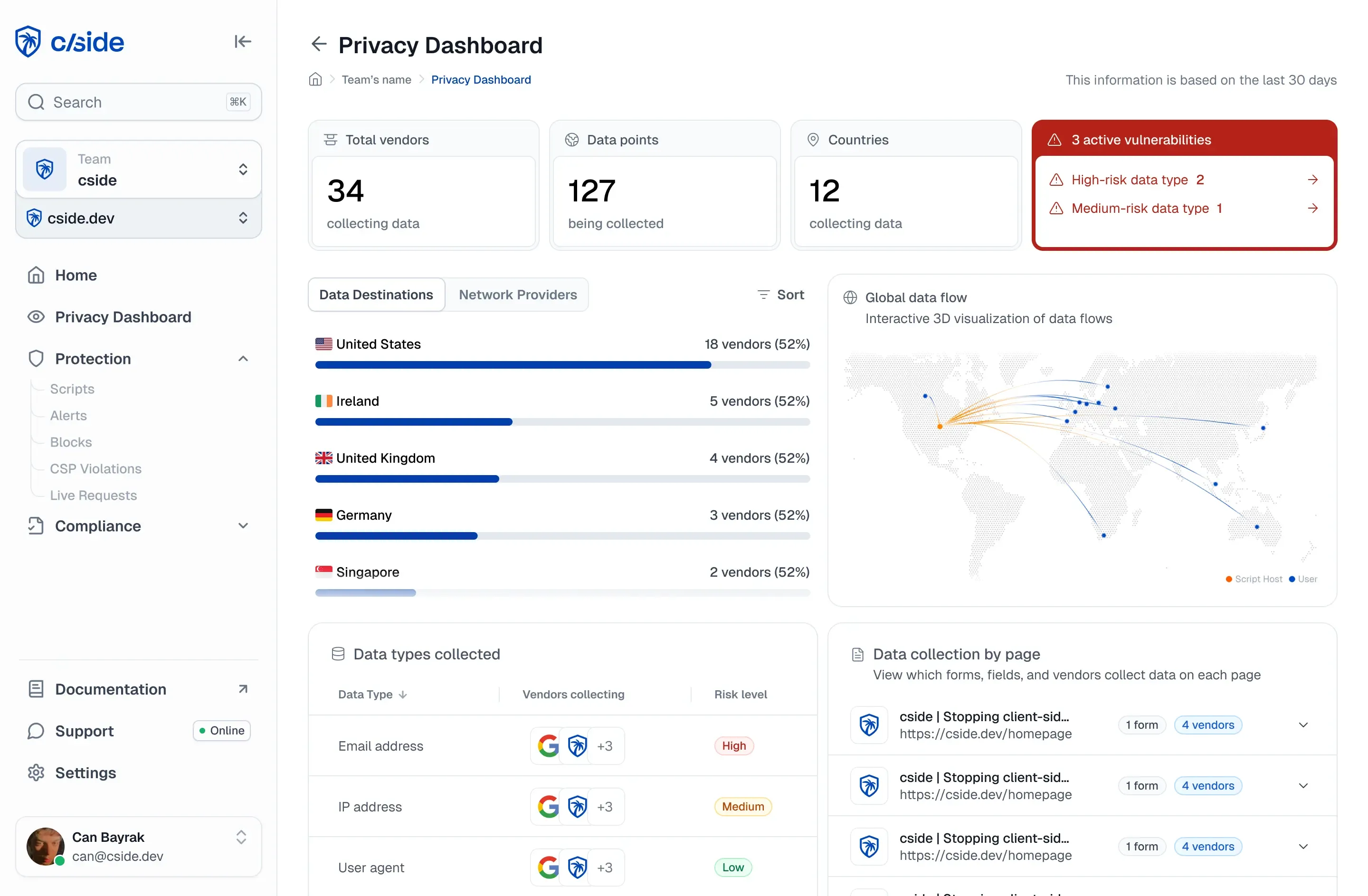
cside is a web security platform that prevents fraud on your website by monitoring the browser runtime. The fingerprinting product collects 102+ signals and focuses on four use cases: account takeover, account sharing, chargeback evidence (CE 3.0 through Chargebacks911), and AI agent detection. The script monitoring product watches every script executing on a page, catching injections, tampering, and skimming attacks that fingerprinting alone does not see.
What is Castle?
Castle is an account security and fraud prevention platform that combines device fingerprinting, real-time risk scoring, and enforcement into a single product. It returns three scores per event (Bot, ATO, and Abuse), supports a no-code policy engine, and integrates with Cloudflare for edge-level blocking. Castle covers web and mobile through native SDKs.
What cside covers that Castle does not
- AI agent detection: cside detects AI agents acting in the browser as a distinct category separate from traditional bots and human users. Castle provides a general Bot Score but does not differentiate AI agents from conventional automation.
- Third-party script monitoring: cside monitors every script executing on your pages. Credential-stuffing injections, session-hijacking payloads from compromised vendors, unauthorized data exfiltration through rogue analytics tags. Castle does not offer script monitoring.
- Client-side controls to comply with PCI DSS and other frameworks: cside's script monitoring satisfies PCI DSS 4.0.1 requirements 6.4.3 and 11.6.1 (script inventory and integrity verification on payment pages). Castle is not positioned against PCI DSS compliance.
- Visa CE 3.0 and Mastercard chargeback program integration: cside integrates directly into Visa and Mastercard chargeback reduction programs through a partnership with Chargebacks911. Device fingerprint data flows into the dispute workflow to produce compelling evidence. Castle does not offer a chargeback integration.

Researching & writing about client side security.