TL;DR:
- Given the sensitivity to compliance, the best vendors for financial institutions must have SOC2 Type 2 certifications, PCI DSS SAQ-D and more.
- Financial Institutions are nation-state targets for bad actors. Therefore the best security vendors for them are invested to be at the cutting edge of technical ability. Good enough is not good enough. An indicator of the right attitude to cutting edge is contribution to standards organizations like the W3C, IETF and TC39.
- Security is layering: a vendor that offers a multi-layer security model helps companies remain safe when bad actors attempt to build bypasses for security layers.
- Conclusion: the best solution for Financial Institutions is cside’s multi-layer approach.
What is Client-Side security?
Client-side security is the practice of protecting the JavaScript dependencies, user data and behaviors that run inside the browser of the visitor.
This includes:
- First-party scripts: JavaScript files loaded from your own domain
- Third-party scripts: from analytics tools, ads, chatbots, tag managers, A/B testing tools
- Inline scripts, embedded content like widgets and SDKs
- Data processed or fetched by the browser
Anything that happens after the initial HTML response by the web server is a client-side action. Attackers increasingly use the browser to execute malicious actions in an attempt to obtain valuable sensitive information. Where data is fetched from 3rd party domain, scripts often serve differently based on IP, request headers, time of the day, location etc.
For example: a marketing tool will collect different data in Europe from the USA for data privacy compliance.
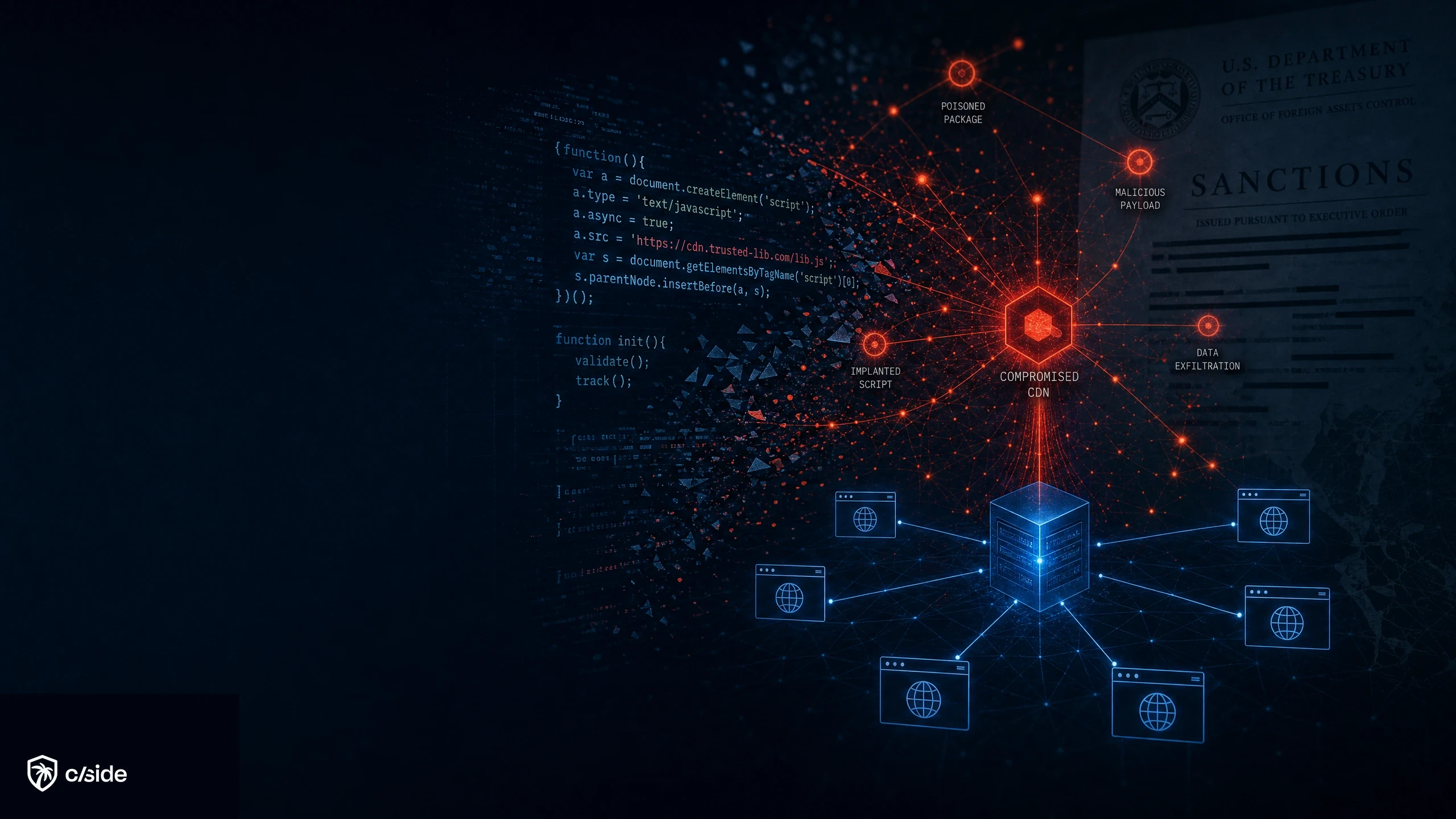
Especially for high value targets using a client-side fetch to inject a malicious payload is a common action because it is much harder to detect and the bad actor can fly below the radar for a long time unless a client-side runtime security solution is being used.
Why are Financial Institutions classified as a nation-state target?
Some bad actors don’t just look to make a quick buck. They can be state sponsored, incentivized to wreak havoc. Destabilize essential services required to run economies.
Financial Institutions are a prime target and with their size and exposure comes additional risk and therefore opportunity for the bad actors. When banks go down, so does the economy.
Financial Institutions are in the same realm as Government IT environments, large scale healthcare providers and critical infrastructure like public transport and energy providers.
To build credibility in the Financial sector brands go through a significant multi-year process to obtain trust of customers across various types. With that comes significant technical debt through legacy applications.
Vast and legacy infrastructure increases attack surface
It’s not an industry secret that many of the large Financial Institutions still run on COBOL. A research paper by a member of the technical staff at PayPal states the problem very clearly: “Traditional banking infrastructure is often outdated and struggles to meet the increasing demands for seamless, real-time digital services.”
Meaning legacy web applications are often layered by more modern technologies increasing the attack surface in order to ship new user experiences. By leveraging vulnerable back-ends to inject client-side scripts or targeting legacy dependencies to infiltrate the supply-chain, bad actors can cause severe harm to global economies.
Client-side attacks target specific assets
Client-side attacks against Financial Institutions usually target:
- User-credentials and session tokens to gain access to accounts
- Payment card information
- Bank statements and sensitive identity information
Strict Regulatory and Compliance Requirements
Financial Institutions are subject to a substantial list of compliance frameworks in order to operate, their banking license depends on compliance.This ranges from complying with PCI DSS, DORA, local privacy laws like CCPA or GDPR and as a sign of trust but often a requirement for business customers: SOC2 Type 2, ISO 27001…
What approach is best for Financial Institutions?
Given the gravity of the target, there is little room for error. So a good solution must fit the application like a glove.
Therefore a layer approach is ideal. Especially if the solution in question is customizable and creates transparency and control where there was lacking control before.
That is why we built cside as a platform leveraging all the different layers available to date.
cside offers two complementary deployment methods, paired with multiple detection engines including open source Large Language Models for analysis.
- Script Method (Easiest): we check script behaviors in the browser and fetch the scripts on our side, then verify we got the same script. We don't place ourselves in the path of a script unless you explicitly ask us to. Easy to implement, no performance impact, and you can still stop script actions or block by URL, hash, or domain.
- Scan Method (Fastest): if you can't add a script to your site, cside scans it using threat intelligence from thousands of other websites with billions of combined visitors. Fast to set up and useful when script installation isn't possible.
We also offer a Content Security Policy endpoint so customers can layer browser-native enforcement alongside cside's JavaScript-based detection.
Security requires a multi-layer model
Most security tools rely on only one of the above mentioned layers, either runtime or out-side in scanning. But the problem is that none of these layers on its own is fully bulletproof and therefore fails to provide comprehensive cover. By combining engines you get closer and closer to full coverage.
Many solutions in the market are side features of larger web security companies. Instead of building a platform for client-side security, they built a tiny side feature. These solutions are constrained by the focus of the business. Often client-side is an area they are unwilling to invest substantial resources in and therefore rely solely on injecting Content Security Policies into the website through their WAF.
Some solutions are effectively just scanners. Bad actors see the scanners and don’t serve the malicious scripts to their point in time check. Given the value of the target, this approach is ineffective.
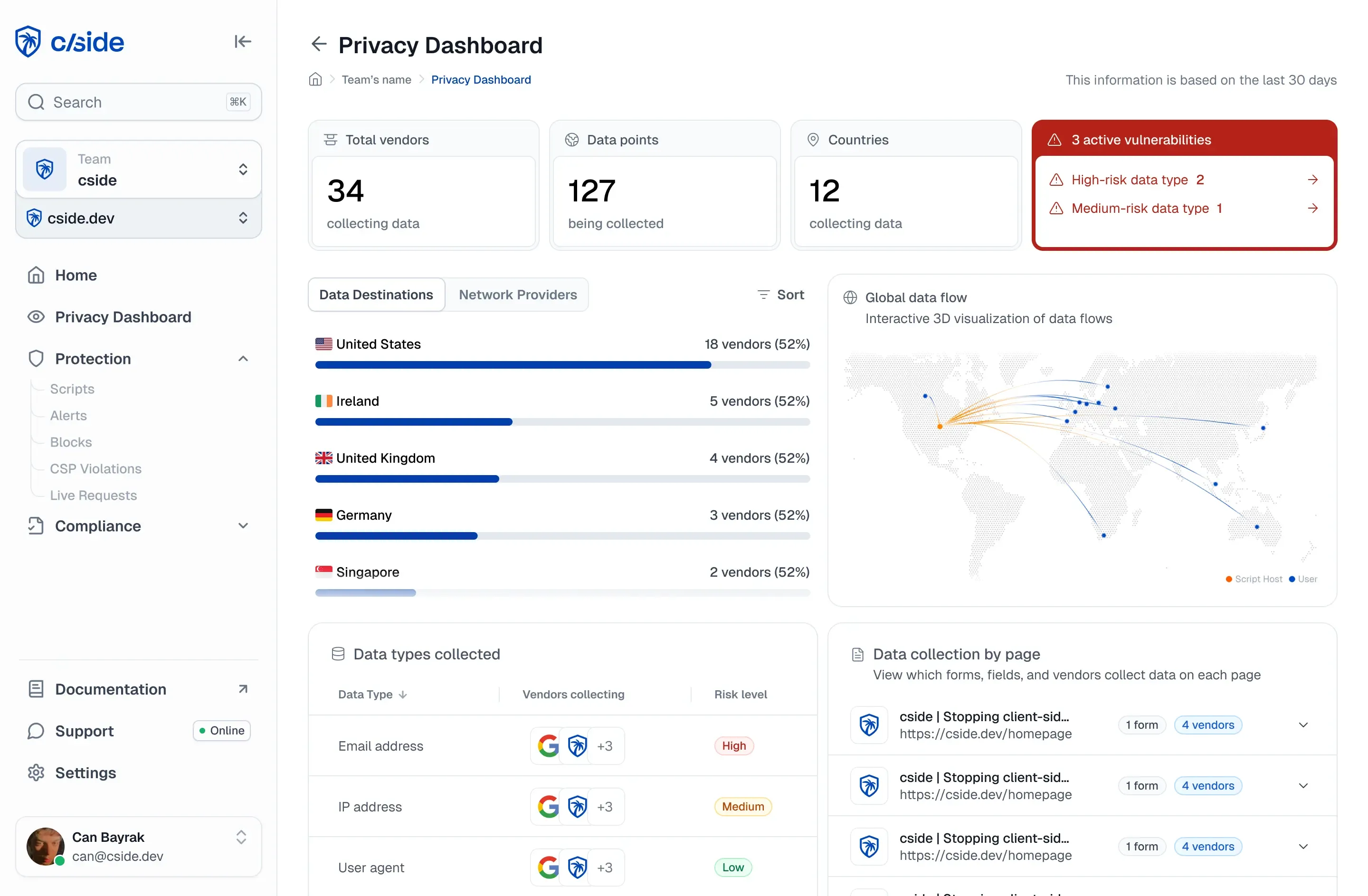
For compliance purposes it's convenient that the solution offers dashboards specifically to address each framework. Frameworks come with a range of unique controls and manually collecting that data is a painful continuous chore.
Some approaches, like scanner based solutions have been found to be commonly bypassed by bad actors. They detect the scanner and serve clean contents to the scanner to fly below the radar. Researchers at ISACA, University of Brighton, Google and Oracle have flagged that dynamic client-side scripts effectively bypass Static Analysis by scanners.
cside is always looking to extend its capabilities and is actively pushing a number of new standards that would enable stronger client-side security using native browser functionality.
The cside team are active contributors to standard bodies like the W3C, IETF, and TC39.
Ready to check cside out? Start for free or book a demo to have a chat with our team.