En bref : exigences CTDPA pour les scripts tiers
- Les bannières ne suffisent pas : Les bannières de cookies recueillent des préférences, pas la conformité CTDPA ; la loi exige une application au niveau des scripts, ainsi que des garanties de sécurité raisonnables contre les attaques les plus fréquemment à l'origine des poursuites en matière de vie privée.
- À qui elle s'applique : Le CTDPA s'applique dès que vous traitez les données de 100 000 résidents du Connecticut, ou de 25 000 résidents plus 25 % de revenus tirés de la vente de données. cside Privacy Watch révèle le comportement réel de chaque script tiers à l'exécution, et non la simple liste de domaines que votre CMP connaît déjà.
- Les preuves attendues : Si votre preuve de conformité se limite à une capture d'écran de votre bannière de consentement, un auditeur demandera ce que vos scripts ont réellement fait lorsque le consentement a été refusé. Si vous pouvez produire un journal comportemental en direct par script, vous disposez de la preuve exigée par le CTDPA.
Peu de temps ? Découvrez cside Privacy Watch. Elle couvre tout ce qui suit en un seul déploiement.
Dans ce blog :
- Le CTDPA s'applique-t-il à mon organisation ?
- Où surviennent les manquements au CTDPA
- Comment garantir la conformité des scripts tiers au CTDPA
- Calendriers du CTDPA
Il existe un fossé grandissant entre ce que les entreprises pensent faire pour protéger les données des utilisateurs et ce que des lois sur la vie privée comme le CTDPA (Connecticut Data Privacy Act) attendent réellement. Le navigateur est l'endroit où les données personnelles sont de plus en plus collectées, mais c'est aussi là où presque personne ne surveille. C'est précisément ce fossé que les régulateurs ont dans leur ligne de mire.
Sans surveillance, des scripts mal configurés ou malveillants peuvent accéder à des champs sensibles, contourner les choix de consentement ou transmettre des données sans les avoir déclarées. Si on leur posait la question « Les scripts tiers sur votre site se comportent-ils comme le stipule votre politique de confidentialité ? », la plupart des organisations seraient incapables de fournir une réponse étayée par des preuves.
Cet article passe en revue les exigences du CTDPA et montre comment mettre la couche navigateur en conformité avant qu'une violation ne se produise.
Le CTDPA s'applique-t-il à mon organisation ?
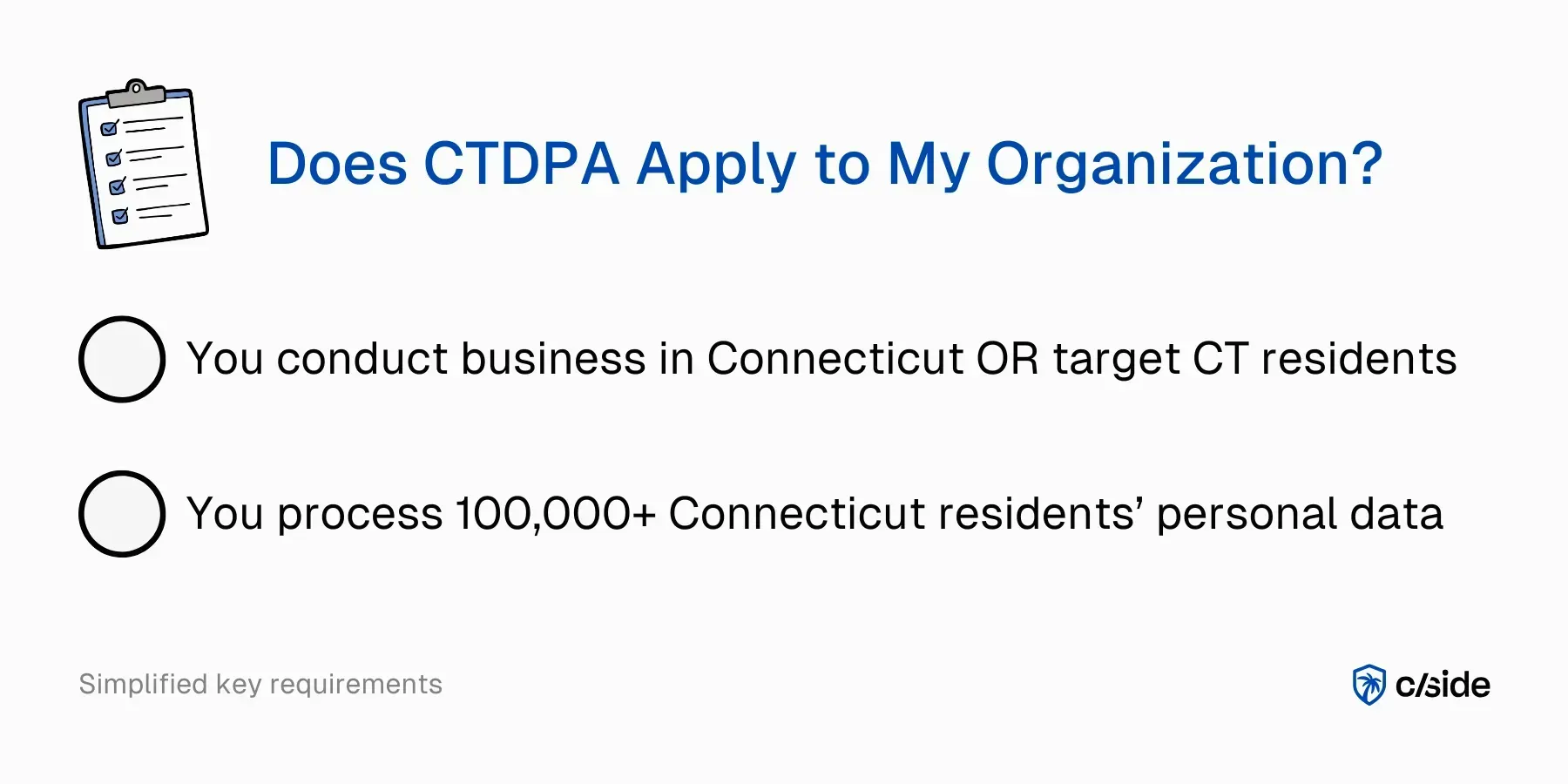
Le CTDPA suit le modèle d'applicabilité « style Virginie/Colorado ». Il s'applique en fonction du volume de données personnelles traitées. Voici les 2 principaux critères que vous pouvez utiliser comme liste de contrôle simple. TOUS ces points doivent être vrais pour que votre entreprise soit soumise aux règles du CTDPA.
1. Critère CTDPA : Vous exercez une activité commerciale au Connecticut OU ciblez des résidents du CT
Cela inclut les entreprises qui :
- Vendent à des consommateurs du Connecticut, font du marketing ou de la publicité auprès de résidents du CT, exploitent un site web ou une application destinée aux clients du CT, ont des utilisateurs, abonnés ou clients au CT.
Cela s'applique même si l'entreprise n'est pas physiquement établie au Connecticut. « Cibler » ne requiert pas une démarche intentionnelle. Si des résidents du Connecticut peuvent accéder à votre site, recevoir vos publicités ou choisir de s'inscrire, vous pouvez tout de même être considéré comme exerçant une activité commerciale dans cet État.
2. Critère CTDPA : Vous traitez un volume significatif de données de résidents du Connecticut
Le CTDPA s'applique si, au cours de l'année civile précédente, vous avez traité :
2 A) Les données personnelles de 100 000 résidents du Connecticut ou plus
OU
2 B) Les données personnelles de 25 000 résidents ou plus ET vous tirez 25 % ou plus de vos revenus de la vente de données personnelles
Détaillons davantage ces seuils :
2 A) (Développé) Les données personnelles de 100 000 résidents du Connecticut ou plus
Données personnelles = toute donnée liée ou pouvant être liée à un individu (adresses IP incluses). Cela est important car un visiteur n'a pas besoin de remplir un formulaire ou de « fournir » explicitement des informations pour être couvert par le CTDPA. La plupart des outils d'analyse, de publicité et de suivi collectent automatiquement des identifiants basés sur l'IP.
Cette limite exclut :
- Les données personnelles traitées uniquement pour finaliser une transaction de paiement
2 B) (Développé) : Les données personnelles de 25 000 résidents ou plus ET vous tirez 25 % ou plus de vos revenus de la vente de données personnelles
Cela concerne principalement :
- Les courtiers en données, les revendeurs de leads, ainsi que les applications ou sites web grand public qui monétisent les informations personnelles
Qui est exclu des exigences du CTDPA :
- Les organismes gouvernementaux, les organisations à but non lucratif (exemptées), les établissements d'enseignement supérieur, les données déjà réglementées par le FCRA, le FERPA ou des cadres similaires
Toutefois : même les organisations exemptées doivent respecter des pratiques de « sécurité raisonnable ». L'exposition de données côté client peut toujours engager la responsabilité au titre d'autres obligations comme la norme PCI DSS.
Qu'est-ce que le Connecticut Data Privacy Act ?
Le Connecticut Data Privacy Act (CTDPA) est une loi sur la vie privée adoptée au niveau de l'État pour donner aux résidents un meilleur contrôle sur la façon dont les entreprises collectent, utilisent et partagent leurs données personnelles. Comme le RGPD et le CCPA, l'objectif du CTDPA est de donner aux consommateurs un contrôle réel sur leurs données personnelles. La loi impose des obligations aux organisations qui collectent, utilisent ou partagent des données personnelles.
La surface de risque pour la vie privée côté client
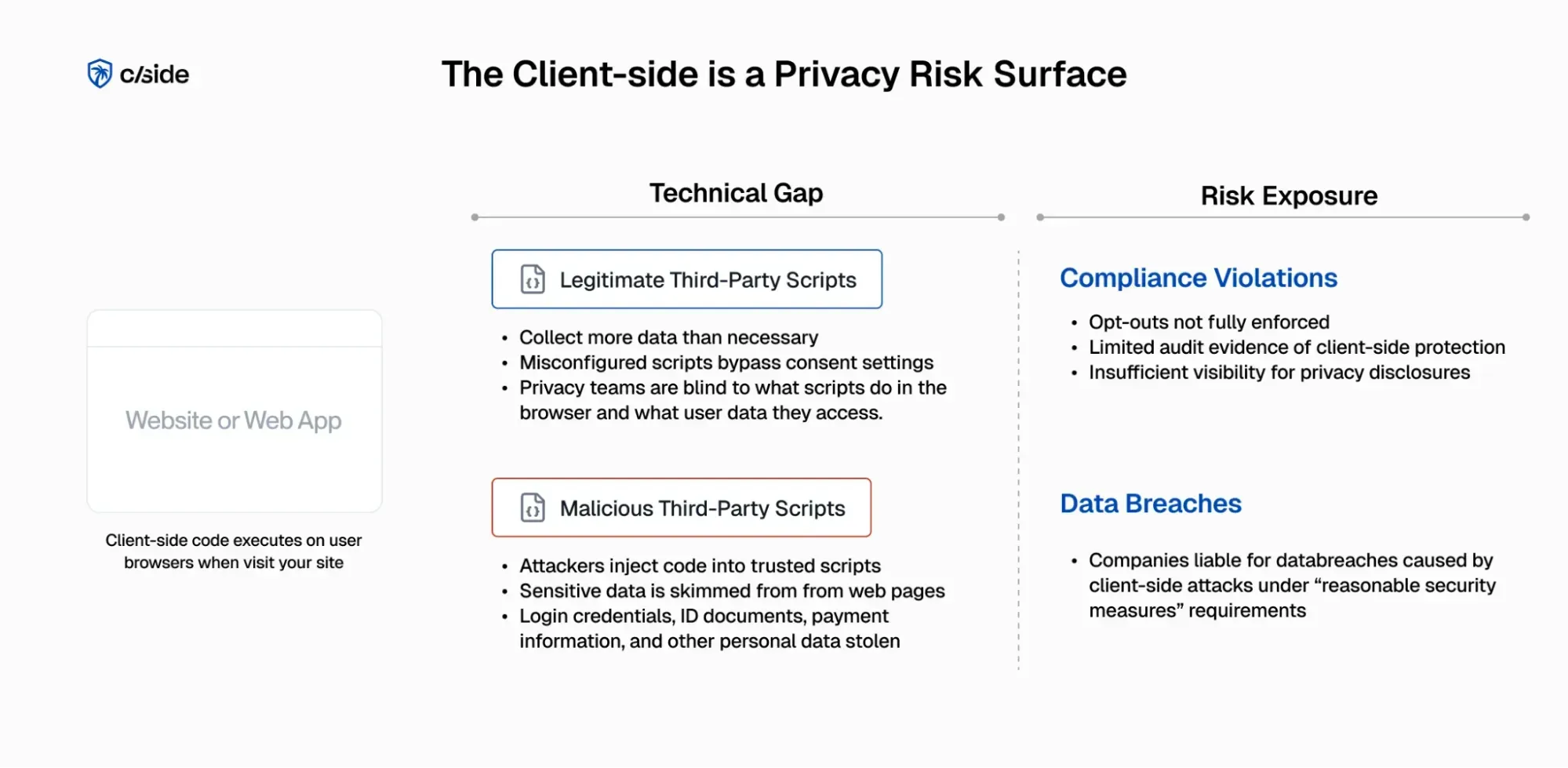
Les lois modernes sur la vie privée comme le CTDPA s'appliquent à l'ensemble du cycle de vie des données, mais la zone à plus haut risque est le site web lui-même. C'est la couche où les utilisateurs interagissent pour la première fois avec votre entreprise et où les données personnelles sont initialement collectées, que ce soit via des saisies de formulaires ou automatiquement par des scripts tiers que vous ne contrôlez pas entièrement.
Malheureusement, le côté client (le code que votre entreprise sert aux utilisateurs lorsqu'ils interagissent avec votre site web) est la couche la moins sécurisée de la plupart des dispositifs de défense des entreprises. Les serveurs sont verrouillés, les employés sont formés aux processus de gestion des données, mais le code qui s'exécute dans le navigateur de l'utilisateur n'est pas surveillé.
Les scripts tiers représentent un risque pour la conformité en matière de vie privée :
Les éléments du site web interagissent avec les données des utilisateurs, et la plupart des équipes n'ont aucune gouvernance sur :
- Les scripts de suivi marketing qui se déclenchent avant le consentement
- Les pixels qui collectent des adresses IP et des identifiants sans option de désinscription
- Les widgets de chat qui traitent des documents et des données de compte
- Les outils de tests A/B qui collectent des métadonnées de session
- Les outils marketing qui déduisent la géolocalisation à partir des signaux de l'appareil
Les attaques côté client représentent un risque de violation de données personnelles :
Toutes les violations de données ne résultent pas d'une intrusion dans le système. De plus en plus souvent, la compromission se produit dans le navigateur : des attaquants injectent quelques lignes de code malveillant dans un script de confiance sur votre site.
Soudainement, des identifiants de connexion, des scans de pièces d'identité et des numéros de carte bancaire sont collectés directement depuis des pages comme les tunnels de paiement, les formulaires d'inscription, les chatbots ou les processus KYC.
Un exemple bien connu de ce type d'attaque est la violation de données de British Airways en 2018, qui a entraîné une amende de 20 millions de livres sterling. Nous couvrons cet incident en détail, ainsi que les exemples les plus récents, dans notre analyse approfondie des plus grandes attaques Magecart.
Une plateforme de sécurité côté client détecte et prévient ces attaques.
Les bannières de cookies suffisent-elles à la conformité CTDPA ?
Les bannières de cookies recueillent les préférences des utilisateurs, mais elles ne les appliquent pas toujours pleinement. En pratique, les bannières présentent plusieurs lacunes :
- Des intégrations incorrectes ou incomplètes entre les bannières de cookies et les gestionnaires de balises comme Google Tag Manager
- Des bannières qui bloquent accidentellement des scripts essentiels tels que les formulaires ou les outils de support en ligne
- Des scripts mal configurés ou malveillants qui ignorent les choix de consentement des utilisateurs
Certains fournisseurs de bannières de cookies tentent de résoudre ces problèmes, mais les mauvaises configurations restent fréquentes. Et même lorsqu'elles sont correctement mises en œuvre, les bannières de cookies ne sont pas conçues pour prévenir les attaques côté client. Cette lacune conduit à un manque de « mesures de sécurité raisonnables », qui est l'allégation la plus fréquemment citée dans les poursuites judiciaires en matière de vie privée sous des lois similaires comme le CCPA.
Où surviennent les manquements à la conformité CTDPA
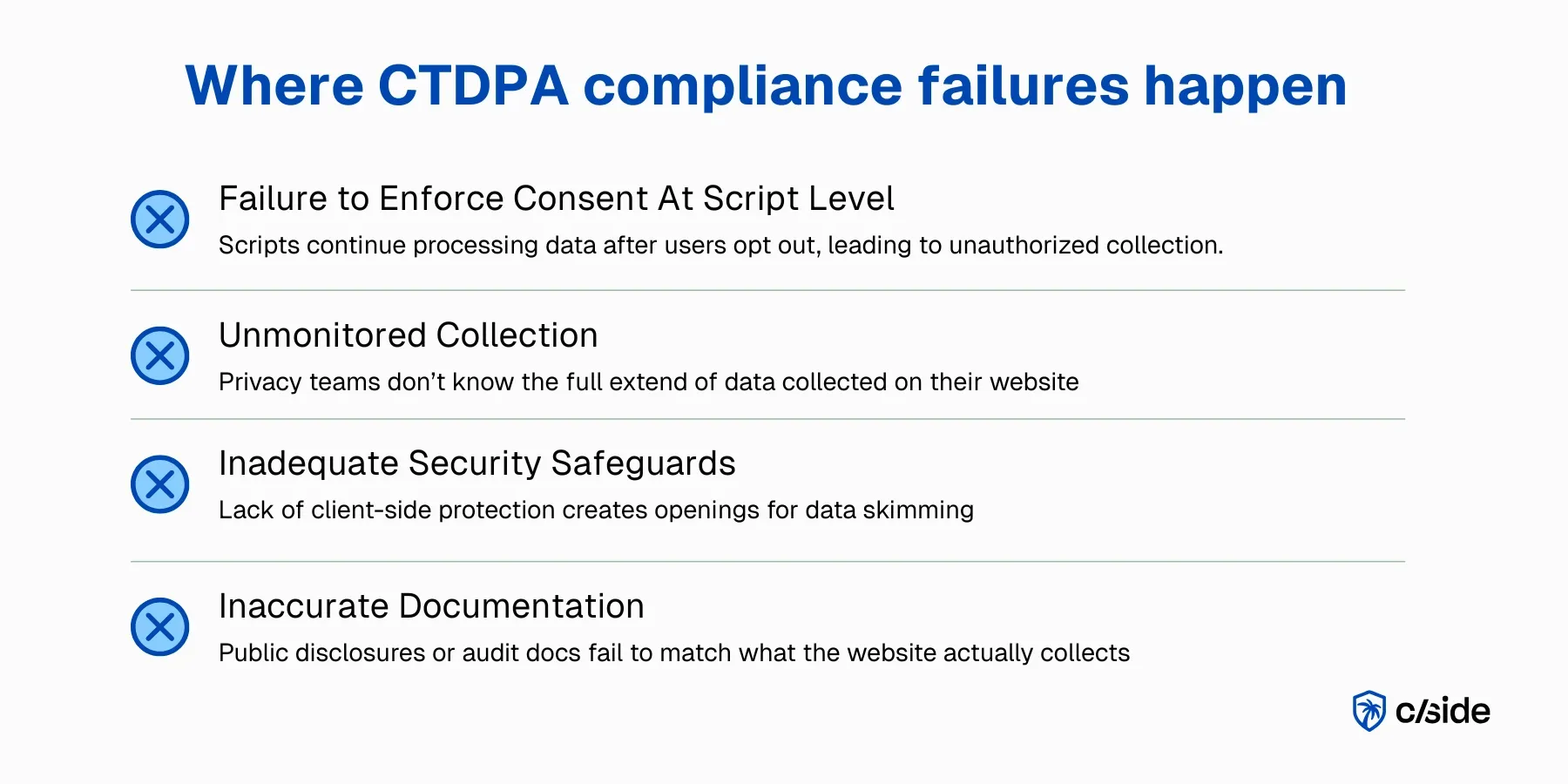
1. Non-respect des droits des consommateurs (accès/suppression/désinscription)
La désinscription est censée mettre fin à tout traitement des données personnelles de l'utilisateur. En pratique, le choix de l'utilisateur doit être respecté à travers plusieurs couches :
- Scripts côté client, outils d'analyse, services de rejeu de session, gestionnaires de balises et plateformes publicitaires
Côté client, cela se dégrade souvent. Les entreprises pensent avoir respecté la désinscription, mais :
- L'utilisateur se désinscrit via une bannière de cookies, mais les scripts continuent de se déclencher
- Les outils d'analyse de type « session replay » continuent de capturer des informations sensibles
- Les « cookies » sont bloqués, mais les scripts continuent de s'exécuter
- Les gestionnaires de balises contournent les paramètres de consentement aux cookies
Respecter les droits du CTDPA exige de s'assurer que les scripts côté client cessent effectivement de collecter ou de partager des données. Cela n'est possible qu'avec des outils capables d'observer et d'appliquer le comportement des scripts directement dans le navigateur.
2. Collecte non surveillée
L'une des plus grandes lacunes en matière de conformité survient lorsque les organisations ne savent pas réellement quelles données sont collectées sur leur site web. Les scripts vont et viennent tandis que les fournisseurs mettent à jour leur code sans préavis. La plupart des organisations seraient incapables de lister tous les scripts actuellement actifs sur leur site, et encore moins d'expliquer à quoi ils accèdent.
3. Absence de mise en œuvre de « mesures de sécurité raisonnables ».
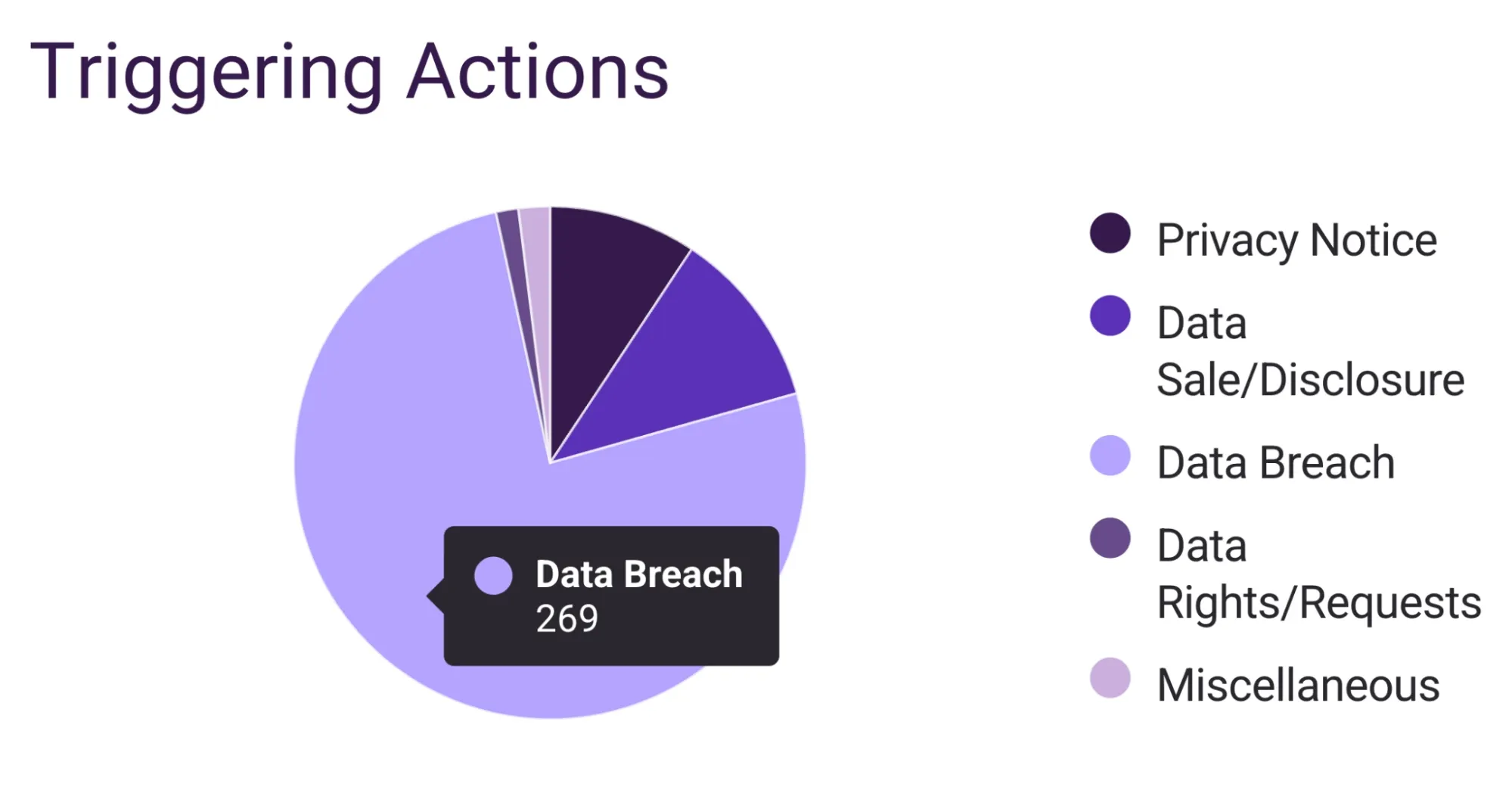
Source : CCPA Litigation Tracker, Perkins Coie
Selon le CCPA Litigation Tracker de Perkins Coie, qui analyse chaque affaire judiciaire publiquement déposée sous le CCPA (un cadre de confidentialité similaire en vigueur depuis bien plus longtemps), la grande majorité des poursuites découle d'un seul problème :
« une allégation de manquement à la mise en œuvre de mesures de sécurité raisonnables ayant entraîné une violation de données »
Le côté client est devenu la surface d'attaque la plus exposée, de grandes organisations ayant subi des violations dues à des scripts malveillants (voir : les attaques contre Ticketmaster et British Airways). Dans bon nombre de ces incidents, les entreprises pensaient être « couvertes » par des outils de conformité qui ne gèrent que des bannières ou des politiques, et non la sécurité réelle du navigateur.
Une véritable protection côté client doit détecter et prévenir des attaques telles que :
- Le formjacking, le détournement de session et le e-skimming
Ces attaques collectent les données des consommateurs directement depuis le navigateur, ce qui signifie que les attaquants n'ont jamais besoin de pénétrer dans votre environnement interne.
4. Déclarations de confidentialité inexactes ou incomplètes
Le CTDPA exige que les organisations divulguent clairement quelles données personnelles elles collectent, pourquoi elles les collectent et quels tiers reçoivent ces informations.
En pratique, de nombreuses déclarations de confidentialité sont incomplètes simplement parce que les équipes n'ont pas une visibilité complète sur chaque script, formulaire ou outil externe opérant sur leur site web.
Réaliser un inventaire des scripts (par exemple via un scan de crawl gratuit) peut aider à établir une image de référence des scripts devant être déclarés.
Principales exigences du CTDPA (Connecticut Data Privacy Act)
Droits des consommateurs
Les organisations doivent donner aux utilisateurs la possibilité de :
- Se désinscrire
- Accéder à leurs données personnelles
- Corriger les inexactitudes dans leurs données personnelles
- Supprimer leurs données personnelles
- Demander une copie portable de leurs données
Avis de confidentialité et transparence
Les organisations doivent fournir un avis de confidentialité clair expliquant quelles données personnelles sont collectées, pourquoi elles le sont et comment les utilisateurs peuvent exercer leurs droits. Cette liste doit également indiquer quels tiers reçoivent leurs informations. Les déclarations doivent être tenues à jour lorsque les pratiques en matière de données changent.
Consentement pour les données sensibles
Le CTDPA exige un consentement opt-in affirmatif avant de traiter des données personnelles sensibles, notamment : les informations de santé, les identifiants biométriques, la géolocalisation précise ou les données relatives aux mineurs.
Minimisation des données
En vertu du CTDPA, les entreprises doivent limiter la collecte de données personnelles à ce qui est réellement nécessaire pour la finalité déclarée. Elles ne peuvent pas recueillir des informations excessives, ni utiliser les données à des fins nouvelles ou sans rapport sans obtenir un nouveau consentement.
Pour une liste exhaustive des exigences, consultez notre section de ressources officielles qui vous orientera vers la documentation officielle sur la loi sur la vie privée.
Ressources officielles et liens gouvernementaux
Connecticut Data Privacy Act (Bureau du Procureur général) :
https://portal.ct.gov/ag/sections/privacy/the-connecticut-data-privacy-act
Il s'agit de la page CTDPA publiée par le Procureur général du Connecticut, l'autorité d'application principale de la loi. Elle fournit des orientations officielles, des mises à jour et des ressources émises par l'État.
Projet de loi officiel du Sénat - Loi publique n° 22-15 (2022)
Il s'agit du texte intégral du Connecticut Data Privacy Act tel qu'adopté par la législature de l'État en 2022.
Calendriers du CTDPA
Le CTDPA a été déployé par phases, avec des obligations supplémentaires ajoutées au fil du temps par voie d'amendements. Voici les dates clés dont la plupart des équipes doivent être conscientes (pour une vue complète et toujours à jour, consultez la section Ressources officielles).
- 10 mai 2022 - Le CTDPA est signé en tant que loi. Le Connecticut adopte sa loi globale sur la vie privée sous la forme du Senate Bill 6 / Public Act 22-15.
- 1er juillet 2023 - La loi entre en vigueur. Les responsables du traitement et les sous-traitants qui atteignent les seuils sont tenus de se conformer à partir de cette date, le Procureur général du Connecticut étant l'autorité d'application.
- 1er juillet 2023 - 31 décembre 2024 - Fenêtre d'application avec « droit de remédiation ». Durant cette période, le Procureur général doit accorder aux entreprises un délai de 60 jours pour remédier à une violation avant d'engager des poursuites, si une remédiation est possible.
- 1er octobre 2023 - 1er octobre 2024 - Entrée en vigueur progressive des amendements relatifs à la santé et aux mineurs. De nouvelles dispositions concernant les données de santé des consommateurs, les applications de rencontres et les services en ligne utilisés par des mineurs entrent en vigueur à plusieurs dates fin 2023 et en 2024.
- 1er janvier 2025 - Signaux d'opt-out universels (ex. : GPC) pris en compte. Les consommateurs du Connecticut peuvent envoyer des signaux de préférence d'opt-out au niveau du navigateur (comme le Global Privacy Control), et les responsables du traitement soumis au CTDPA sont tenus de les respecter.
- 1er juillet 2025 - Les évaluations de protection des données s'appliquent aux nouveaux traitements à haut risque. Les exigences d'évaluation s'attachent aux activités de traitement créées ou générées à partir de cette date.
- 31 décembre 2025 - Expiration du droit légal de remédiation. Après cette date, le Procureur général n'est plus tenu d'offrir un délai de remédiation de 60 jours, bien qu'il puisse toujours le faire à sa discrétion.
- 1er juillet 2026 et au-delà - Entrée en vigueur d'amendements supplémentaires. Les amendements adoptés en 2025 (SB 1295) introduisent d'autres modifications, notamment des seuils mis à jour et des exigences d'évaluation d'impact, la plupart des changements prenant effet à partir de mi-2026.
Comment cside aide les organisations à atteindre la conformité CTDPA
Transparence sur les flux de données côté client
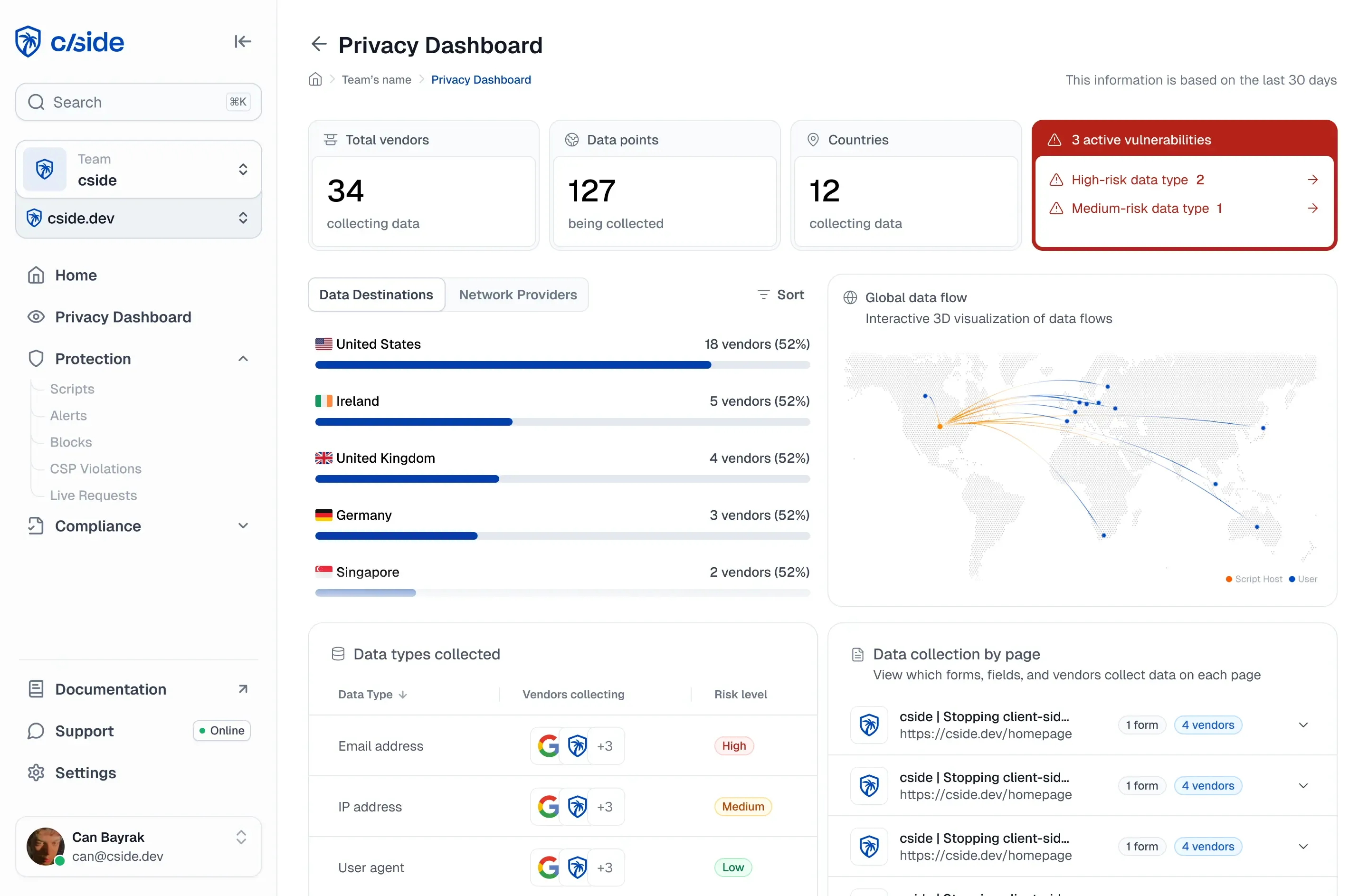
- cside révèle quels scripts collectent des données personnelles, ce qu'ils collectent et où ces données sont envoyées. Les équipes chargées de la vie privée obtiennent la visibilité nécessaire pour publier des déclarations précises.
Minimisation des données au niveau des scripts
- La plupart des sites web collectent plus de données qu'ils ne le souhaitent, simplement parce que les scripts évoluent au fil du temps. cside signale lorsqu'un script commence à collecter plus d'informations qu'il ne le devrait, aidant les équipes à maintenir une collecte strictement délimitée.
Mesures de sécurité raisonnables
- cside détecte les scripts malveillants ou altérés, les modifications suspectes du code côté client et les comportements de skimming de données au niveau du navigateur. Cela soutient l'exigence du CTDPA de mettre en œuvre des mesures de sécurité raisonnables et prévient les violations de données potentielles.
Validation du comportement des tiers
- La surveillance en temps réel garantit que les sous-traitants tiers respectent vos obligations en matière de vie privée au lieu de les enfreindre involontairement à votre place.
Journaux d'audit et preuves disponibles
- cside fournit un tableau de bord et des journaux historiques détaillés montrant l'activité des scripts ainsi que les mesures de traitement des données. Cela donne aux équipes chargées de la vie privée les preuves forensiques dont elles ont besoin pour démontrer leur conformité au CTDPA lors d'audits ou d'enquêtes.
FAQ
Le CTDPA s'applique-t-il aux entreprises situées en dehors du Connecticut ?
Oui. Le CTDPA s'applique à toute organisation qui traite les données de résidents du Connecticut et qui atteint les seuils de volume, quel que soit le lieu où l'entreprise est physiquement établie.
Les bannières de cookies suffisent-elles à satisfaire aux exigences de consentement du CTDPA ?
Dans la plupart des cas, non. Les bannières de cookies recueillent les préférences et gèrent les cookies, mais le CTDPA exige une application au niveau des scripts ainsi que des mesures de sécurité raisonnables capables de prévenir les attaques exposant des données personnelles.
Qu'est-ce qui constitue des « mesures de sécurité raisonnables » au sens du CTDPA ?
Les organisations doivent protéger les données personnelles contre tout accès non autorisé, y compris les risques côté client tels que les scripts mal configurés, les outils tiers non surveillés et les attaques de skimming.