Resumen: cumplimiento web de la tdpsa
- ¿Qué es la TDPSA? La Ley de Privacidad y Seguridad de Datos de Texas (TDPSA) es una ley de privacidad estatal que otorga a los residentes de Texas derechos sobre sus datos personales y exige a las organizaciones implementar salvaguardias de seguridad razonables a lo largo de todo el ciclo de vida de los datos, incluidos los sitios web y las herramientas de terceros.
- ¿A quién aplica la TDPSA? La TDPSA aplica a organizaciones que hacen negocios en Texas o se dirigen a residentes de Texas, procesan o venden datos personales, y no califican como pequeña empresa según los criterios de la SBA.
- ¿Cuáles son las causas más comunes de incumplimiento de la TDPSA? La mayoría de los fallos se producen cuando las organizaciones no respetan correctamente las solicitudes de exclusión voluntaria de los consumidores, mantienen divulgaciones de privacidad incompletas u obsoletas, carecen de visibilidad sobre el tratamiento de datos por parte de scripts de terceros, o no cuentan con salvaguardias de seguridad razonables.
- ¿Por qué es esencial la monitorización del sitio web para el cumplimiento de la TDPSA? Dado que los datos personales a menudo se recopilan, comparten o exponen en el navegador a través de scripts web que tu equipo no controla del todo, monitorizar el lado del cliente y los rastreadores de datos de terceros es fundamental para prevenir fugas de datos y demostrar el cumplimiento.
¿Poco tiempo? Consulta cside Privacy Watch. Cubre todo lo de abajo en un solo despliegue.
Gestionar un negocio hoy en día implica custodiar una gran cantidad de información de otras personas. Dado que las brechas de datos ya no son algo excepcional, los reguladores están elevando el listón en cuanto a cómo se maneja esa información. La Ley de Privacidad y Seguridad de Datos de Texas es un ejemplo claro de ese cambio.
Muchas empresas ya actuaban con cuidado, pero la TDPSA convierte la protección en algo obligatorio y establece las consecuencias cuando se ignora la seguridad. Cabe destacar que gran parte de los datos sensibles se accede, procesa o expone en el lado del cliente a través de navegadores y scripts de terceros que se ejecutan en tu sitio web. Esta falta de visibilidad te hace vulnerable a infracciones de la TDPSA.
En este artículo analizamos qué es la TDPSA, si aplica a tu organización, las razones más comunes de las infracciones y por qué no puedes ignorar la seguridad del lado del cliente para cumplir plenamente con la TDPSA.
¿Qué es la Ley de Privacidad y Seguridad de Datos de Texas?
La Ley de Privacidad y Seguridad de Datos de Texas (TDPSA) es una ley de privacidad del consumidor que otorga a los residentes de Texas derechos específicos sobre su información personal. Fue promulgada el 18 de junio de 2023.
Exige a las organizaciones (responsables del tratamiento) limitar la recopilación de datos únicamente a lo necesario para una "finalidad(es)" concreta. La ley otorga a los texanos el derecho a averiguar si una empresa está utilizando su información personal y de qué manera. También pueden acceder a sus datos, corregirlos, eliminarlos o solicitar una copia, y optar por no participar en publicidad dirigida, venta de datos y elaboración de perfiles.
Las infracciones de la TDPSA pueden acarrear sanciones civiles de hasta $7,500 por infracción, y la autoridad de aplicación recae exclusivamente en el Fiscal General de Texas.
¿Aplica la TDPSA a mi organización?
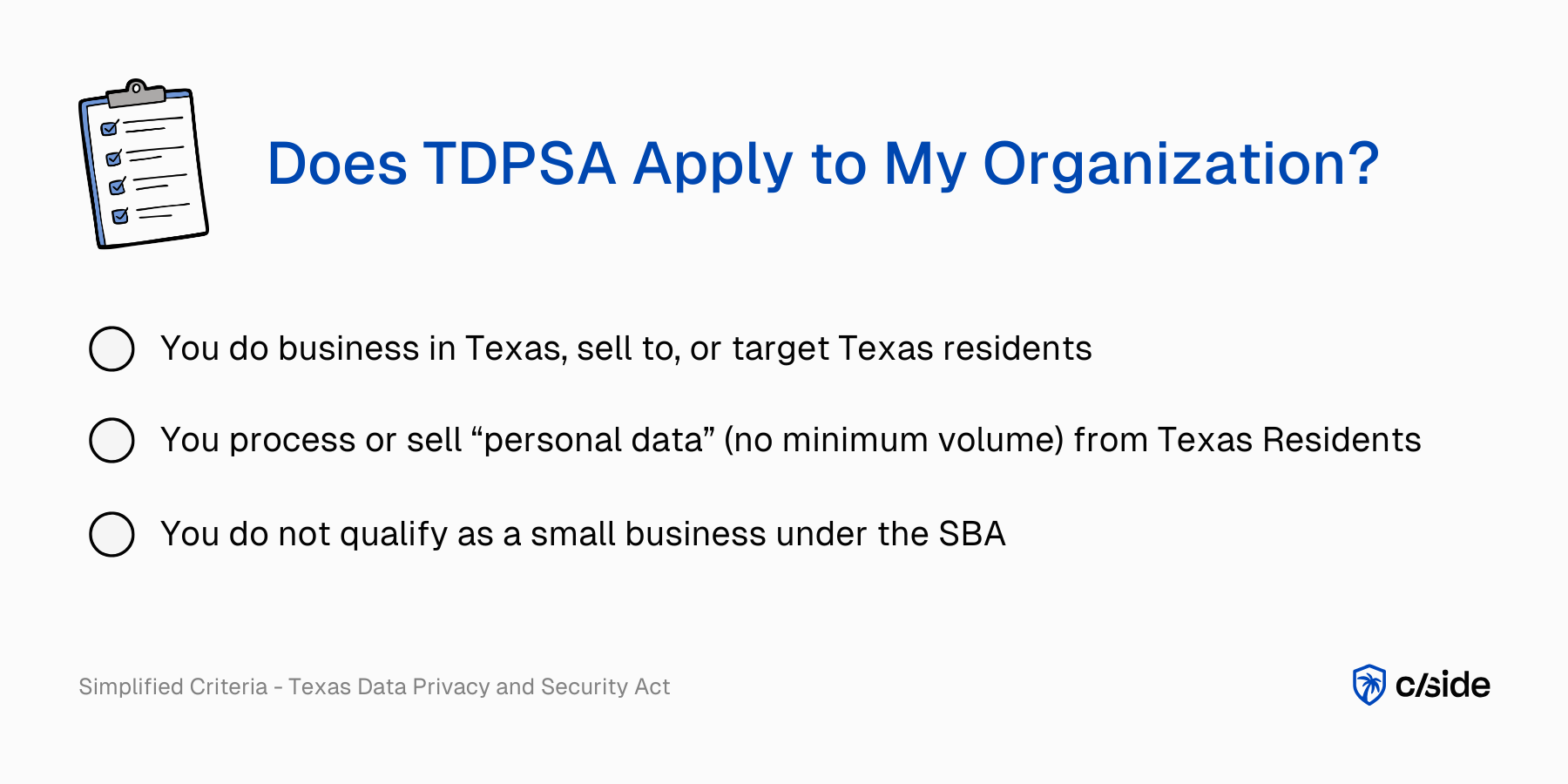
La TDPSA aplica a tu organización si cumples las tres condiciones siguientes:
a. Haces negocios en Texas o produces bienes o servicios que consumen los residentes de Texas (esto puede incluir productos o servicios en línea que llegan a consumidores de Texas).
b. Procesas o vendes "datos personales" de esos residentes de Texas. Aquí, datos personales significa cualquier información vinculada o razonablemente vinculable a una persona identificada o identificable. A diferencia de la CCPA de California o la CPA de Colorado, la TDPSA no incluye un umbral de ingresos o número de consumidores para determinar la aplicabilidad.
c. No eres una "pequeña empresa" según las normas de la Administración de Pequeñas Empresas de los Estados Unidos (SBA).
Si respondes afirmativamente a las tres condiciones anteriores, las principales protecciones de privacidad y obligaciones empresariales de la TDPSA aplican a tu organización.
Excepciones a la TPDSA
Existen ciertas excepciones, independientemente de estas condiciones. Entre ellas se incluyen:
- Agencias estatales y subdivisiones políticas, organizaciones sin fines de lucro, instituciones de educación superior (públicas o privadas), instituciones financieras reguladas por la Ley Gramm-Leach-Bliley, entidades sanitarias cubiertas por la HIPAA y sus socios comerciales, y algunos proveedores de servicios regulados y de suministros.
¿Cuáles son los requisitos clave de la TDPSA?
Estos son algunos de los requisitos fundamentales para las organizaciones bajo la TDPSA:
Divulgar las prácticas de datos personales con claridad
La TDPSA exige que expliques qué datos personales se recopilan, por qué se recopilan, cómo se utilizan y con quién se comparten.
Debes informar claramente a los clientes sobre cómo utilizarás y procesarás sus datos en un lenguaje fácil de entender.
Obtener consentimiento afirmativo para el tratamiento de datos sensibles
Debes recopilar consentimiento explícito de adhesión voluntaria antes de procesar datos sensibles como la geolocalización precisa o la información biométrica. La ley prohíbe basarse en un consentimiento implícito, agrupado u oculto. En otras palabras, el acuerdo del usuario debe ser específico e inequívoco.
Responder a las solicitudes de derechos de los consumidores dentro de los plazos requeridos
La TDPSA permite a los consumidores acceder, corregir, eliminar u obtener copias de sus datos, y optar por no participar en determinados tratamientos. Las organizaciones que reciban cualquiera de estas solicitudes deben atenderlas en un plazo de 45 días, con una única prórroga limitada cuando esté justificada.
Habilitar la exclusión voluntaria de la venta de datos, la publicidad dirigida y la elaboración de perfiles
Las organizaciones deben informar claramente a los consumidores cuando se produzcan estas actividades y proporcionar un mecanismo de exclusión voluntaria real y funcional que detenga el tratamiento.
Los mecanismos de exclusión voluntaria deben funcionar en todos los flujos de datos, incluidos los que se activan en el lado del cliente. Si los scripts de seguimiento o los píxeles continúan enviando datos después de una exclusión voluntaria, la organización sigue incumpliendo la TDPSA.
Gestionar y supervisar a los proveedores y encargados del tratamiento
Las empresas deben establecer contratos que limiten el uso de los datos y supervisar activamente el comportamiento de los proveedores. Esto incluye comprender qué actividades de tratamiento de datos realizan los proveedores durante las sesiones de los usuarios en el sitio web.
El lado del cliente es la superficie de riesgo de privacidad moderna
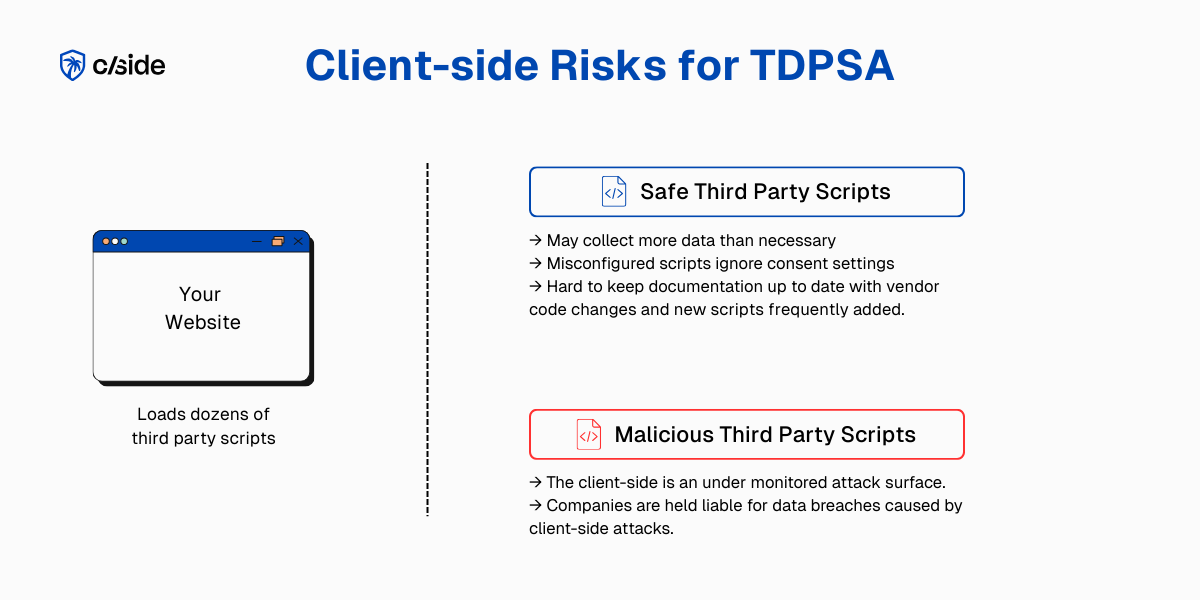
El lado del cliente se ha convertido en una superficie de riesgo de privacidad primaria para las infracciones de leyes de protección de datos como la TDPSA. Esto se debe a que cada vez más datos personales se recopilan y transmiten a través del navegador del usuario.
Los scripts de terceros son un riesgo de cumplimiento de privacidad bajo la TDPSA
Los scripts de terceros se ejecutan en el navegador del usuario, pero siguen siendo responsabilidad de la organización que los instaló en el sitio.
- Las organizaciones modernas ejecutan varios scripts, la mayoría instalados por distintos equipos para distintos fines.
- Estos scripts suelen ejecutarse sin control, recopilando datos personales como direcciones IP, identificadores, entradas de formularios o señales de comportamiento.
- Bajo la TDPSA, la organización es el "responsable del tratamiento" porque decide utilizar esos scripts y se beneficia de ellos. Aunque un proveedor externo recopile los datos, el responsable sigue siendo responsable de cómo se "procesan" los datos personales.
- Si los scripts recopilan datos más allá de lo divulgado en el aviso de privacidad, las organizaciones corren el riesgo de infringir las normas de limitación de finalidad y transparencia de la TDPSA, incluida la "publicidad dirigida" o la "venta de datos" no intencionadas.
Los ataques del lado del cliente son un riesgo de brecha de datos de privacidad bajo la TDPSA
- Los ataques del lado del cliente se producen cuando código malicioso o comprometido se ejecuta en el navegador. Esto puede ocurrir a través de una biblioteca de terceros hackeada, una actualización de script envenenada o una etiqueta inyectada.
- Si una organización no monitoriza ni controla lo que se ejecuta en el lado del cliente, puede ser incapaz de demostrar que tomó medidas técnicas razonables para proteger los datos personales.
- Las brechas del lado del cliente también dificultan la respuesta a las solicitudes de derechos de los consumidores.
- Además, si los datos filtrados no pueden rastrearse ni eliminarse, el responsable del tratamiento puede no cumplir con las obligaciones de acceso, eliminación o exclusión voluntaria.
¿Son suficientes los banners de cookies para el cumplimiento de la TDPSA?
No, los banners de cookies por sí solos no son suficientes para el cumplimiento de la TDPSA. Un banner puede recopilar el consentimiento, pero tiene un control limitado sobre lo que los scripts hacen realmente una vez que la página se carga.
Los banners de cookies tampoco impiden que las cookies y scripts "aceptados" recopilen más datos de los necesarios o los envíen a destinatarios inesperados.
Las CMP y los banners de cookies son elementos valiosos de una estrategia de cumplimiento para sitios web, pero por sí solos no abordan los requisitos relativos a las salvaguardias de seguridad ni al mantenimiento de la visibilidad sobre cómo se comparten los datos entre distintas jurisdicciones.
Dónde suelen producirse los fallos de cumplimiento de la TDPSA
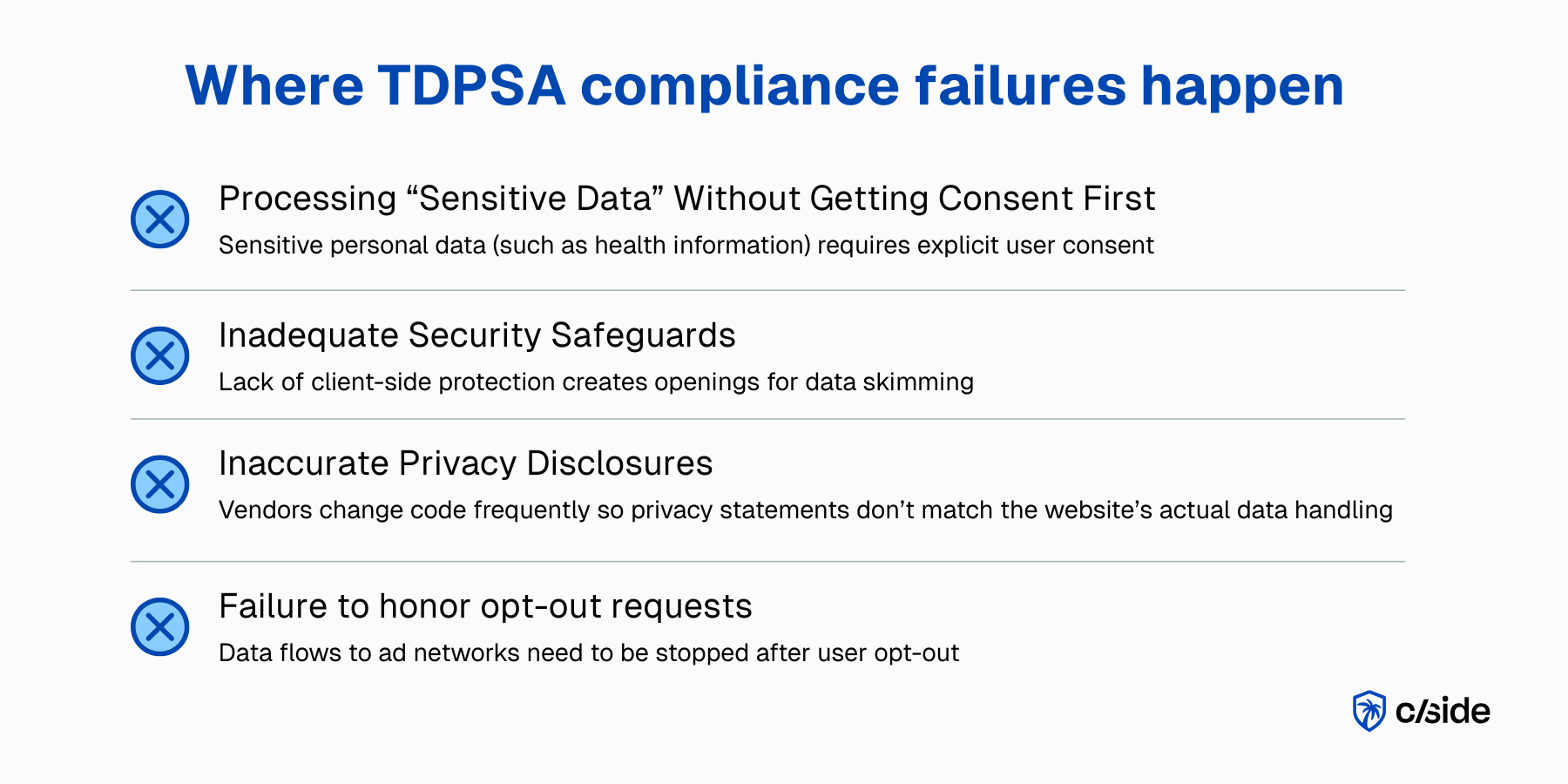
Los fallos de cumplimiento de la TDPSA suelen producirse cuando las organizaciones asumen que el manejo de datos es más sencillo de lo que realmente es.
En una organización típica, los datos personales circulan por muchos sistemas, equipos y proveedores, y cada transferencia introduce un riesgo. Sin sistemas y procesos claros para almacenar, gestionar y revocar el acceso a estos datos, las organizaciones corren el riesgo de infringir la TDPSA.
A continuación se presentan algunas razones comunes de los fallos de cumplimiento de la TDPSA:
1. Procesar datos sensibles sin obtener el consentimiento previo
Muchas empresas recopilan o venden datos de ubicación precisa y otra información sensible. Esto ocurre a veces sin el consentimiento explícito del usuario.
Con la TDPSA, el estado de Texas ha intentado frenar esta práctica.
Bajo la ley, la transparencia es primordial. Si los datos se comparten con terceros o se utilizan para fines que no se divulgan claramente, la organización deja de cumplir sus obligaciones, aunque la omisión haya sido involuntaria.
Una de sus primeras y también más destacadas acciones de aplicación fue cuando el Fiscal General del estado demandó a Allstate y a su filial de datos, Arity, por recopilar, utilizar y vender datos de ubicación y movimiento de teléfonos móviles de texanos sin los permisos adecuados.
2. Salvaguardias de seguridad inadecuadas
La TDPSA exige prácticas de seguridad razonables. Esto incluye comprender dónde están expuestos los datos. Muchas organizaciones centran sus esfuerzos de seguridad en servidores y bases de datos. Sin embargo, ignoran las integraciones, las herramientas de terceros y los elementos del sitio web que gestionan el tratamiento de los datos de los usuarios.
Esas superficies no monitorizadas pueden dar lugar a una exposición no intencionada de datos sensibles a través de código mal configurado o inyecciones maliciosas que extraen información de identificación personal (PII).
Las acciones y orientaciones de la FTC sobre píxeles de seguimiento (como se vio en los casos GoodRx y BetterHelp) demuestran que la filtración del lado del cliente de información sanitaria o de ubicación desencadena acciones de aplicación.
Estos son también precisamente el tipo de fallos técnicos que la TDPSA trata como incumplimientos de la obligación de proteger y limitar adecuadamente el tratamiento de datos.
3. No ser transparente sobre la venta de datos y la publicidad dirigida
El Fiscal General de Texas, Ken Paxton, comentó sobre el incidente de Allstate:
"Los datos personales de millones de estadounidenses fueron vendidos a compañías de seguros sin su conocimiento ni consentimiento, en violación de la ley. Los texanos merecen algo mejor y pediremos cuentas a todas estas empresas."
Incluso si intercambias datos personales de consumidores por valor, como análisis, segmentación publicitaria o enriquecimiento de datos, eso sigue contando.
Los reguladores quieren saber si los consumidores entienden que su comportamiento, ubicación u otros identificadores se están utilizando para elaborar perfiles o mostrarles anuncios dirigidos. Si una empresa no divulga claramente este tratamiento y no ofrece un mecanismo de exclusión voluntaria, Texas lo considera una infracción, independientemente de que la empresa considere que la práctica es marketing estándar.
El lenguaje vago como "podemos compartir datos con socios" no es suficiente. Si se produce publicidad dirigida o venta de datos, debe divulgarse explícitamente.
4. No respetar las solicitudes de exclusión voluntaria
Los avisos de privacidad pueden ser engañosos. Muchos sitios web informan a los usuarios de que pueden optar por no participar en la venta de datos o en la publicidad dirigida. Sin embargo, esas exclusiones voluntarias pueden llevar a enlaces rotos, formularios no funcionales o sistemas que ignoran señales basadas en el navegador como el Global Privacy Control.
Los reguladores no consideran esto un problema técnico menor, sino una denegación de los derechos del consumidor.
La acción de aplicación contra Sephora en California ilustra esto claramente.
Sephora informó a los usuarios de que podían optar por no participar en la venta de datos, pero continuó enviando datos a socios publicitarios. Los reguladores trataron esto como una violación de los derechos del consumidor, obligando a la marca de belleza a pagar una sanción de $1.2 millones.
Texas también está aplicando requisitos similares bajo la TDPSA.
Recursos oficiales de la TDPSA y enlaces gubernamentales
Aquí están los principales recursos oficiales donde puedes leer la ley y obtener orientación autorizada sobre la Ley de Privacidad y Seguridad de Datos de Texas (TDPSA):
- Fiscal General de Texas, Página principal de la TDPSA: la página oficial de la Oficina del Fiscal General que explica la Ley de Privacidad y Seguridad de Datos de Texas. Cubre la descripción general de los derechos, las obligaciones y quiénes deben cumplirla.
- Código de Comercio y Negocios de Texas, Capítulo 541 - Texto estatutario completo: el texto oficial del estatuto tal como está codificado en el Código de Comercio y Negocios de Texas. Incluye todas las definiciones, derechos del consumidor, obligaciones del responsable del tratamiento, requisitos de aviso, normas de aplicación y más.
Biblioteca Jurídica del Estado de Texas, Antecedentes de la TDPSA y enlaces al texto del proyecto de ley: esta página ofrece un resumen de la biblioteca pública y dirige al texto real del proyecto de ley y a las definiciones del Capítulo 541 del Código de Comercio y Negocios de Texas.
Cronología de la TDPSA
18 de junio de 2023: Se promulgó la Ley de Privacidad y Seguridad de Datos de Texas (TDPSA).
1 de julio de 2024: Entran en vigor la mayoría de las disposiciones de la TDPSA. Estas incluyen obligaciones fundamentales como los deberes de tratamiento de datos, los avisos de privacidad, las respuestas a los derechos de los consumidores, las evaluaciones de protección de datos y los requisitos de seguridad.
1 de enero de 2025: Los responsables del tratamiento deben reconocer los métodos de exclusión voluntaria universales que permiten a los consumidores utilizar señales y herramientas globales para expresar sus preferencias de privacidad. Estos pueden incluir configuraciones del navegador, extensiones o enlaces de exclusión voluntaria a nivel de dispositivo.
Por qué se introdujo la TDPSA
La TDPSA se introdujo para proteger los datos personales de los residentes de Texas en un momento en que las brechas de datos se han convertido en una realidad cotidiana.
Un informe del Comité de la Cámara de Representantes de Texas de noviembre de 2022 señala que la amenaza que representan las empresas que poseen y comercian con datos de consumidores sin el conocimiento de estos es real. Incluso nombra empresas específicas que manejan mal los datos de los consumidores.
Este informe analiza las leyes de privacidad ya aprobadas por otros estados de EE. UU., como California y Virginia, y argumenta a favor de una legislación similar en Texas.
En palabras del propio informe:
"Texas debería considerar la aprobación de legislación que otorgue a los consumidores mayor control sobre sus datos. Las disposiciones importantes para una ley sólida incluirían el derecho de los consumidores a corregir y eliminar su información."
Cómo cside ayuda a las organizaciones a lograr el cumplimiento de la TDPSA
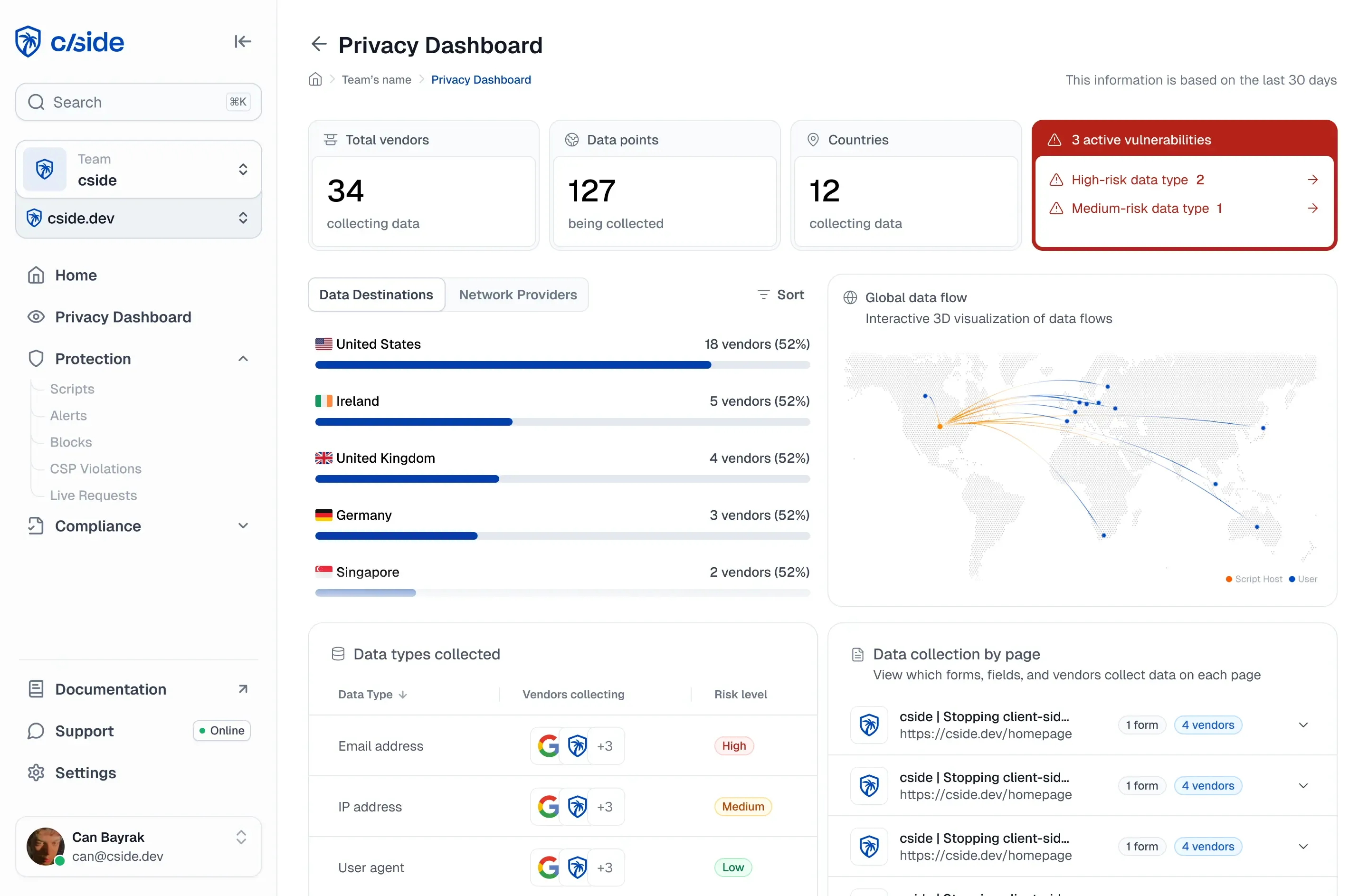
cside Privacy Watch ayuda a cerrar una brecha de privacidad importante que muchas herramientas de seguridad tradicionales pasan por alto: lo que realmente se ejecuta en el navegador del usuario.
Visibilidad sobre la recopilación de datos en el sitio web
- cside proporciona una visión clara de qué scripts operan en tu sitio web, a qué datos acceden y a dónde se envían esos datos. Esto ayuda a los equipos a mantener registros precisos de la recopilación de datos y respalda divulgaciones de privacidad claras y actualizadas.
Minimización de datos mediante monitorización continua
- A medida que las herramientas de terceros cambian con el tiempo, pueden empezar a recopilar más datos de los que originalmente se pretendía. cside detecta estos cambios a medida que se producen, lo que permite a los equipos identificar la recopilación de datos innecesaria.
Apoyo a las salvaguardias de seguridad razonables
- La TDPSA exige a las organizaciones implementar medidas razonables para proteger los datos personales. cside monitoriza el comportamiento sospechoso de los scripts, los cambios no autorizados y los patrones de exfiltración de datos para prevenir fugas de datos provocadas por ataques del lado del cliente.
Supervisión de herramientas de terceros
- Muchos fallos de cumplimiento se originan en proveedores externos. cside valida que los scripts de terceros se comporten de la manera prevista dentro de tus expectativas de privacidad.
Documentación y evidencia lista para auditorías
- cside mantiene registros detallados de la actividad de los scripts, los cambios de configuración y el comportamiento en el manejo de datos. Estos registros proporcionan evidencia defendible en la que las organizaciones pueden apoyarse durante auditorías o investigaciones regulatorias.
Puedes comenzar con nuestro plan gratuito permanente o reservar una demostración para obtener más información sobre los requisitos del lado del cliente de las leyes estatales de EE. UU. como la TDPSA.
Para las organizaciones sujetas a otras leyes de privacidad estatales de EE. UU., consulta también nuestra guía de requisitos y cumplimiento web de la NJDPA para la Ley de Privacidad de Datos de Nueva Jersey.