Key Points
- SEON is a broad anti-fraud and AML compliance platform. cside collects fingerprinting and behavioral signals from your website to feed into anti-fraud workflows.
- Both products protect against account takeover and multi-accounting. cside also detects account sharing, which SEON does not. SEON offers KYC verification, AML compliance, and chargeback dispute management, which cside does not.
- Pricing and accessibility are very different. cside starts at $99/month with self-serve signup. SEON is an enterprise product starting at $699/month. cside is a better fit for mid-market or small business teams that want a lighter tool with quick implementation.
- cside offers a separate client-side security product for PCI DSS requirements 6.4.3 & 11.6.1 that prevents web skimming. SEON does not cover client-side security.
Introduction
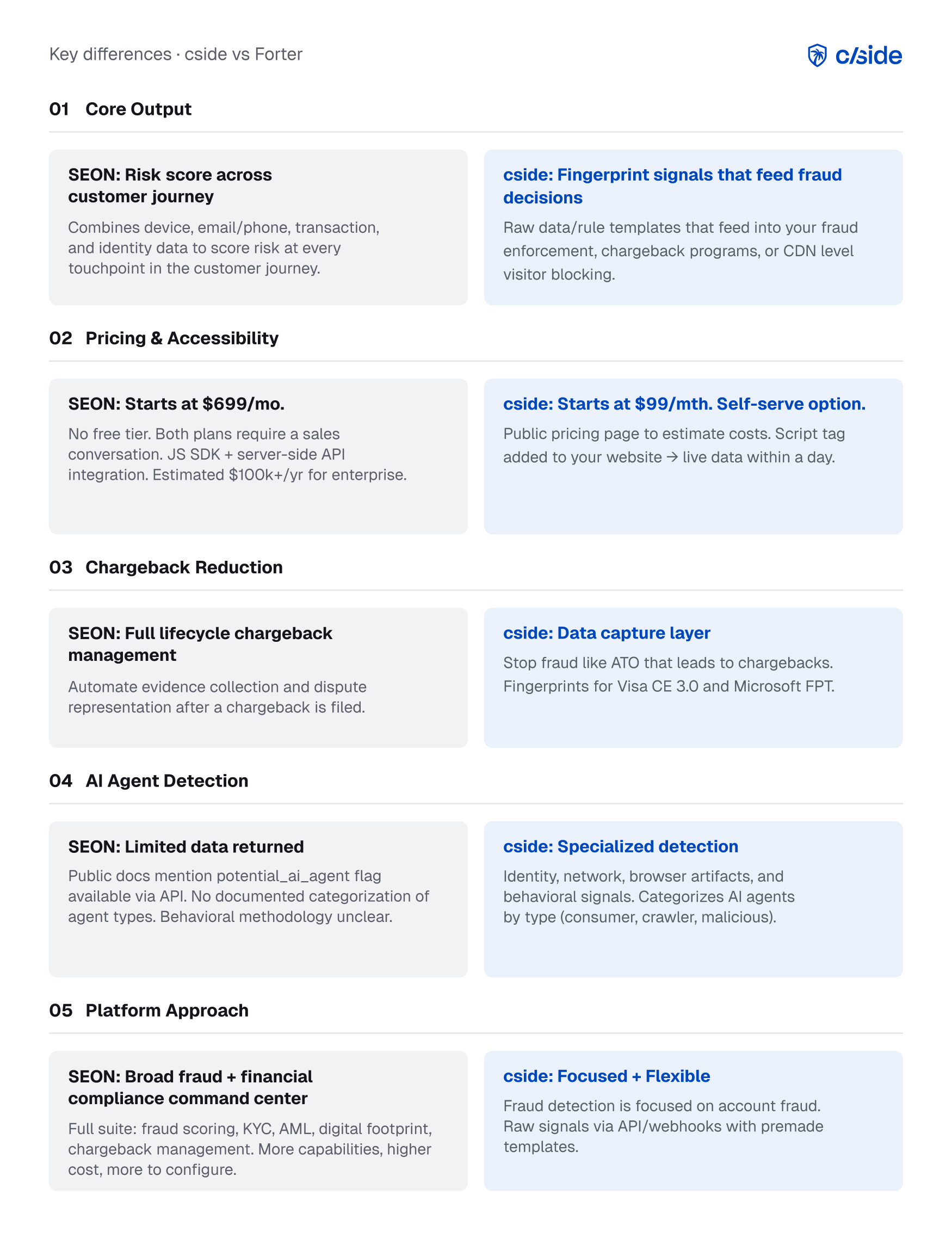
SEON is a broad anti-fraud command center. It covers device intelligence, digital footprint enrichment, transaction monitoring, KYC, AML compliance, and chargeback case management. Created by founders that saw gaps in fraud management software while they were running a crypto exchange, it is a solid solution for fraud teams that want a single platform to mitigate fraud across multiple different verticals.
cside collects fingerprinting and browser signals from your website that feed into fraud workflows. It goes deep on a narrower set of use cases: account takeover, account sharing, AI agent detection, and chargeback evidence for compelling evidence programs.
Where the two overlap is device fingerprinting, account takeover, and multi-accounting. The difference is that SEON aims to be a command center for enterprises across KYC, AML, transaction scoring, and chargeback management. cside is a more focused solution for teams trying to solve a specific fraud challenge without wanting to buy in to a full platform.
Disclosure from the author: cside is an adjacent competitor of SEON. Teams can use cside in unison with their anti-fraud suite. This comparison aims to be factually accurate about both products. It's based on public information and is updated periodically.
SEON vs cside: Pricing & Accessibility
| cside | SEON | |
|---|---|---|
| Pricing | Starts at $99/mo | Starts at $699/mo |
| Free tier | Yes | No. Free trial upon request |
| Self-serve Onboarding | Yes. Dashboard can be accessed in minutes. | No. "Speak with an expert" on all plans. |
| G2 rating | 4.8/5 | 4.6/5 |
| Implementation | Script tag added to your website. Live in under a day. | JavaScript SDK + server side integration. |
| Industries served | E-commerce, SaaS, FinTech, Crypto, Gambling websites | FinTech, Payments, iGaming, Financial Services, Retail |
Free plan
cside: Free forever. Basic fingerprinting fraud detection signals. Free trial for the Business plan if you want to test advanced signals.
SEON: No free tier. SEON offers a free trial on request.
Pricing
cside: Starts at $99/month. Estimate pricing on cside's pricing page. Fraud detection signals include impossible travel, VPN/Proxy detection, browser tampering, multi-device access and more.
- Enterprise: custom quote.
SEON: Starts at $699/month for the Starter plan, which does not include case management, AML compliance, or dedicated implementation support. Enterprise pricing is custom and not reported publicly. For comparable enterprise solutions, average pricing is $100k+/yr with annual contracts.
Reviews
- cside: 4.8/5 on G2. 4.9/5 on Sourceforge.
- SEON: 4.6/5 on G2.
Implementation
- cside: Self-serve onboarding available with dashboard access in minutes. Add a script tag to your website (similar to analytics tools). Can be live in under a day. Guided onboarding available for enterprise use cases.
- SEON: Requires adding a JavaScript SDK to your website plus a server-side integration. All plans require an enterprise sales process before you can start. Full deployment across fraud, KYC, and AML modules involves additional configuration.
SEON vs cside: Fraud Use Cases
| cside | SEON | |
|---|---|---|
| Account Takeover (ATO) | Yes (credential stuffing, suspicious access detection) | Yes |
| Multi-accounting | Yes | Yes |
| Account Sharing Detection | Yes | No |
| Friendly Fraud Chargeback Evidence | Yes (through integration with Chargebacks911) | Yes (through integration with Chargeflow) |
| Anti-Scraping | Yes | No |
| Chargeback Representation | No | Yes (via Chargeflow) |
| Transaction Decisioning | No | Yes |
| Client-side script monitoring | Yes. Core focus. Valid for PCI DSS Requirements 6.4.3 & 11.6.1 | No |
| AML Compliance | No | Yes |
| KYC | No | Yes |
This is where the coverage difference becomes clear. SEON and cside both fingerprint devices, but SEON feeds that data into a broader scoring engine alongside email lookups, phone lookups, transaction history, and identity verification. cside focuses entirely on what is happening in the browser: device fingerprints, behavioral signals, and script execution. You can optionally connect that information to a broader data set by integrating with the rest of your fraud stack.
cside Fraud Use Cases:
- Account takeover: Flag suspicious access when a new device, location, or browser environment logs into an existing account. Match device fingerprints against established session history to catch credential stuffing and unauthorized logins.
- Account sharing: Track how many distinct devices access a single account and flag when usage exceeds your policy. Enforce with MFA challenges, upgrade prompts, or session limits.
- Multi-accounting: Identify users operating multiple accounts from the same device or browser. Stop bonus abuse, referral fraud, and policy circumvention.
- Compelling Evidence programs: Device fingerprints are the strongest evidence piece in Visa CE 3.0 and Mastercard First Party Trust. cside integrates with Chargebacks911 to submit fingerprint data into these programs.
cside also has a separate award winning client-side security product that protects your website from payment page skimming (sometimes referred to as Magecart).
SEON Fraud Use Cases:
- Risk score the customer journey: SEON evaluates risk at registration, login, transaction, and withdrawal. It combines device signals with digital footprint data and transaction history to produce a fraud score. You can auto-approve, auto-decline, or send to manual review.
- KYC and AML compliance: Document verification, liveness detection, sanctions screening, transaction monitoring, and SAR filing. These are regulatory requirements for fintech and iGaming companies. cside is not a compliance tool and does not cover this ground.
- Account protection: SEON flags fake signups, credential stuffing, and ATO using a combination of device fingerprinting, behavioral biometrics, and digital footprint signals.
When cside is the best fit
- You have a specific account fraud problem but don't want to buy into a full platform: For example - a SaaS company bleeding revenue to account sharing or a mid-market e-commerce team that needs device fingerprints for Visa CE 3.0 but doesn't need KYC, AML compliance, or transaction scoring. cside solves those use cases directly without requiring you to adopt a broader suite.
- You want raw signals and flexibility over a managed risk score: SEON does offer a robust API that you can access, but cside was built with developer experience and customizability in mind. You get device fingerprints, behavioral risk scores, and a persistent visitor ID through an API and webhooks. You decide what to do with them. Build your own rules, feed them into your existing fraud stack, or use cside's premade templates.
- You want to get live fast without a complicated sales process: cside has self-serve signup, usage-based pricing starting at $99/month, and a free tier. A fraud analyst can add a script tag (similar to adding an analytics tag) and access the dashboard the same day. You can set rules immediately for alerts and then layer in enforcement when you feel confident.
When SEON is the best fit
If you need a single platform that covers fraud, identity verification, and compliance under one roof, SEON is built for that.
- You need fraud prevention and AML compliance in the same tool: Your team manages both fraud detection and regulatory obligations like sanctions screening, transaction monitoring, and SAR filing. SEON consolidates these into one platform with shared case management.
- You want full lifecycle chargeback management: Your team is spending hours manually gathering evidence and filing disputes. SEON's chargeback management automates evidence collection and representation submission after a dispute is filed. cside operates earlier in the chargeback lifecycle, preventing chargebacks from being recorded through compelling evidence programs or by stopping fraudulent chargebacks from credit card testing and account takeover.
SEON vs cside: Detection Features
| cside | SEON | |
|---|---|---|
| Coverage | Website | Website + mobile apps |
| Device + browser fingerprinting | Yes (102+ signals). | Yes. |
| AI agent detection | Yes (behavioral signals) | Basic. Single flag: potential_ai_agent. |
| Stealth browser detection | Yes | Partial |
| Custom Rules | Yes. Unlimited. | 50 on Starter. Unlimited on Premium. |
| Raw data available | Yes (webhook, API). Focused on fingerprinting, browser artifacts, and behavioral signals. | Yes. Broad signal mix spanning transaction data, account data, and basic fingerprinting data. |
| Transaction data analysis | No | Yes |
| Digital footprint enrichment | No | Yes |
AI Agent Detection
AI agents are amplifying fraud vectors that already existed: account creation at scale, credential stuffing, bonus abuse, and card testing. Both SEON and cside recognize that AI agent traffic needs to be identified, but the depth of detection differs significantly.
SEON's device intelligence includes a potential_ai_agent flag that fires when automated or non-human interaction patterns are detected. Their documentation also references flags for device farms, emulators, and remote access tools. But the methodology behind the AI agent flag is not described in detail, there is no public documentation on what behavioral signals are analyzed, and it is unclear whether SEON categorizes different types of AI agents or simply returns a binary result.
cside's AI agent detection is a core capability. Detection works across four layers: identity, network, browser environment, and behavioral signals. The behavioral layer is where the approaches diverge most. cside monitors browser artifacts and interaction patterns at the execution level, following a proven methodology explored in academic research from University of California researchers.
Both vendors recognize that "blocking all bots" is not the right approach in the agentic era. Agentic traffic should be categorized and enforced accordingly:
- Consumer agents like Perplexity Comet, Claude Computer Use, and OpenAI Operator. They represent legitimate demand through a new channel.
- LLM crawlers and model trainers from major AI platforms.
- Malicious agents running automated fraud.
cside categorizes agents into these distinct types so you can enforce different policies for each. We broke down why blocking crawlers (e.g. robots.txt) is not enough in our guide: How to Block Fraudulent AI Agents on Your Website.
What is cside?
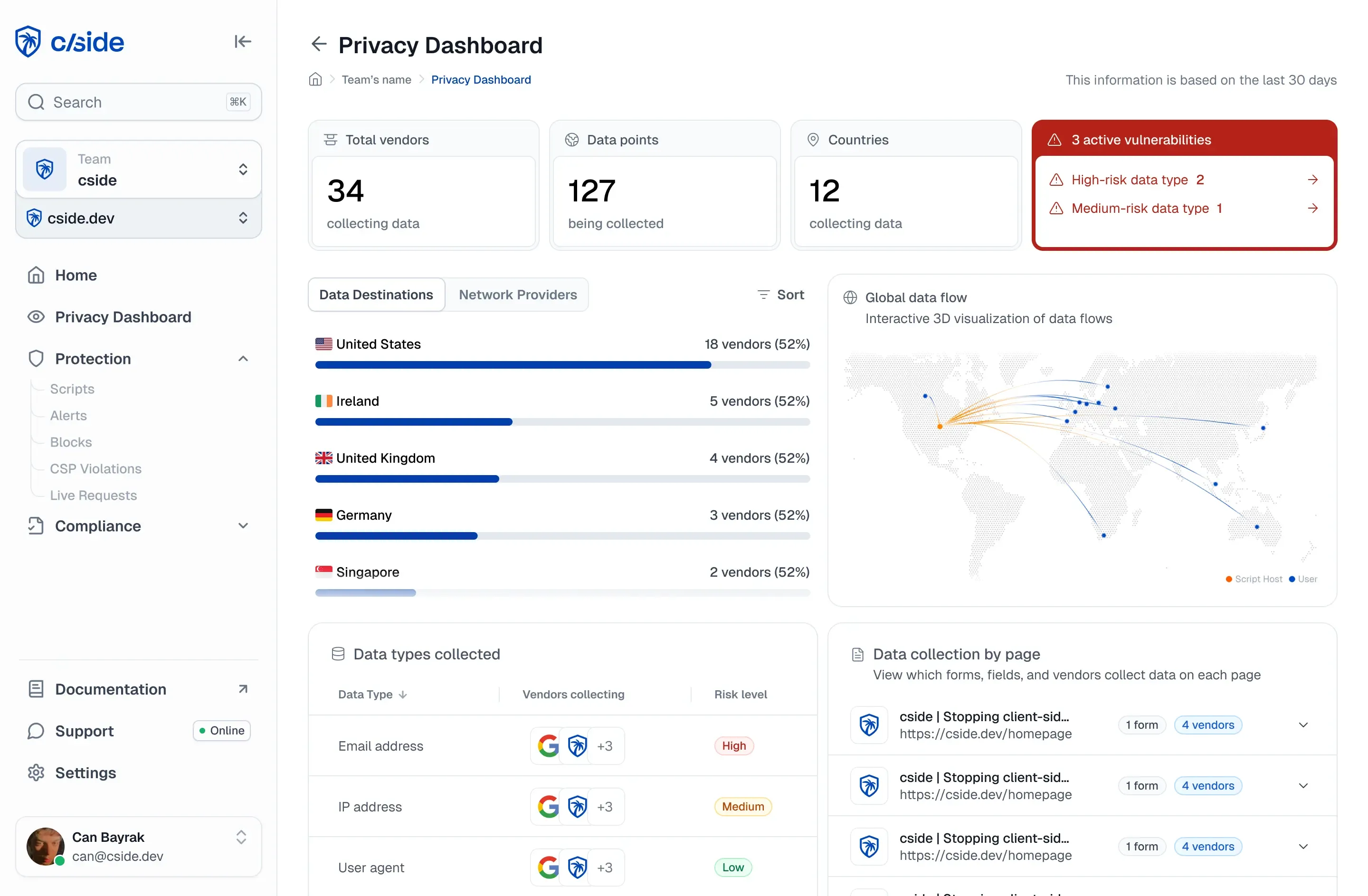
cside is a web security platform that prevents fraud on your website by monitoring the browser runtime. The fingerprinting product collects 102+ signals and focuses on four use cases: account takeover, account sharing, chargeback evidence (CE 3.0 through Chargebacks911), and AI agent detection. The script monitoring product watches every script executing on a page, catching injections, tampering, and skimming attacks that fingerprinting alone does not see.
What is SEON?
SEON is an anti-fraud and AML compliance platform. They combine device fingerprinting, digital footprint enrichment (email and phone lookups against 300+ social platforms), transaction monitoring, KYC verification, and AML compliance into a single command center.
What cside covers that SEON does not
- Account sharing detection: cside tracks how many distinct devices access a single account and flags when usage exceeds your policy. This is primarily a SaaS and media streaming problem rather than an e-commerce problem.
- Client-side security: cside's script monitoring product watches every script executing on your website, catching web skimming, formjacking, and malicious code injections. It satisfies PCI DSS 4.0.1 requirements 6.4.3 and 11.6.1. SEON does not offer client-side security or script monitoring.

Researching & writing about client side security.