Obfuscation or webpage integrity? Pick the category first
Jscrambler sells two things that solve unrelated problems, and most people searching for an alternative only want one of them.
Code protection obfuscates your own JavaScript and adds anti-tampering and anti-debugging so that someone reverse-engineering your bundle has a harder time. The threat model is your intellectual property and client-side logic you do not want copied or bypassed.
Webpage integrity watches the third-party scripts running on your pages, so you know what loaded, what it did, and whether it changed. The threat model is a payment page skimmer, a compromised vendor, or a fourth-party script your vendor pulled in without telling you. This is the half that maps to PCI DSS 4.0.1 requirements 6.4.3 and 11.6.1.
Almost every alternative below replaces the second half only. If you need the first half, the market is much smaller and the open-source option at the end of the list is the usual starting point. Getting this wrong is the most expensive mistake in this evaluation, because a script-monitoring tool will not protect your source and an obfuscator will not get you through a QSA review.
The options in detail
cside
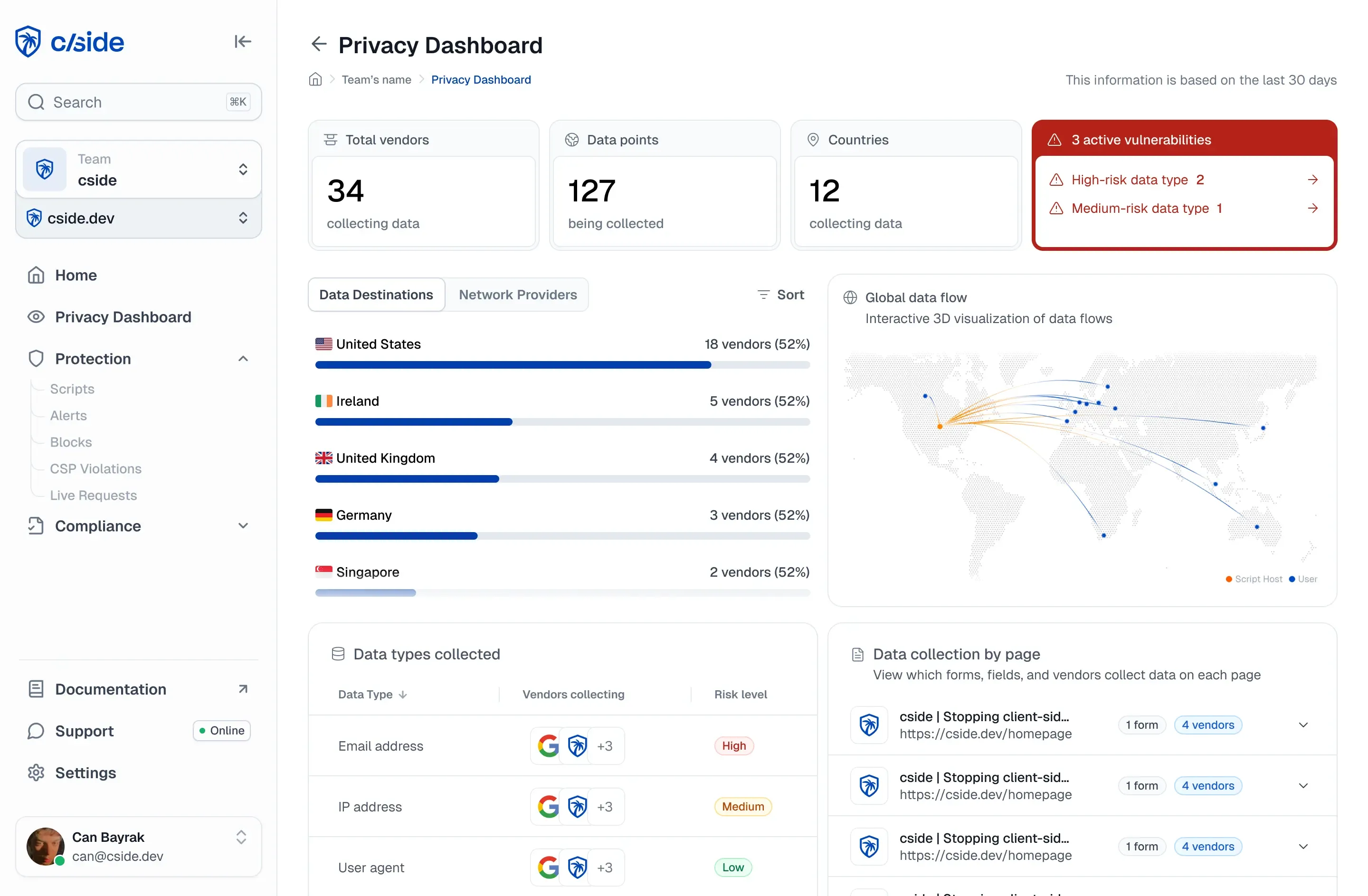
cside is a single first-party JavaScript snippet with two operating models. Script Method fetches each third-party script on cside infrastructure to hash, archive, deobfuscate and analyse the payload, and its in-page engine records what each script does in the real session; blocks are enforced at runtime in the browser, alongside CSP. Scan Method runs an agentic crawler that maps the vendor load chain, including the fourth-party scripts your vendors pull in. It needs no DNS change and does not sit in front of your traffic.
For a Jscrambler Webpage Integrity replacement it is close to like-for-like on monitoring, and adds payload archiving that is useful when a QSA asks what a script was actually doing on a given date. It publishes public pricing and has a free plan, so you can deploy and evaluate without a procurement cycle.
Choose cside over Jscrambler when PCI DSS 6.4.3 and 11.6.1 are the reason you are buying and you want evidence you can hand to an assessor.
Choose Jscrambler over cside when you need JavaScript obfuscation and code hardening, which cside does not do at all.
Reflectiz
Reflectiz takes a scanner approach: it reviews your pages on a schedule from its own cloud infrastructure, so there is nothing to add to the page and no runtime footprint. That is genuinely attractive if your security team is reluctant to introduce another script, or if you want coverage across many domains quickly.
The tradeoff is inherent to scheduled scanning. Coverage is limited to what the crawler sees when it runs, so behaviour that only appears for logged-in users, in specific geographies, or between scans can be missed.
Choose Reflectiz over cside when adding any script to the page is a blocker and periodic visibility is enough.
Source Defense
Source Defense is the most architecturally different option here. Rather than only reporting on third-party scripts, it applies a permission model that constrains what those scripts are allowed to do in the page, so a compromised vendor script can be prevented from reading a form field.
That prevention posture is the reason to pick it. It also means more configuration up front, because you are defining policy per script rather than turning on monitoring.
Choose Source Defense over cside when your requirement is to actively restrict script behaviour rather than detect and evidence it.
Akamai Page Integrity Manager
Akamai delivers script monitoring through its edge platform. For an organisation already standardised on Akamai, this is the path of least resistance: no new vendor, no new contract, and it inherits existing platform access controls.
The constraint is the same as the benefit. It assumes you are an Akamai customer, and its depth on script forensics is generally shallower than tools that do only this.
Choose Akamai over cside when vendor consolidation matters more than depth and you are already on Akamai.
Imperva Client-Side Protection
Imperva's client-side module gives script inventory and Content Security Policy management inside the Imperva platform, aimed squarely at the PCI DSS requirements. Like Akamai, its main appeal is to existing customers who want one console and one contract.
If you are not already an Imperva WAF customer, buying the platform to get the client-side module is rarely the cheapest route to compliance.
Cloudflare Client-Side Security
Formerly Page Shield, Cloudflare's client-side product monitors the scripts and connections it observes on traffic already flowing through Cloudflare, and reports on Content Security Policy violations. It is bundled at higher plan tiers, so for many teams the incremental cost is zero.
The limitation follows from where it sits: it sees what the edge sees. Deeper questions about what a script did once it was running in the browser are not really its remit.
Choose Cloudflare over cside when you are already on a plan that includes it and basic script visibility satisfies your scope.
javascript-obfuscator
The open-source option, and the honest answer to "is there a free Jscrambler alternative". It is a mature, widely used obfuscator that you self-host and wire into your build. It does string encoding, control-flow flattening, dead-code injection, and self-defending output.
What you give up is everything around the transform: no runtime threat detection, no anti-debugging telemetry back to a console, no support contract, and no help at all with third-party script monitoring or PCI scope. For teams whose only requirement was "make our bundle harder to read", that is often an acceptable trade.
How to choose a Jscrambler alternative
Four questions settle most evaluations:
- Which product are you replacing? Code protection and webpage integrity have almost no vendor overlap. Answer this before you shortlist anything.
- Is a compliance deadline driving this? If PCI DSS 6.4.3 and 11.6.1 are in scope, ask each vendor what artefact it hands an assessor, not just what its dashboard shows.
- Can you add a script to the page? If not, scanner-based tools are your category and you should accept the coverage tradeoff explicitly.
- Do you want detection or prevention? Monitoring tells you what happened. A permission model stops some of it happening. They are different budgets and different rollout risks.
If you want the direct head-to-head rather than the survey, the cside vs Jscrambler comparison covers pricing, evidence, and coverage side by side.
Related resources

Researching & writing about client side security.