Start with why you are leaving
Most shortlists in this category get built the wrong way round, by comparing feature grids before anyone has written down the constraint that triggered the search. Three constraints account for almost every Cloudflare Page Shield evaluation, and each one rules out a different set of replacements.
You are not routed through Cloudflare. Client-Side Security is an add-on to the Cloudflare edge. If your traffic goes through another CDN, or you run more than one, adopting it means migrating your edge to get a control that lives in the browser. Any script-tag based tool avoids that entirely, because it deploys inside the page rather than in front of it.
Content Security Policy does not fit your site. Cloudflare discovers scripts by adding a report-only CSP header to a sample of HTML responses and collecting the violation reports browsers send back, and its enforcement works by adding directives to an enforceable CSP header. That model assumes CSP is viable for you. It often is not: sites built heavily on inline scripts cannot get a workable policy, single-page applications where checkout is not a standalone document are awkward to scope, and multi-tenant platforms whose customers inject their own tags cannot maintain a stable allowlist. If CSP is the blocker, a replacement that also depends on CSP will not solve it.
The tier you are on does not cover your requirement. Free and Pro plans get script monitoring. Connection and cookie monitoring arrive at Business. Malicious script detection, code change detection, data export and content security rules all sit in Client-Side Security Advanced, and content security rules are capped at five. Requirement 11.6.1 is about detecting unauthorised change, so a team without code change detection has a gap that will surface in an assessment.
There is a fourth reason that shows up in conversations more than in feature comparisons: findings arrive without context. The product tells you a resource loaded. It does not tell you who the vendor is, what the script does, or whether it belongs on a payment page. That triage work lands on your security team every week.
The options in detail
cside
A single first-party script tag in the head of the page. It inventories every third-party script, records how each one behaves as it executes in real user sessions, archives the payload that actually ran, and monitors security-impacting response headers for change.
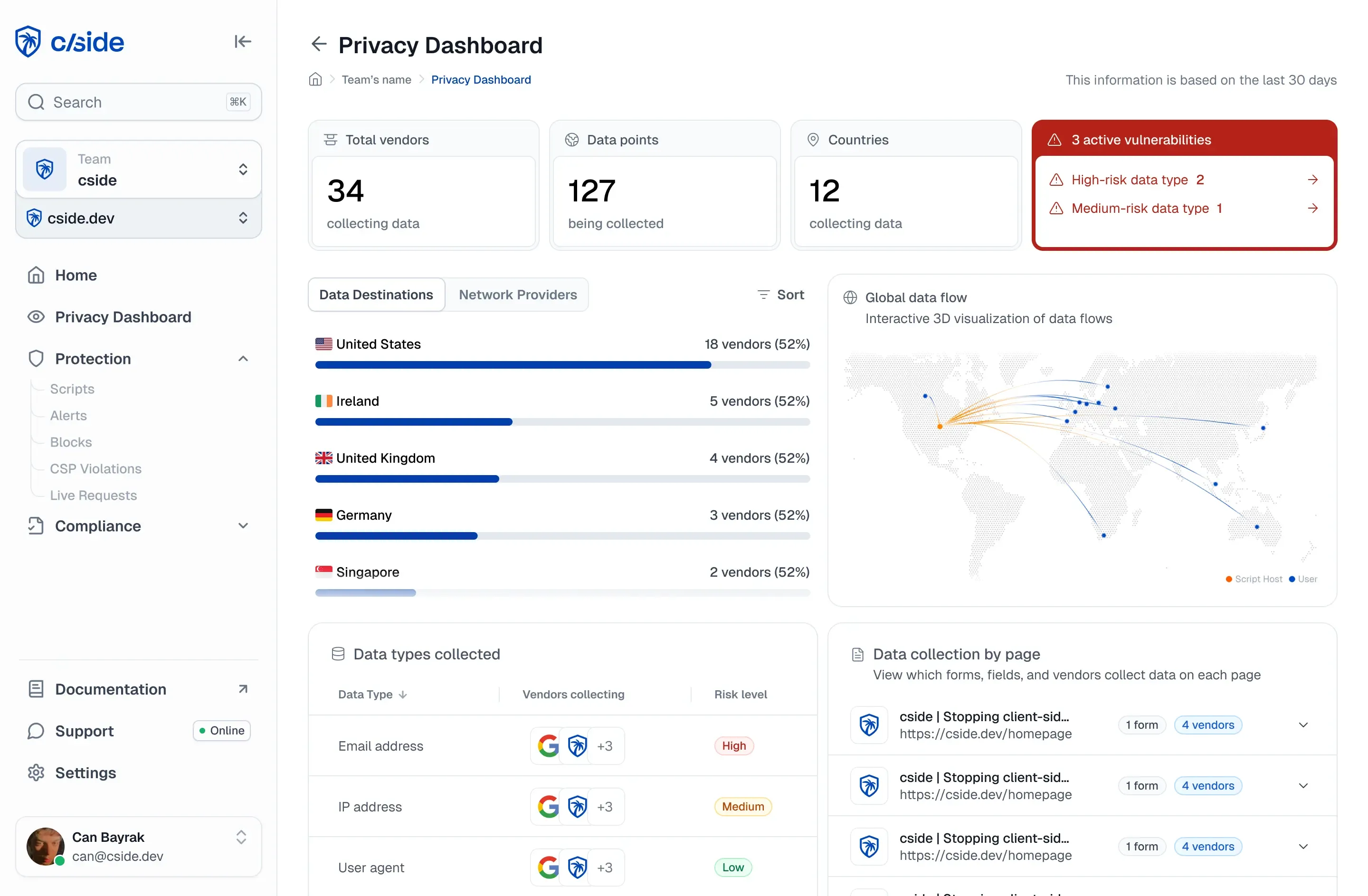
The practical differences against Cloudflare are deployment and coverage. It runs on any CDN, WAF or hosting, so there is no edge migration. It does not require a Content Security Policy to detect or to block, which is what makes it viable on inline-script-heavy sites and single-page applications. It observes every session rather than a sample, so a payload served only to one geography, one device class or one time of day is still recorded. And the PCI workflow is built in: a dashboard mapped to requirements 6.4.3 and 11.6.1, validated by QSA firm VikingCloud, with AI-assisted script justification so the written evidence is generated rather than assembled by hand in a spreadsheet.
There is a free plan, and a CSP reporting endpoint is included on every tier, so teams that want to keep their existing policy can do that and add in-session analysis on top. See the head to head detail on cside vs Cloudflare Client-Side Security.
Worth knowing before you shortlist it: it is a script in the page, so someone needs permission to add a tag to your payment pages. That is usually a thirty to forty minute job, but it is a different approval path from a setting in a dashboard you already own.
Reflectiz
A remote scanner that loads your pages from cloud infrastructure on a schedule and reports what it finds. Nothing is added to the page, which makes it the easiest option to get approved when adding a script tag is politically or technically hard.
The trade-off is inherent to scanning. It is a point-in-time check from known infrastructure, so a script that behaves differently for real logged-in users, for a particular geography, or outside business hours can serve the scanner something clean. Scanners also need credentials and test data to reach payment pages behind a login, which is its own maintenance burden.
Source Defense
Takes a different angle: rather than recording what scripts did, it runs them in a controlled context and restricts what they are permitted to do, such as reading form fields or making outbound connections.
That is a strong model if your goal is to constrain third-party behaviour by policy. It is a heavier integration than a monitoring tag, and the evidence it produces is oriented around enforcement rather than a forensic archive of payloads, so check it against what your QSA expects to see.
Akamai Page Integrity Manager
The closest structural equivalent to Cloudflare's offering: a client-side module delivered through a CDN platform. If you are already an Akamai customer, consolidating vendors is a real advantage and the commercial conversation is simpler.
It carries the same shape of constraint that pushed you off Cloudflare, though. Coverage is tied to traffic delivered through Akamai, so it does not help a multi-CDN estate or a team that wants the client-side control decoupled from the edge.
Jscrambler Webpage Integrity
Webpage integrity monitoring sold alongside Jscrambler's JavaScript code protection product. Teams that also need obfuscation and anti-tampering for their own code get both halves from one vendor, which no one else in this list offers.
If you only need the integrity half, you are buying into a suite, and the enterprise sales and custom quoting cycle is slower than self-serve, which is awkward when a compliance deadline is the reason you are shopping.
Feroot
Client-side security with a strong privacy and consent angle alongside PCI script monitoring. A good fit if data leakage and consent enforcement sit in the same team's remit as payment-page integrity, since you get both in one console.
DomDog
A focused, lower-cost client-side monitoring option aimed squarely at PCI scope. Worth a look for smaller estates that want an inventory and change alerting without a platform commitment. Expect a narrower feature set than the enterprise options above.
Report URI
Not a Page Shield replacement, and it does not claim to be. It is a CSP and security header reporting endpoint. If your conclusion is that CSP is working fine for you and what you actually lacked was somewhere to collect violation reports, this is the cheapest way to close that gap. It will not give you a script inventory, justifications, or payload-level evidence for an assessment.
How to choose
If CSP fit or CDN lock-in is what pushed you off Cloudflare, you need a tool that deploys in the page and does not depend on a policy: cside, Source Defense or Feroot.
If adding a script tag is the blocker, you need a scanner, and Reflectiz is the reference option. Accept the point-in-time limitation going in.
If you are consolidating on an existing platform vendor, Akamai Page Integrity Manager is the equivalent move, with the same edge dependency you are currently trying to escape.
If the driver is a PCI DSS 4.0.1 assessment with a date attached, weight two things above features: whether the tool produces the written justifications requirement 6.4.3 asks for rather than a CSV you fill in yourself, and whether its change detection covers both script contents and security-impacting headers for requirement 11.6.1 on the tier you can actually buy.

Founder and CEO of cside. Previously a product manager on Cloudflare Page Shield (now Cloudflare Client-Side Security). Co-chair of the W3C Anti-Fraud Community Group and a Forbes 30 Under 30 honoree. Building accessible security against client-side attacks, web security is not an enterprise-only problem.