SaaS Security & Fraud Prevention for the Browser Layer
- 01
Client-side attacks bypass your security
Your servers and APIs are protected by traditional security tools, but they are blind to what's happening in the browser. Before they even get to your backend, user credentials, session tokens, and sensitive data are valuable information that can be stolen by malicious scripts.
- 02
3rd party integrations are your weak link
Analytics platforms, customer support widgets, marketing tools, and payment processors all execute JavaScript in your users' browsers. A breach in any one of these can compromise your entire application.
- 03
Compliance frameworks require client-side security
You are required to protect user data from unauthorized access inline with SOC 2, ISO/IEC 27002, and GDPR. This protection includes data in the browser, but most SaaS companies are blind into client-side threats.
- 04
Supply chain attacks are increasing
Trusted libraries and SDKs are compromised when attackers target the software supply chain. Introduction of malicious code into your application can happen when you update a dependency.
- Monitor & secure every script running in your application
- Detect and block malicious code before it executes in the browser
- Get real-time alerts when scripts change behavior
- Maintain complete audit logs for compliance
- Meet SOC 2, ISO/IEC 27001, and GDPR requirements
- Protect sensitive user data from exfiltration
How cside Protects SaaS Platforms
cside's architecture provides full client-side protection that integrates smoothly with your SaaS application, giving you visibility and control over every script running in your users' browsers.
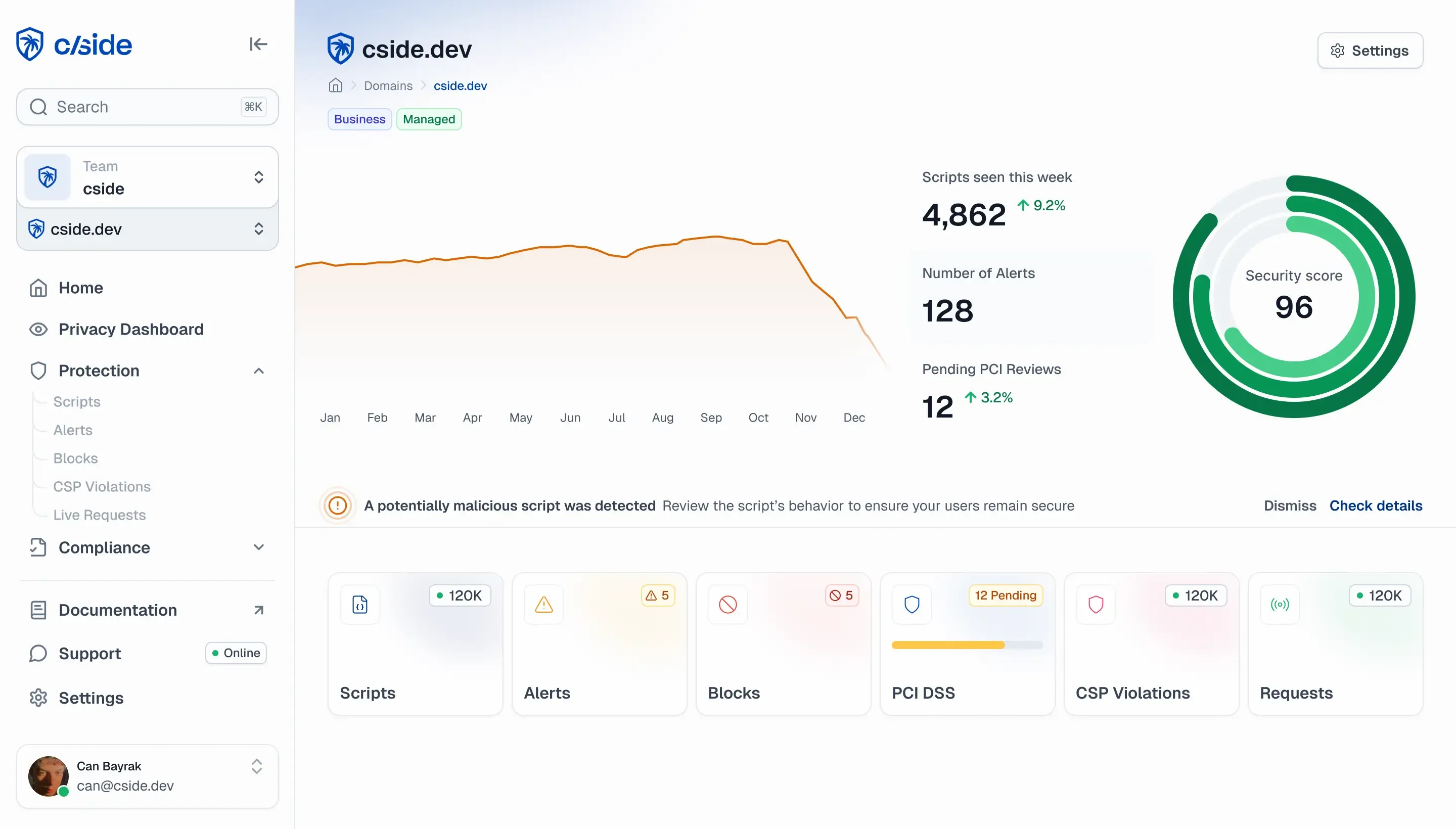
How cside Protects SaaS Platforms
Client-Side Intelligence
cside monitors the activity of every script, blocking malicious code from reaching users on your platform.
Account Takeover Prevention
Stop attackers from hijacking user accounts with client-side behavioral analysis, device fingerprinting, and real-time session monitoring.
AI Agent Detection
Detect agentic traffic and enforce guardrails. Block malicious AI bots while guiding trusted AI shoppers through safe purchase flows.
Applicant Check
Stop fraudulent job applications with device fingerprinting that detects VMs, VPNs, and deepfakes before they reach your ATS.
Privacy Monitoring
Identify what personal data each third-party script has access to and where it's sent. Stay compliant with GDPR and prevent PII leaks.
Automated PCI DSS Compliance
PCI 6.4.3 & 11.6.1 requirements with script inventory, change detection, justifications, and audit-ready reports.
Common Client-Side Attacks on SaaS Platforms
Session Hijacking
Malicious scripts steal session tokens and authentication cookies, allowing attackers to impersonate legitimate users
Data Exfiltration
Compromised scripts capture sensitive business data, user information, and proprietary data displayed in the browser
Software Supply Chain
Attackers compromise trusted npm packages, analytics libraries, or SDK providers to inject malicious code into your application
Expired Domains
Scripts from expired or abandoned domains can be purchased by attackers and modified to steal data
Cross-Site Scripting (XSS)
Attackers inject malicious scripts through user inputs or API vulnerabilities to steal credentials or perform unauthorized actions
Formjacking
Malicious code intercepts form submissions to steal login credentials, payment information, or other sensitive data
Keylogging
Scripts that record every keystroke in the browser, capturing passwords, credit card numbers, and confidential information
Cryptocurrency Mining
Hidden scripts that use your users' computing resources to mine cryptocurrency, degrading performance and user experience
Why Attackers Target SaaS Platforms:
Access to user credentials, API keys, and business data across multiple customers
Integrations with multiple third-party services increase attack entry points
Onboarding forms collect sensitive business information
Modern web apps serve more code in the browser, widening the attack surface.
How cside Outperforms Alternatives
cside delivers advantages traditional tools can't match.
| vs. Crawler-Based Solutions | vs. Content-Security Policy (CSP) | vs. Client-Side Agents |
|---|---|---|
| Sees real user behavior, not sanitized crawler views | Monitors script payloads, not just sources | Undetectable monitoring attackers can't bypass |
| Catches attacks aimed at specific segments | Detects breaches at trusted third-party providers | Complete historical script behavior tracking |
| Detects threats between periodic scans | Handles dynamic scripts CSPs can't control | Future-proof against evolving techniques |
Secure Your SaaS Platform Before It's Too Late
"cside security gives us the visibility we need into our client-side attack surface. We can now proactively identify and mitigate threats before they impact our users."
Let our experts show you how to protect your SaaS platform from client-side attacks and data breaches.
Questions, answered
01 How does cside help with SOC 2 and ISO/IEC 27001 compliance?
We provide you with complete audit logs, real-time monitoring, and automated alerts for all client-side activities. You can use these logs to prove to auditors that you protect user data from unauthorized access in the browser. Learn more about ISO/IEC 27001 compliance.
02 Can cside integrate with our existing security tools?
The answer is yes. We integrate with your SIEM, security orchestration platforms, and incident response workflows via webhooks and APIs. Your existing security stack is complemented by cside by covering the client-side attack surface.
03 How quickly can we deploy cside?
Most SaaS platforms can deploy cside in under a week. Our architecture requires minimal code changes and integrates smoothly with your existing infrastructure.
Didn't find what you were looking for?
Talk to an expertReady to secure saas platforms
Talk to a security expert. Or set up your free plan in minutes.